The Light Never Lies – Book Cover Reveal

Notes by Gayle Moore-Morrans, editor and blogger:

Isn’t this a beautiful book cover? I was inspired by reading Francis Guenette’s latest post telling of her and her husband’s collaboration in producing a book cover for her new book, “The Light Never Lies” Just as I am doing at present, Francis is planning to forego the assisted self-publishing route and do her own layout, design, etc. using Create Space. I’ve just sent her the following message:

“Gorgeous book cover, Fran. You and your husband are good collaborators. Thanks for the tip on Book Cover Pro. I’ll have to look into it. It sounds like you and I are on the same track. I’m also working on Ian’s children’s book ‘Jake, Little Jimmy and Big Louie’ and am being guided with layout through Edwin Scroggins book ‘How to Self-Publish Your Book Using Microsoft Word 2007. ‘ So I’ll be using CreateSpace as well.”

Our 8-year-old granddaughter has done the illustrations so I’m also collaborating on that as I adjust and edit her drawings using Microsoft Word Paint. I’ve never used it before and find it quite fun. She has done some darling illustrations for the book but I find that her depictions of the leading characters are not always consistent from illustration to illustration. So MSPaint is allowing me to make the boy and the birds more consistent without losing her child’s perspective. It’s fun but painstaking. I’ll be anxious to see how you are doing with the layout. I hope to start mine soon. Best wishes for the New Year.”

francisguenette's avatardisappearinginplainsight

E-book cover draft for THE LIGHT NEVER LIES

The learning curve has been negotiated and the hard work has paid off. We recently purchased a program called (deluxe edition) with the idea that husband Bruce was going to take over cover design for all my future forays into the world of book publishing and we can hopefully spread the cost over several covers. Like any good wife, I went into the process sounding enthusiastic while internally filled with doubts. Obviously, the guy is a skilled photographer and has a great deal of patience for tinkering with things but did that make him a book cover designer? I wasn’t sure.

My doubts have been shelved and I’m thrilled to reveal the ebook and softcover for The Light Never Lies and a bit about the process of creation. Keep in mind though, this is not a primer on how to use BookCoverPro – that is way beyond my powers to…

View original post 551 more words

“Why I Write – My Writing Journey” – AN INVITATION TO VOTE AGAIN FOR IAN MOORE-MORRANS, A FINALIST IN THE AUTHOR’S SHOW CONTEST “50 GREAT WRITERS YOU SHOULD BE READING”

Seal-2013Finalist-300On September 18, 2013 we blogged an invitation to vote for Ian Moore-Morrans as he entered the first phase of The Authors Show 2013-1014 contest “50 Great Writers You Should Be Reading” which ended on November 1st.  We greatly appreciate any and all votes cast. Enough of you did vote for him so that now Ian is a finalist in the second (and final) phase of the contest. This is an invitation to AGAIN VOTE FOR IAN in this final phase.

Here is the information from Danielle Hampson, Executive Producer of The Authors Show:

The final phase of our contest is now open for voting through December 1, 2013. The top fifty authors with the most votes will be included in the 4th edition of  “50 Great Writers You Should Be Reading” to be published in January 2014.  A special prize will also be awarded to the top winner in each book genre: Fiction, Nonfiction, Children and Christian.  To view the names of all the finalists and to vote for your favorite author in our final phase, go to: 

http://www.wnbnetworkwest.com/WnbAuthorsShow50Writers2013-Contest-Finalists.html.”

Thanks in advance to those of you who will cast a vote for Ian. We are including a copy of Ian’s entry into the contest which asked for him to write about his journey as a writer. We hope you will enjoy it.

Best wishes,

Ian and Gayle Moore-Morrans

Why I Write – My Writing Journey

by  Ian Moore-Morrans

Author of From Poverty to Poverty: A Scotsman Encounters Canada

Folks remark that I have a gift for gab and storytelling. However, whatever free time I had was taken up by music-making. Important as it was to me, writing took a back seat to making music.

Though growing up in abject poverty in Scotland during the Great Depression, I was fortunate to attend school until I was 14. I liked learning and tried my best to do well in my class work. My English teacher had remarked about the quality of my essays and compositions. When she mentioned that I should become a journalist after I finished school, I found it an intriguing but totally impossible suggestion. I could only conclude, ‘What a picture that would be—me sitting at a desk with holes in my shoes and no underwear!’

When schooling was over, I had to find a job. Working as an apprentice to a local blacksmith, I had neither time nor energy to write, though I earned some money and built up muscle. My free time was spent learning to sing and play an instrument as part of the Salvation Army. Music-making became my passion.

Four years later I joined the Royal Air Force. Finally I had decent food, clothing and living conditions plus an opportunity to learn a trade—Flight Mechanic Engines—and to continue to play in a band. I served in England, Wales, Scotland and the Suez Canal Zone in Egypt. Being far away, I enjoyed writing letters home and hearing remarks about how exciting I made my life sound and how much folk learned from reading what I wrote. I was to benefit most by corresponding with my pen-pal. Mary and I kept up a steady correspondence and then met in Glasgow just after I returned to Britain. We were soon married.

Whenever I had a chance at work or leisure, I told stories when I wasn’t singing songs or playing my trumpet. I fancied myself an entertainer but never thought of trying to earn a living at it. After five years’ service, I left the RAF. Not only did I have a wife to support; we were soon blessed with two daughters. I found work as a machine fitter in the steel industry around Glasgow. After awhile I applied for a clerk’s job in a big steel company. When interviewed, the supervisor mentioned that one of the biggest problems in the job was reading what someone had written. He asked me to write the numbers from 1 to 10 and also spell each one out in longhand and then print the words in capital letters. “Very good” he said, “at least we’ll have one person whose writing is legible. When can you start?” I couldn’t believe that was the test! Soon, my “penmanship” earned me a better job as a shift scheduler.

Having been misled by the inflated promises of an unscrupulous Ontario official, we got “itchy feet” and headed for Canada. Arriving in 1965, we soon found that my promised machining job was not available, nor were we in a financial position to buy a house as we had been led to believe. After five years of misadventures finding and keeping jobs and suitable homes, we finally reached the level of prosperity we had had in Scotland.
My family and I continued to live and work in Canada, moving almost every year to a different house, town or province (and different band) as jobs came and disappeared. I never seemed to have time to write down my stories, though I told plenty of them, both true and made-up. Finally, in 1995 at age 63, I decided if I didn’t start writing, I’d never do it.

In longhand over three evenings, I wrote “My Friend Jimmy,” a children’s story about a budgie that had no wings. Then I bought a simple, used computer and studied a learn-to-type book. I rewrote my children’s story and sent it away to a publisher, thinking full well that he would deem it the very best children’s story he had ever read! Soon I could just about paper the wall with rejections. ‘Never mind,’ I thought, ‘where there’s life, there’s hope.’ I went on to write others, thinking that I’d give “My Friend Jimmy” a try again at a later date. (Now, 17 years later, my wife/editor is starting the layout for “Jake, Little Jimmy and Big Louie,” a highbred of the original story!)

Next, I tackled my life’s story. Several times I’ve encountered people who heard my Scottish “burr” and then told me of Scottish ancestors. After inquiring, I would hear they had died and the family didn’t even know where in Scotland they had originated. Finally, I vowed to write my life story to avoid that state. Thus began the long process of remembering and writing into the wee hours of the night over the course of several years. I ended up with two volumes called “From Poverty to Poverty” and “Came to Canada, Eh?” Again, I submitted manuscripts which were politely rejected.

In 1984, I taught an adult class for men who had metal-cutting lathes and wanted to learn how to better use them. I loved this first and only experience of formal teaching. Later, I wrote a “how-to” book about machining steel, written for the type of people I had been teaching. Completed in 1998, I called it “Metal Machining Made Easy.” I did all of the 60-odd illustrations by hand. This was published in 2002 through Writers Exchange in Australia.

Shortly thereafter, my wife Mary died. I vowed to go on with life, continue to write but also to socialize and enjoy what time I had left. Then came the most significant encounter of my life. I started a conversation with an attractive widow about the eclectic assortment of stories I had begun writing after retirement. When I learned that Gayle was working as a magazine editor, I began to envision a future of our living and working together. We married in 2003 and, after she took an early retirement, we bought a motor home and set out to explore Mexico. While basking along Mexico’s Pacific coast, Gayle started editing my stories while I sat at the laptop and did re-writes, as well as writing a story of revenge called “Legal Hit Man.” Later moving inland to the mountainous north shore of Lake Chapala, we became residents of the world’s largest community of English-speaking expatriates. We joined the local writers’ group and met some wonderful writers from around the world. Soon my short story, “The Moonlit Meeting,” was published in a local magazine.

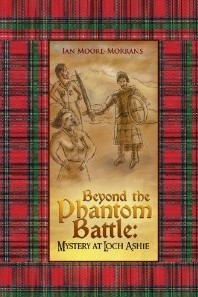
We returned to Canada in 2007 and now live in British Columbia. We have since published two books with a Scottish flair—a novel of adventure and time-travel, “Beyond the Phantom Battle: Mystery at Loch Ashie” and my memoir “From Poverty to Poverty: A Scotsman Encounters Canada.”

Age has caught up with me. When I first started seriously writing, I sketched out a few notes and went to work with everything flowing fairly smoothly. I kept going at all hours and wherever I was. At present, after over five years of illness, it’s becoming harder to find the energy to write. Luckily, I have a number of manuscripts waiting for Gayle to work on. Then I read through edits, give my approval or comments, and let her do the rest. Aren’t I fortunate?

Installment 5 of “Jake, Little Jimmy and Big Louie,” a Children’s Chapter Book

We apologize for the long delay in posting the next installment of Ian’s children’s chapter book, “Jake, Little Jimmy and Big Louie.” Our excuse is that we have been otherwise occupied for most of January and the first days of February because Gayle finally had a surgery date of February 7th for a total hip replacement on the left side. She has had both her right knee and right hip replaced in the past – the knee in 2000 and the hip in 2011. Now she is truly a bionic woman on both sides!

Ian is still trying to adjust to a number of changes in his medications and couldn’t be left completely alone while Gayle was in hospital, so we had to arrange for some home care and a LifeLine installation for him. That is going well and we’ve been able to count on the home care attendant to help both of us for a short time after Gayle was discharged on February 9th. Thank goodness for our Canadian health system. So far we have had little additional expenses other than the low LifeLine costs, our pharmacy expenses until the yearly supplement kicks in and our regular monthly BC health payments.

Ian and Jimmy, the cockatiel, circa 1999.

Ian and Jimmy, the cockatiel, circa 1999.

Today we are sharing a photo taken about 1999 of Ian schmoozing with his cockatiel Jimmy, who was the inspiration for this present story about a budgie named Jimmy. We hope you’ll enjoy it and the next chapter of “Jake, Little Jimmy and Big Louie.” If you remember the last chapter, Jimmy had been lost and just as the chapter ends Jake had received the good news that Jimmy had been found and would be returned by the police.

“JAKE, LITTLE JIMMY AND BIG LOUIE”

by Ian Moore-Morrans

edited by Gayle Moore-Morrans

Copyright © 2012

CHAPTER FIVE

Jimmy Returns and “Thing” Arrives

The following day, the police were at Jake’s house with Jimmy safely in his cage. Jake was in orbit over the news that Jimmy had been found, for he had hardly slept that whole week while Jimmy was missing. Lying awake in his bed at night, he had prayed that Jimmy would be kept safe, wherever he was, and that Jimmy would come home soon. He promised to love Jimmy and always try to take very good care of him. This promise had kept him certain that Jimmy would be found, so when Jake’s father told him the good news, he sort of expected it.  ‘Well’ he thought, ‘it got Jimmy back to me.’

(The rest of the chapter’s content has been deleted prior to publication.)

Picture suggestions:

Jake smiling and holding little Jimmy, just as Ian is holding Jimmy the cockatiel in the photo at the beginning of this posting

Jimmy sitting on Jake’s shoulder.

Celebrating Self-Publishers

Phantom Battle book cover

With thanks to Xlibris, the self-publishing company with which we published Ian’s novel, Beyond the Phantom Battle: Mystery at Loch Ashie, we are re-posting the latest encouragement about self-publishing from the Xlibris website.

Self-publishing has been both an enjoyable adventure and a lot of work. We enjoy the freedom self-publishing gives us to publish and edit our books with a free hand. It is good to see that a number of very successful authors have also gone through the self-publishing procedure.

The following article is re-posted from Xlibris:

“Getting Your Push from Big Name Indie Writers

“They say it is wise to learn from the mistakes of others. This also holds true for self-publishing. Famous independently published authors—then and now—have been rejected by traditional publishers at one point but eventually made a name for themselves by choosing a publishing route off the beaten track. If, however, you have already stumbled along the way, these nuggets might save you from giving up your self-publishing dreams.

“Alexandre Dumas (1802-1870) Born and raised in poverty with his father dying when he was four, Dumas faced discrimination because of his ethnic African ancestry. However, with his rich imagination, the Count of Monte Cristo author overcame his lowly social stature by penning quite a number of high-adventure tales and historical chronicles published under his name. His works were translated in numerous languages, making him one the world’s widest-read French writers.

“Edgar Allan Poe (1809-1849) The creator of the detective fiction genre had to fight tooth and nail to make a living from his craft. The American literary genius was unfortunate to have written at a time when the US publishing industry suffered from weak copyright law. While his first self-published work The Raven didn’t bring him much financial success, the poem is considered one of the greatest gems in literature history.

“Mark Twain (1835-1910) The American author of the timeless novel The Adventures of Huckleberry Finn built his own publishing company that flourished but suffered bankruptcy following a failed investment in a faulty typesetting machine invention. To rebuild his fortune, he used his natural gift of gab, touring different countries for public speaking engagements. He also wrote more books to pay off his debts.

“George Bernard Shaw (1856-1950) The Irish playwright had initially published his early works to attract producers. Although his first novels were a flop, he was a dedicated playwright who learned from his mistakes. ‘Success does not consist in never making mistakes but in never making the same one a second time,’ he said.

“Rudyard Kipling (1865-1936) The British Nobel Laureate in literature was known to be a fervent artist who wrote almost without pause. He reported for his newswriting job six days a week, with only a day each off Christmas and Easter breaks. His passion for writing was such that he self-published his first collections of poetry. The rest, as they say, is history.

“Stephen Crane (1871-1900) Hailed by literary pundits as ‘one of the most innovative writers of his generation,’ he started writing at the age of four and published his early works at age 16. His first novel Maggie: A Girl of the Streets was, however, rejected by a traditional publisher who thought the story was too unrealistic. Crane loaned money from his brother, published the book, and enjoyed commercial success thereafter.

“Virginia Woolf (1882-1941) She and her husband co-owned a publishing company where her works, along with other notable writers such as T.S. Eliot, were published. Although she believed that “a woman must have money and a room of her own if she is to write fiction,” she married an average-income earning civil servant with whom she nurtured a healthy personal and business relationship.

“Ezra Pound (1885-1972) As a twenty-something sacked college professor with dwindling funds, the American poet self-published his first poetry book, A Lume Spento (With Tapers Spent). He sold 100 copies at six cents apiece. The compilation was praised by The London Evening Standard for being ‘poetic, original, imaginative.’ Pound also befriended celebrated Irish poet W. B. Yeats, whose publisher promoted the book, resulting in its success.

“Anaïs Nin (1903-1977) She is best known as one of the pioneer women writers of the female erotica genre. The French-Cuban diarist, whose journals detailed her own erotic adventures, self-published her first book Under a Glass Bell. The book, hailed as Nin’s finest work, launched her literary success.

“E. L. James The British author of the best-selling novel Fifty Shades of Grey revealed that the novel sums up her ‘midlife crisis.’ Starting out as a fan fiction writer, she got her inspiration from the vampire series The Twilight Saga. The worldwide-commercial success of the erotic trilogy has proven that a novice writer can make it big in the publishing industry.

“Amanda Hocking Cashing in on the popularity of vampire-themed novels, the twenty-something American novelist, formerly a group home worker, has used the booming e-book industry to self-publish her paranormal romance novels. She has sold more than a million copies and was the first self-published author to hit $2 million in sales in 2011. She later signed a $2-million worth contract with a traditional publisher.

“J. A. Konrath The American e-book writer of mystery, thriller, and horror genres is an ardent supporter of self-marketing. He holds a spot in the ‘5 E-book Authors To Watch’ by Mediabistro.com. It’s almost impossible to believe that his previously unpublished stories had reportedly been rejected almost 500 times before he reached his rock star status as a self-published author.

“We hope these stories will motivate you and keep you writing, whether you’re considering starting a writing a career or are already working on your first book.”