A MUSICAL WALL DISPLAY

A MUSICAL WALL DISPLAY

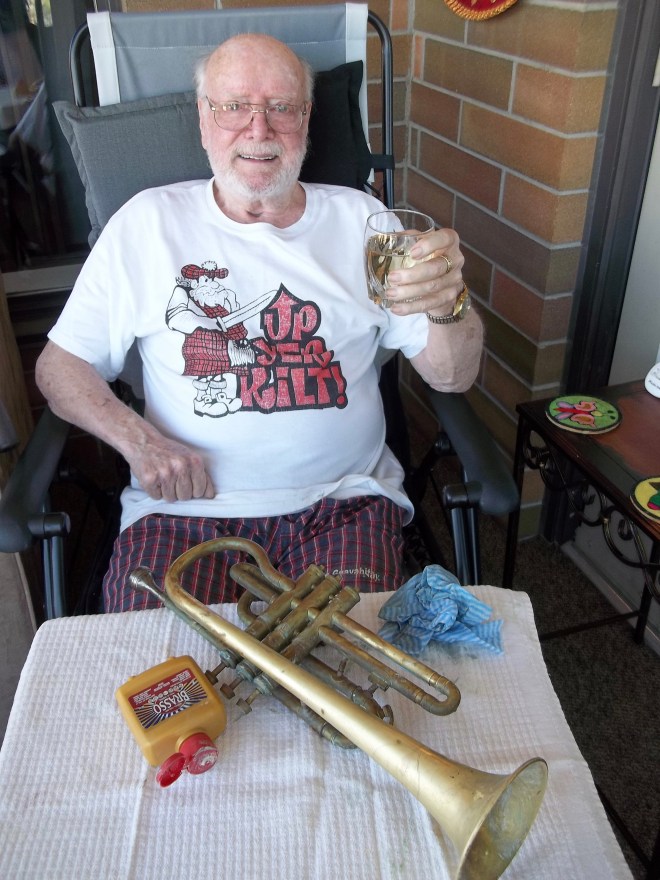
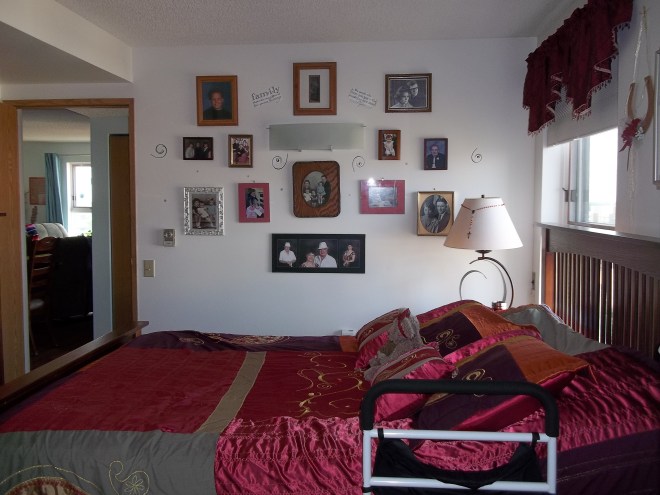
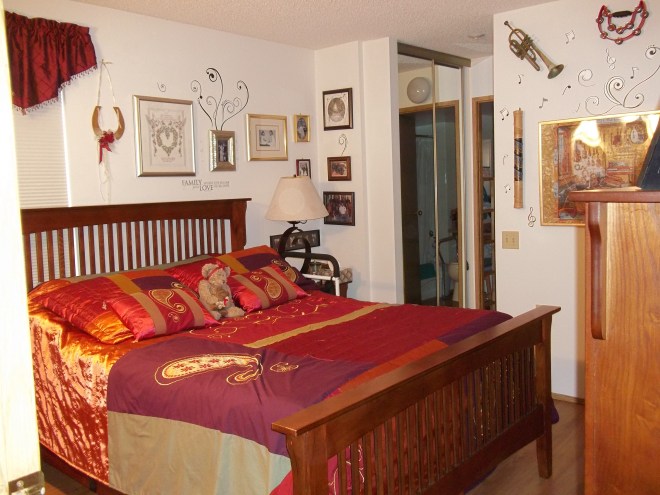
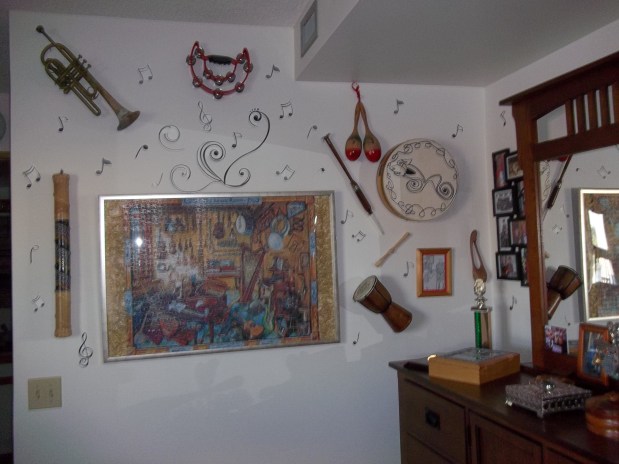
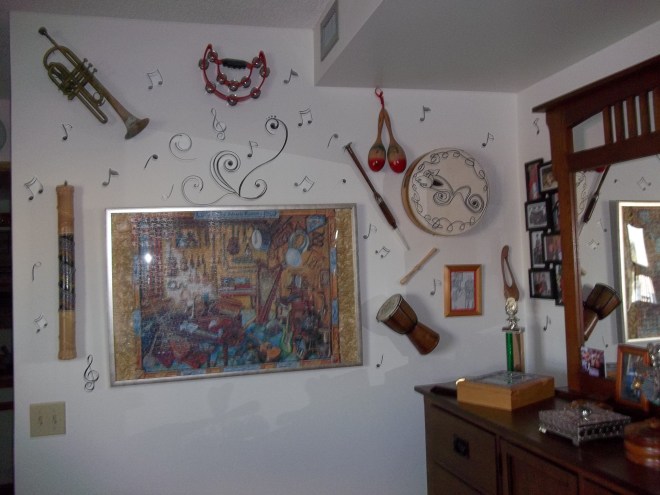
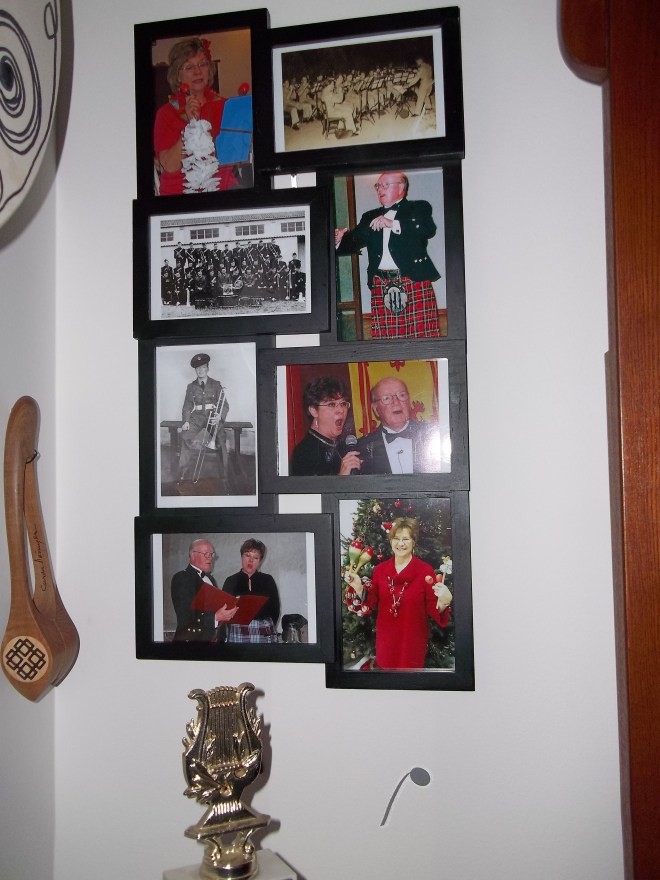
Bedroom Music WallA note to retired musicians: Here’s a way to display musical instruments that may have been played for years, are no longer in use but can still be enjoyed. We’ve included longtime bandsman Ian’s antique trumpet and a chanter used for those who want to practice the bagpipe but not make too much noise as well as a number of percussion instruments Gayle used when keeping time with a ukelele band, including a Celtic bodran and tipper, a hand drum, tambourine, a set of maracas, carved wooden spoons and a rainstick. Also included are photos of Ian posing with a trombone he played in a military and Salvation Army band, playing lead trumpet in a Royal Air Force band in the former Suez Canal Zone, of Gayle with her ukelele band and of us singing duets at a Robbie Burns’ party and as the duo “Okanagan’s Mr. Scotland and His Bonnie Lassie.” Displayed nearby are two trophies Ian won in years gone by for singing Scottish songs.

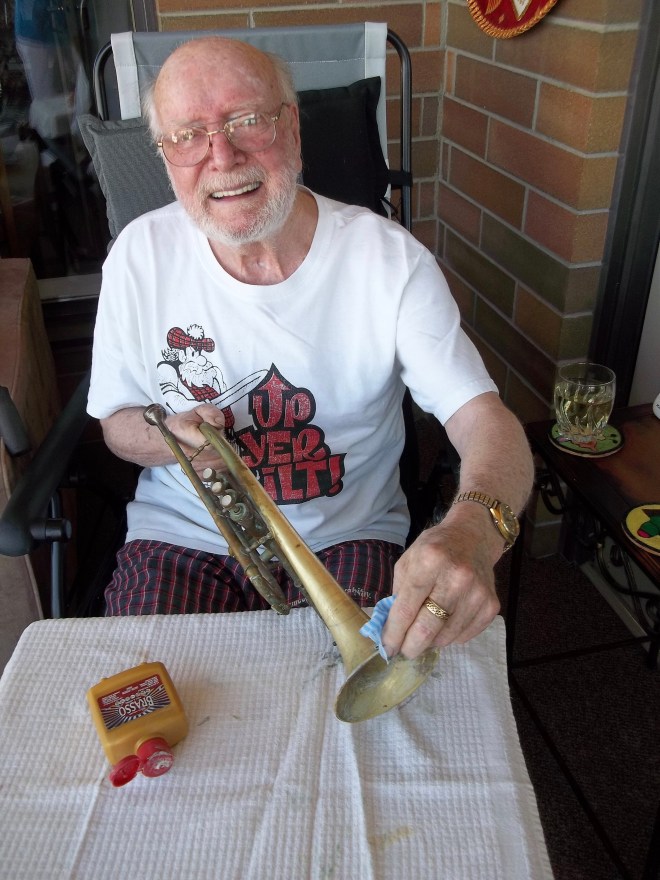
The crowning piece is the last trumpet Ian still owns. It has been about 12 years since he  gave up playing but Gayle has finally convinced him that he needs to polish up his trumpet, at least for our display. So here he is with a bottle of Brasso and some soft cloths starting on what is going to be a huge task. He found the trumpet years ago in some antique or thrift shop and found out it was made in Winnipeg probably in the early days of the last century. We could hardly see the manufacturer’s etching on the trumpet’s bell but after the initial polishing attempt can read “Premier Williams Winnipeg” and further on down the bell a large number “37”. We’ve heard a few squawks from it so far. Ian’s lip (embouchure) is sorely out of practice! However, we were both pleased that he had awakened an interest in the trumpet again. (Gayle is not going to hold her breath until the trumpet polishing is finished!)

100_1275100_1278100_1279

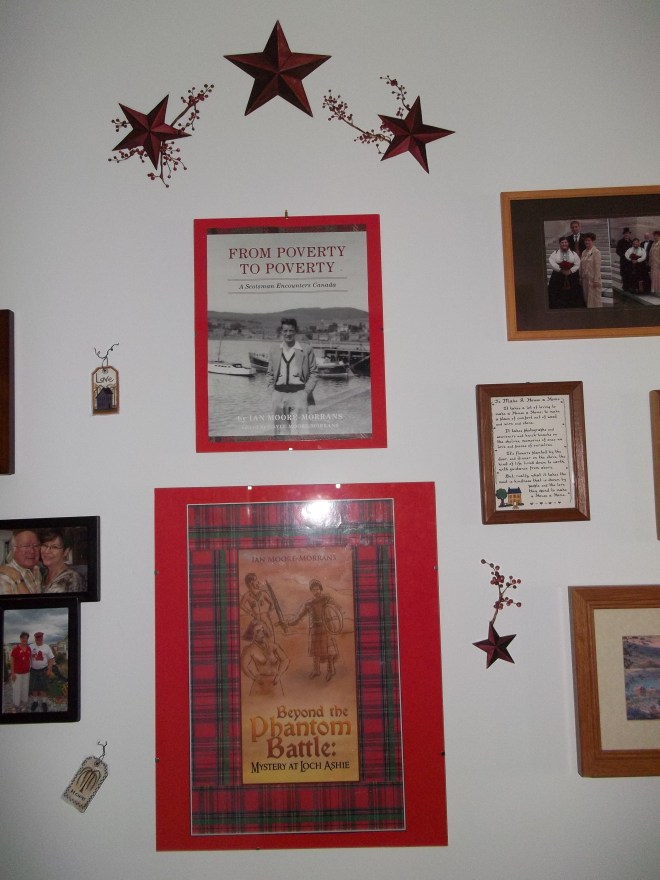
Ian documents his early years of music making in the Salvation Army and RAF in Scotland, other parts of the UK and in the British military sector of the Suez Canal Zone in Egypt in the early ’50s in his first memoir “From Poverty to Poverty: A Scotsman Encounters Canada.” Gayle is now editing the second memoir “Came to Canada Eh? Continuing a Scottish Immigrant’s Story” where further music making will be documented in Canada. A third memoir, written by both of us entitled “Mexican Follies” tells of the beginnings of our colloboration in music-making and in jointly producing books. Publication plans for that depend on how quickly Gayle gets to the editing. For her, there is never enough time and too many interruptions but little by little she hopes to get to publication again – some day!

Below is an excerpt from “From Poverty to Poverty: A Scotsman Encounters Canada” which tells a comical story about Ian’s attempt to “show off” with his trumpet to his new wife:

The following Saturday night, our dance band was playing at Forres Town Hall. I had been bragging to Mary about the introduction to the song, “Cherry Pink and Apple Blossom White,” that I played on trumpet, standing up, before the rest of the band joined in. It consisted of the first three notes, then into a big glissando, using the third valve slowly, to go down and then up to the third note again and then continuing right into the melody when the rest of the band joined me. It was just a copy of what a big-time trumpet player (Maynard Ferguson) of that era did. Everyone thought it was very effective, sounding and looking quite professional. So, there I was saying, “Wait ‘till you hear me play!”

Saturday night came and my Mary was sitting at the side of the hall, close to the band, her eyes firmly fixed on “Lover-Boy.” Then it was time for me to shine. I stood up, the first two notes came out correctly, but I have no idea what happened to the bit where I was supposed to do the fancy stuff. I played absolutely terrible! The rest of the band started all right, but I had to sit down with a very red face—even redder than usual! In front of my Mary, too! You know, I must have played that “intro” at least 40 times previously without fail. (That’s what I get for trying to show off, eh?)
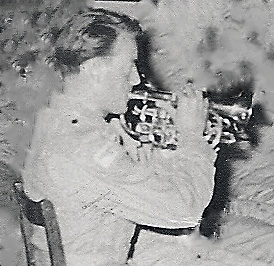
Ian playing solo cornet

Ian is playing a cornet in this photo, but about a year or two before his trumpet story above. A cropped version on an RAF photo, ca. 1952.
Bedroom-Ian and Gayle musicmaking photos

DECORATING OUR “FOREVERMORE HOME” WITH PICTURES AND MEMORABILIA

After two and a half months getting settled in what we have come to refer to as our “Forevermore Home” (or should that be “Forevermoore”? Nah, it leaves out the “Morrans” part of our name), Gayle is finally posting about what some of our friends and neighbours have started calling “the MM Gallery.” You see, we have made 10 moves in our almost 13 years of marriage and we’ve started saying the only way we will move again is if we are taken out in coffins or to a nursing home. At ages 73 and 84, and with Ian’s not-so-good health, we are planning to stay put “forevermore.” We moved last summer half way across Canada to a downtown senior’s high-rise apartment building in Winnipeg but to a too-small apartment as that was all that was available at the time. On June 1st this year we moved “up in the world” to the penthouse floor (17th) to a bit larger apartment with a fabulous view of the city and sky. After cleaning out a rental storage area and (again) downsizing some things that we have given away to family members and the Sally Ann Thrift Shop, we have finally found room for all those pictures and memorabilia that we’ve decided we just don’t want to part with. That leaves us living in the “MM Gallery.”

Hallway-Memorabilia Plaque.JPG

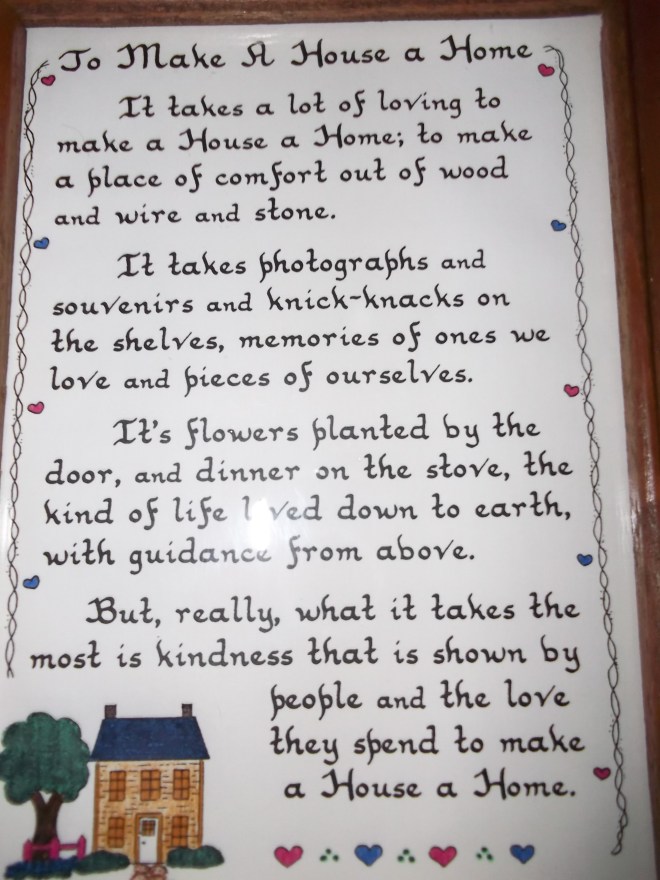
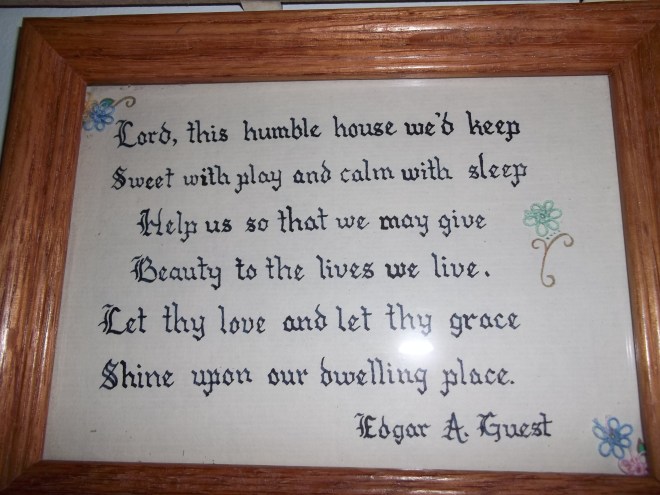
The above-pictured plaque is a feature of our hallway wall and poetically expresses our sentiments about the type of decorating we have in our Forevermore Home.

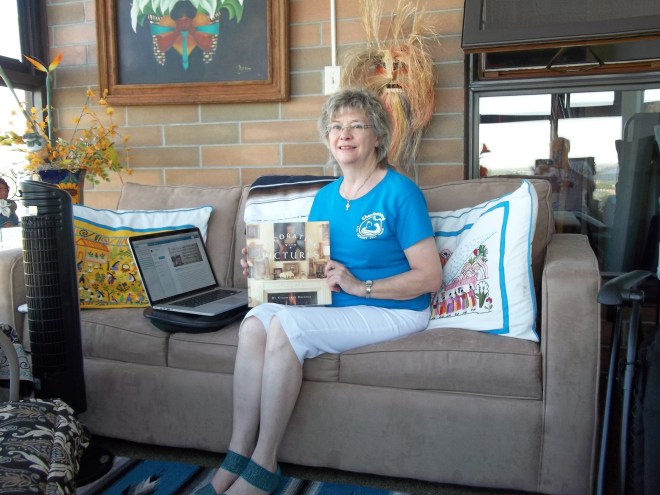
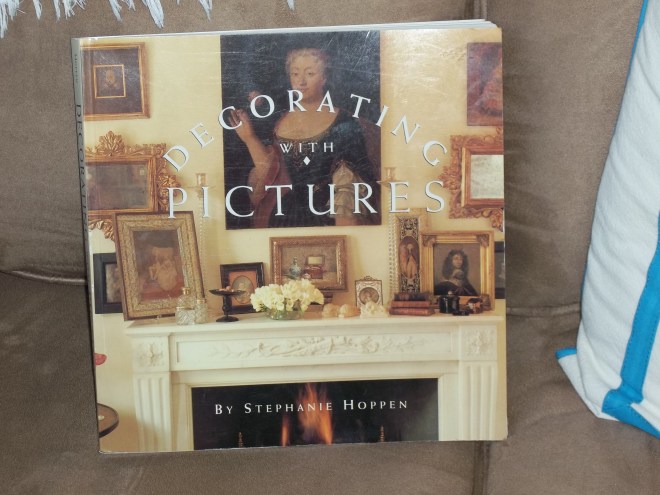
One of Gayle’s hobbies is combing used book stores for unusual books that mirror her interests. Some years ago she came across a book entitled “Decorating With Pictures” (© 1991 by Stephanie Hoppen, Clarkson Potter/Publishers, New York).

100_1284M100_1285

Hoppen’s text and pictorial examples couldn’t have matched any more perfectly Gayle’s natural inclinations to decorate with lots of colour and gusto. Reading the book and looking at the many and various examples of rooms full of a “wonderful kaleidoscope of colors and textures” were a true inspiration and vindication. Now, in our Forevermore Home nothing is going to be stored away for use “some day”; we are going to use things or get rid of them. Like Hoppen, we believe “pictures are the soul of a house.” Some people may remark that our home looks “busy” or “overwhelming”; but we have persisted in celebrating those items of artwork and memorabilia that we have collected over the years. We continually delight in relishing the displays on a daily basis. How great it was, then, to read Hoppen’s statement, “I love lots of pictures. I love mixing different media and different subject matter. I love framing some identically, some differently, and I love the effect that simply regrouping or reframing a collection of pictures can have on a room. A collection of pictures takes time to amass, time to evolve, and is ever-changing as new pictures come and old ones are reframed and rehung. It is a living, growing thing but don’t be frightened by it. Use it, tame it, tailor it to your own likes and needs.”

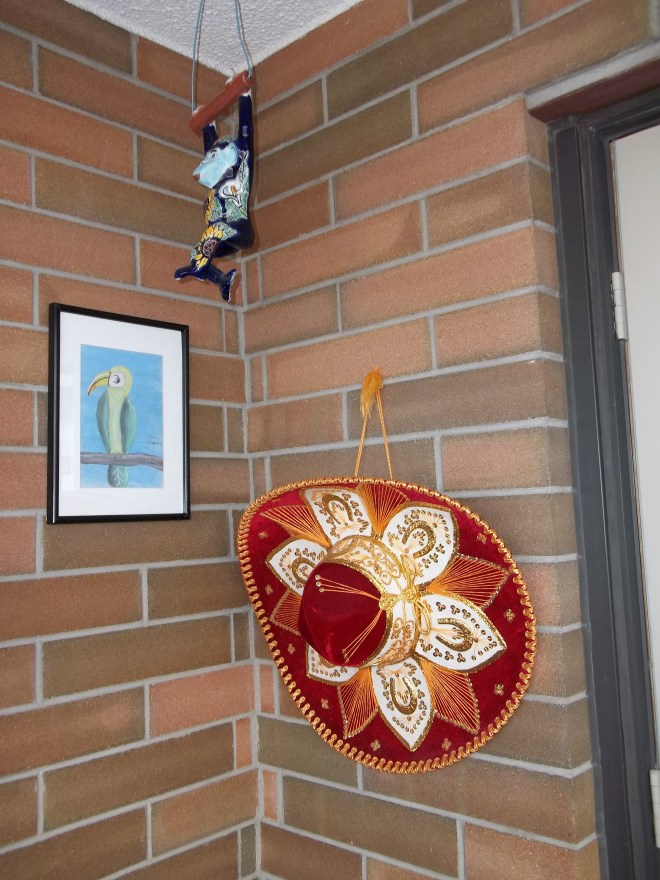
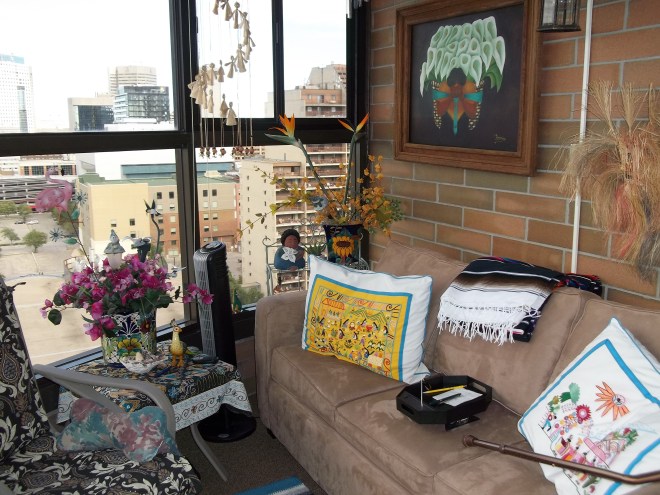
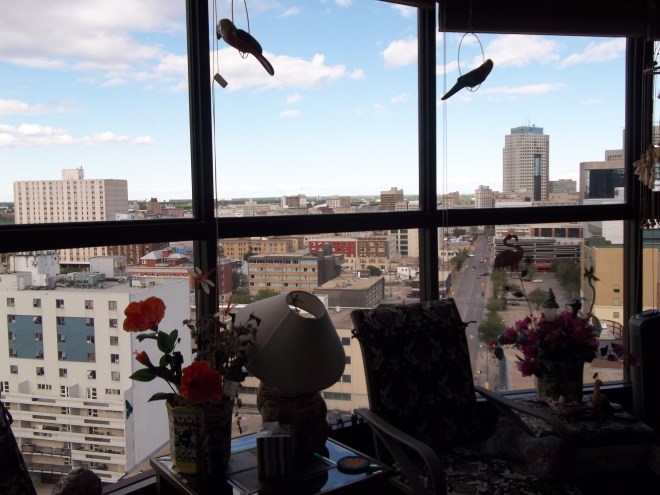
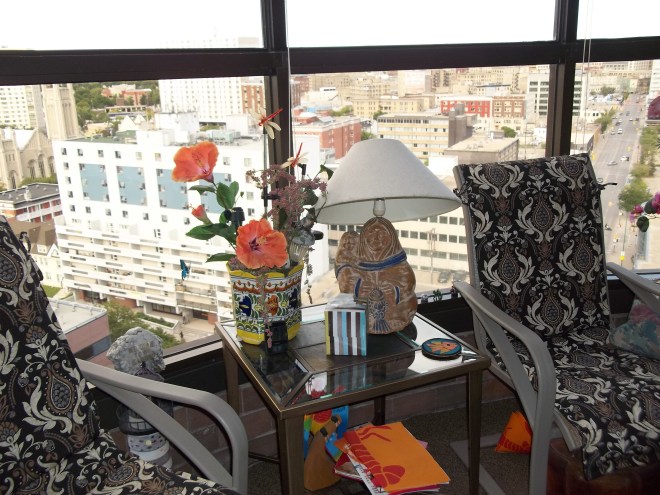
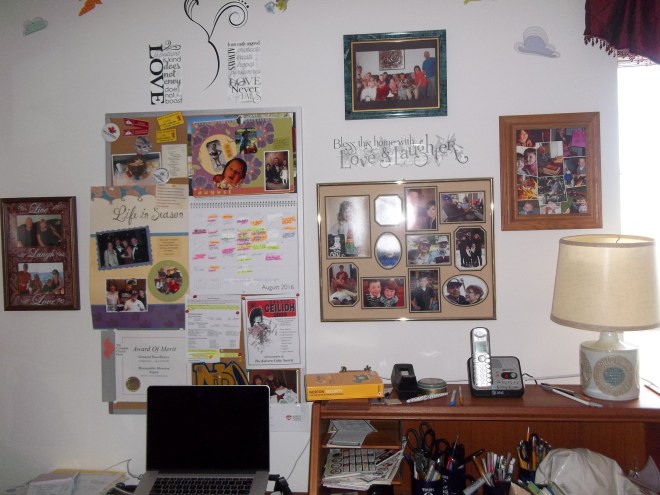
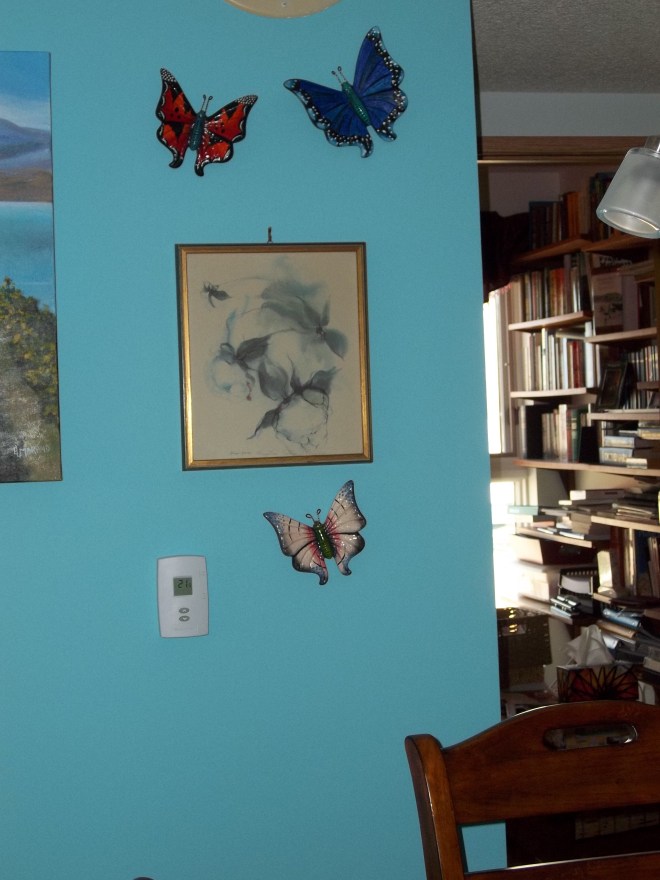
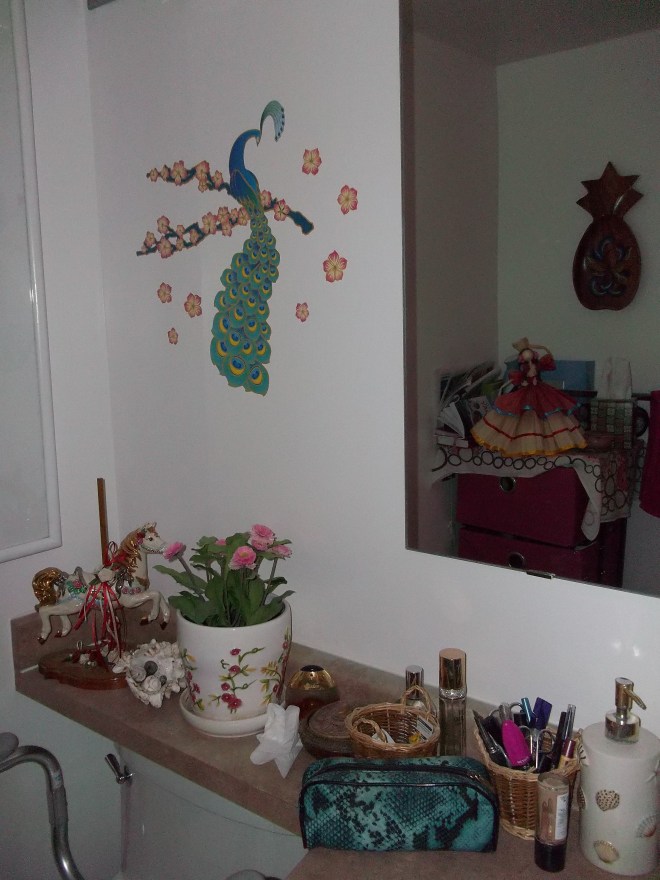
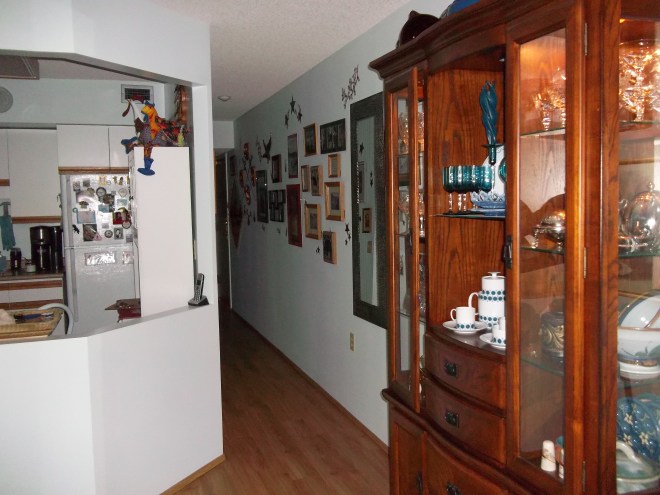
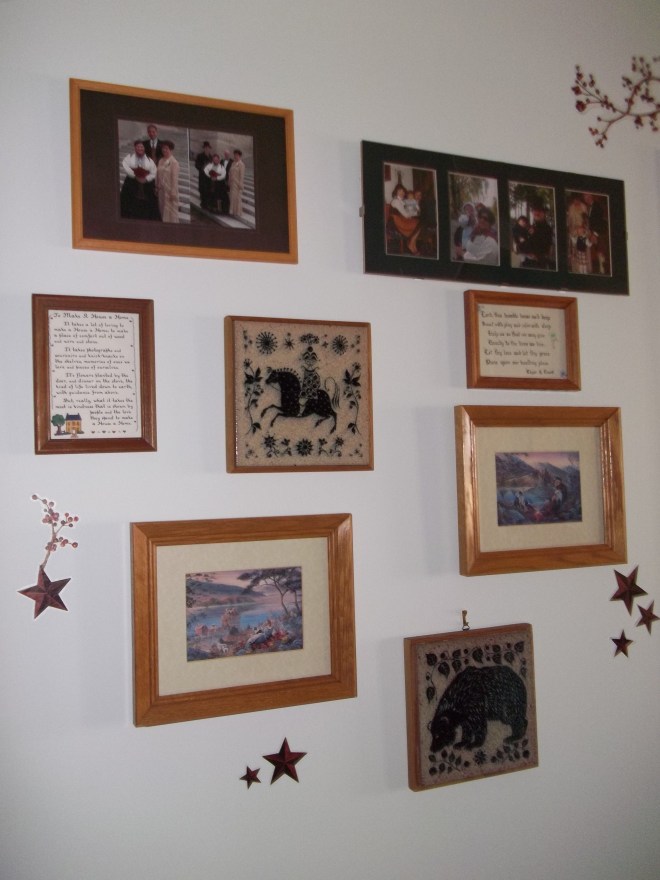
Here are some samples of the lavishly-laden walls, shelves and windows in our apartment:

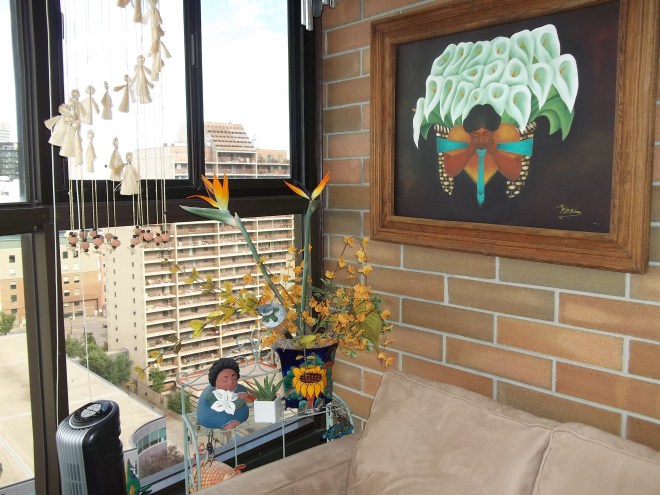
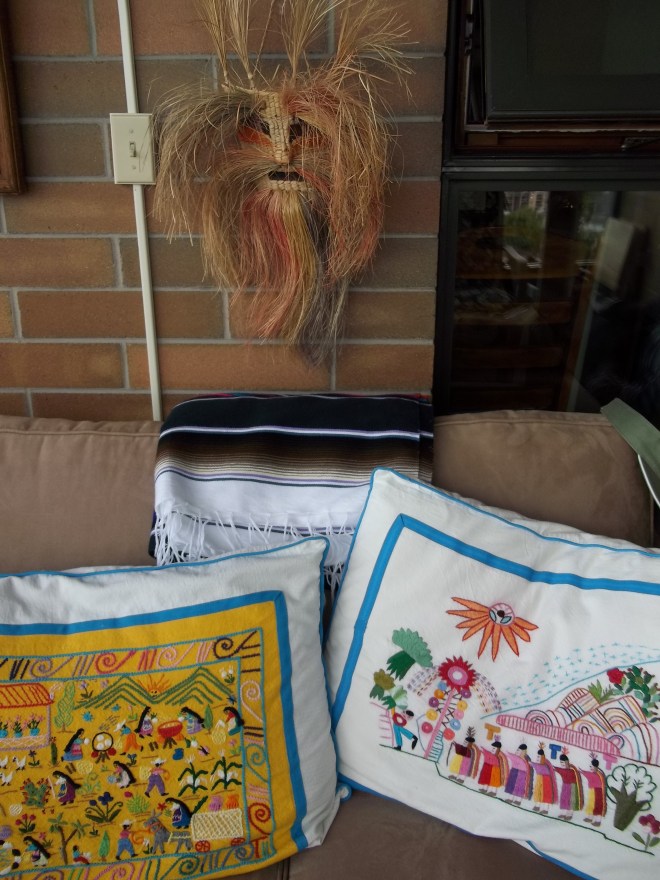
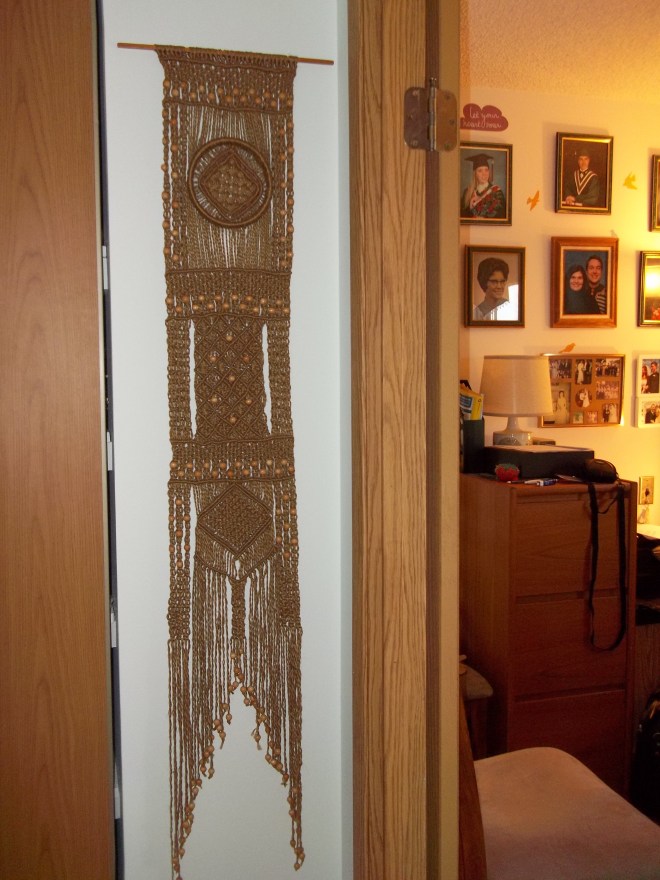
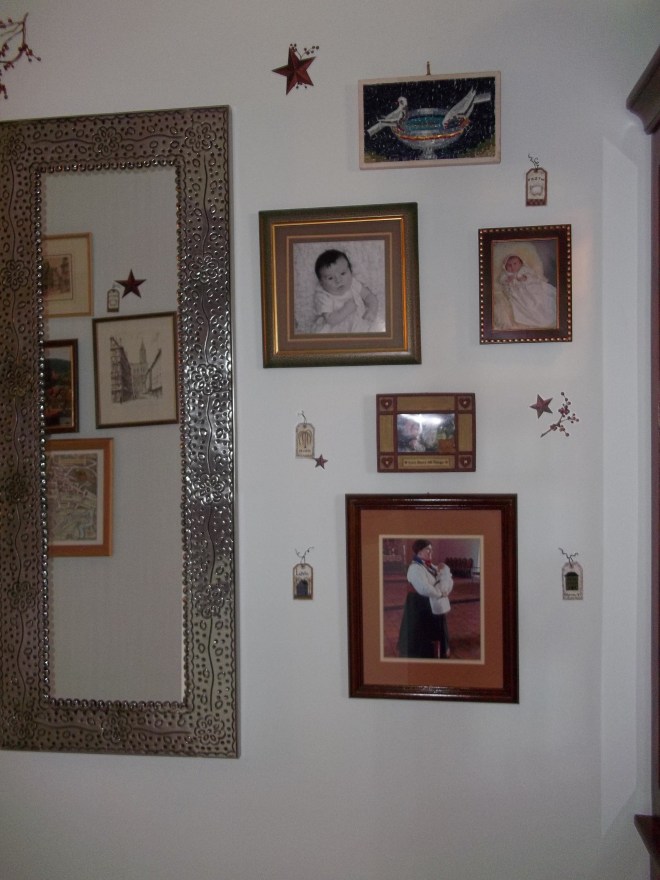
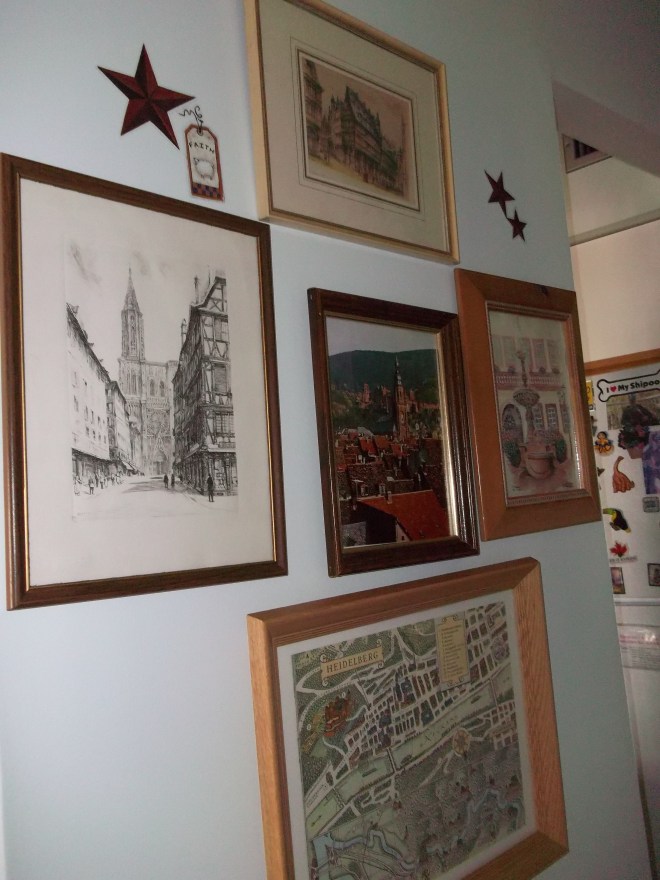
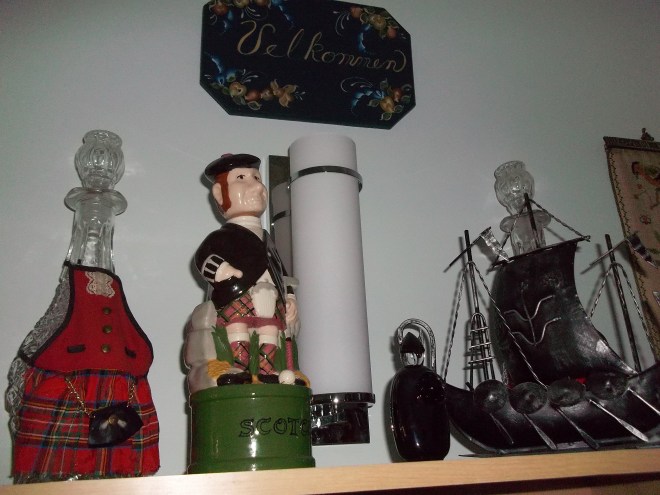
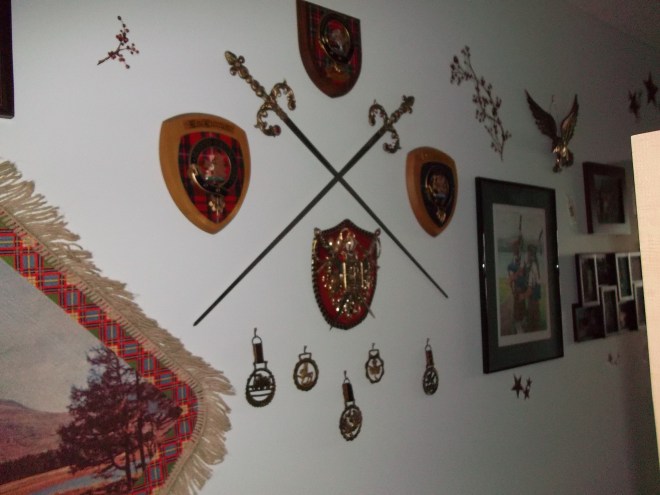
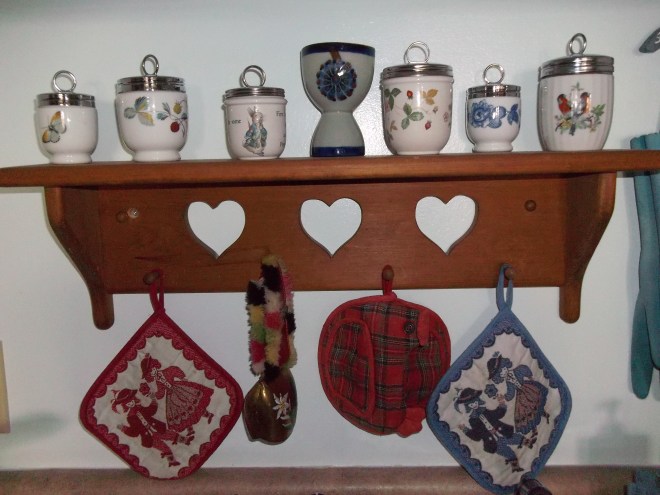
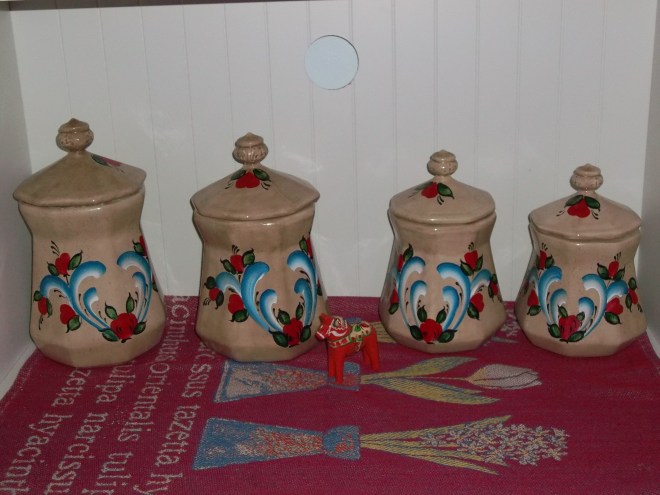
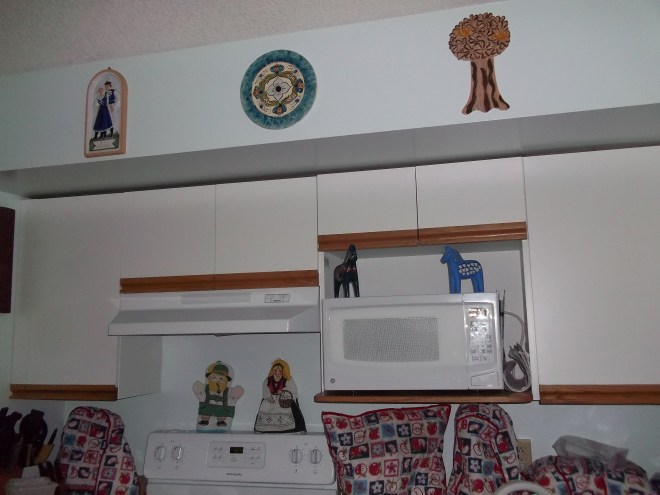
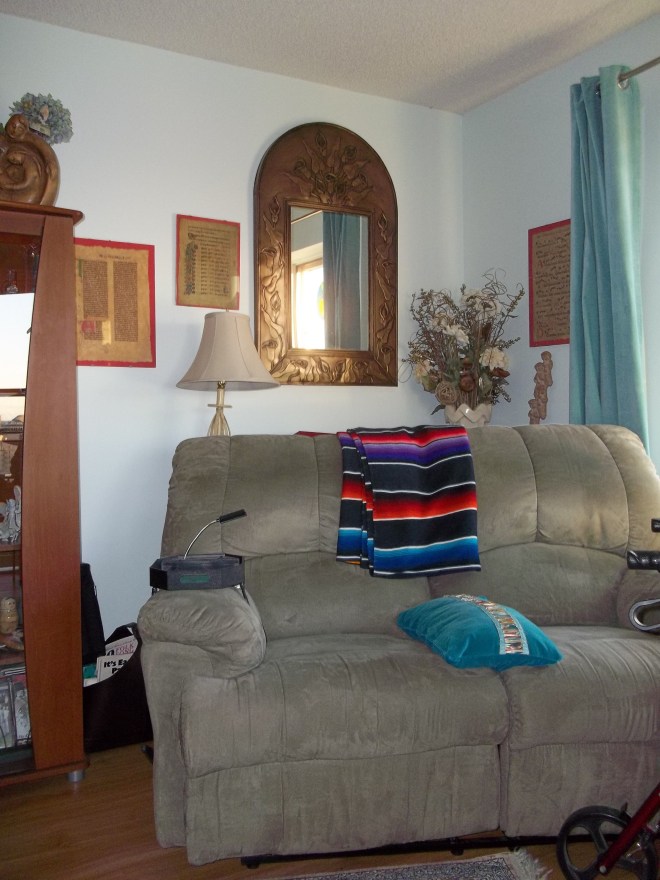
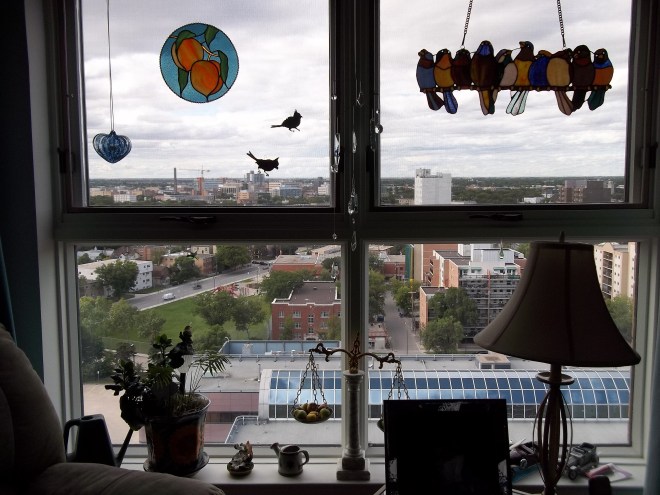
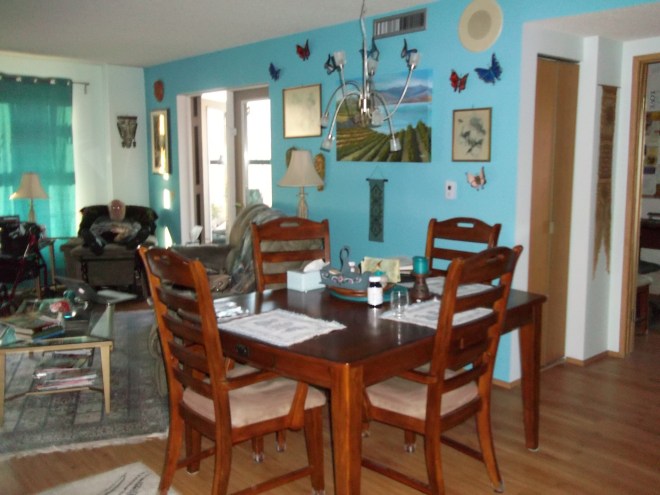
Balcony Monkey, Parrot & SombreroBalcony Southeast CornerBalcony Window View 2Balcony window viewBalcony-Calla Lily & Sunflower artBalcony-Mexican Mask, Embroidery & WeavingBedroom Music WallBedroom North WallBedroom Southeast Corner into EnsuiteBedroom-Ian and Gayle musicmaking photosDen East WallDen-Bookshelf WallDen-north wallDining Room Watercolour Peonies and Ceramic ButterliesDining Room-Artwork - Oil, Lithograph, Silkscreen, etched candles, crystal stemware and decantersHalf-bathHallway looking southHallway to Den - Macrame HangingHallway-Family baptismal photosHallway-Family photosHallway-German and Alsatian picturesHallway-Ian's book promotionsHallway-Scandanavian and Scottish greeting shelfHallway-Scottish GalleryHallway-Scottish Swords and Shields plus Horses' BrassesHallway-Wedding and Ethnic PicturesKitchen-Egg Coddlers, Swedish shelf, Austrian and Scottish pot holders, cow bellKitchen-Rosemaled Canisters and Dalarna Hest, Swedish ClothKitchen-Slovakian, Norwegian and German Plaques, Swedish Dalarna Hesten, German and Norwegian doll pot holdersLiving Room Northwest CornerLiving Room West WallLiving Room Window View and Stained GlassLiving:Dining Room Northeast Corner

The particular tastes in memorabilia that we have chosen to celebrate are as follows:

For Ian: Anything Scottish, such as swords, shields, bagpipes, kilts, tartans, crystal bells and whisky decanters; items associated with his avocation of music-making; memorabilia from his profession as a machinist, such as metalwork, coins and vintage model automobiles; reminders of his early apprenticeship as a blacksmith, such as figures of horses, horses’ brasses and smithing; animal pictures and figures.

For Gayle: Folkart of many countries, particularly the Scandinavian and North Dakota traditions to which she was exposed from childhood and the German and other European traditions she encountered in her early adult years; percussion instruments; flower displays, vases and unique flower pots; embroidered, macraméd, rosemaled and appliqued items; crystal and porcelain; handmade pottery; original oil, watercolour or acrylic paintings; lithographs and copies of medieval manuscripts; religious artwork; German wood carvings.

Jointly: Family photographs including baby and childhood photos; group photos; graduation and wedding pictures. Items from our over-two years’ living in Mexico and from our shared interest in depictions of birds from stained glass to paintings to needlework to figurines.

Perhaps these will be subjects for in-depth postings in the future.

We’ll close with the house blessing made for Gayle years ago by Pam, a dear friend.

Hallway-House Blessing Plaque


Touring the Royal Canadian Mint

royal-canadian-mint-winnipeg

According to its website at mint.ca, the Royal Canadian Mint decribes its Winnipeg location as “… our high-tech, high-volume manufacturing facility. Every single Canadian circulation coin is produced here – literally billions each year. Established in 1976, the Winnipeg plant occupies a 14,864 m2 state-of-the-art facility.” Ian has a special connection to Winnipeg’s Mint since he worked in that architectularly-beautiful and important building for three years shortly after it opened.

Gayle’s editing of our next book, Ian’s second memoir entitled Came To Canada, Eh? Continuing A Scottish Immigrant’s Storyis finally back in full swing after about a three-month hiatus to pack up and move into a larger apartment in our seniors’ lifelease building in Winnipeg. Finding appropriate photos to include with a story about one of the unique jobs Ian held has proved an impossibility until today. Camera in hand,  we made a trip to Winnipeg’s Royal Canadian Mint where Ian had worked from 1977 until 1979.

Though having lived in Winnipeg twice for a total of about 22 years and often having seen the beautiful Royal Canadian Mint building from the highway, Gayle had never toured the facility. Ian hadn’t been back to the building for 37 years. What a fun tour we had yesterday!

Included below is a portion of our book’s fifth chapter which Ian calls, “Heading A Wee Bit Back East-Winnipeg, Here We Come.”

“As I wasn’t too satisfied in the job I first had in Winnipeg, I applied for and got a job in the new “money factory” that had opened in Winnipeg in 1976. I should maybe explain that the “money factory” was the Royal Canadian Mint (certainly the most impressive-looking building I’ve ever worked in). The Mint building is a large, shining triangle rising up out of the surrounding prairie with a small picturesque lake at its side populated by a flock of Canada geese and an occasional pelican or two. Whenever anyone asked me what I worked at, I would say that I made money. Actually, I worked in the die production department,  using a lathe and a milling machine to make some of the dies that were eventually used to stamp images on the coins.

(If you happen to have any 1977-1979 Canadian coins in your pocket, there’s a possibility that they were stamped with dies that I made. Incidentally, the Royal Canadian Mint also produces coins for about 75 other countries as well.)

“The public was regularly invited to take tours of the mint so they could see the process by which Canadian coins were produced. You might say that I became a bit of a ‘tourist attraction’ during those tours. No one ever commended me for making the tours a bit more colourful, but I believe I did. You see, I love to whistle and have found that whistling makes the work go faster and also makes it more interesting. So there’s me, merrily whistling along (probably a Scottish folk tune) when I overheard a commotion on the catwalk above our work station. A small crowd of tourists had stopped and were pointing down at me while commenting on the ‘happy work atmosphere.’ Well, I couldn’t ignore them, so I gave them a wee wave and a bow. From then on whenever a tour came by, I would wave at the group and give them a nice whistled tune. They could have called me the Mint’s version of one of the seven dwarfs of Snow White fame (probably “Happy”) performing “Whistle While You Work.”

“[While this book was going through its final edit in 2016, my wife/editor thought we needed to add a few photos of the mint as I didn’t have any in my photo collection. We decided to take a tour of the mint, to educate her on the minting process and help me reminisce a bit, all the while taking a few photos. This time I was an 84-year-old tour participant, listening to a guide, peering from the catwalk and straining to see the process from my wheelchair. I didn’t hear any whistling or see any workers waving; but considering that the catwalk over the working floors has been  glassed in, I’m not sure we could have heard someone whistling anyway. The tour is still interesting, though; at least for anyone curious about the minting process. We were fascinated to learn of the two-metal process that was developed for the “toonie” ($2 dollar coin) that is made of a steel ring around a brass disc. Both the “loonie” ($1 coin picturing the North American bird, the loon) and the “toonie” were introduced long after I had left the mint job.]”

Copyright © 2016, Ian Moore-Morrans

Below you can check out some of the photos Gayle took yesterday of the “Parade of Nation’s Flags”along the entrance to the Mint representing some of the 75 nations for whom the Mint produces coins; a front view of the Mint location; a view of the machine shop where Ian used to produce dies for coins; and two photos of Ian sitting on his wheelchair in the lobby where he enjoyed posing with a unique “Mountie” and an antique minting machine, as well a mint.ca website photo of some beautiful Canadian coins made right at the Royal Canadian Mint in Winnipeg.

This slideshow requires JavaScript.

“THE MOVE FROM HELL”

WARNING: ALL MOVING COMPANIES ARE NOT EQUAL!

LET THE CUSTOMER BEWARE!

We called it “The Move From Hell.” Okay, we didn’t literally move “from Hell” but from the Okanagan Valley in British Columbia, more like Paradise than Hell. Yet, our move proved to be “hellish.” In May and June 2015 we made what we sincerely hope is the last major move of our lives from Vernon, British Columbia to downtown Winnipeg, Manitoba. Two moving companies contributed to making our move less than ideal: Two Small Men With Big Hearts (TSM) in Kelowna, BC and AMS Transportation Ltd. Inc. headquartered in Dundalk, Ontario. The latter company was the most “hellish.”

In 2007, we had used TSM out of Winnipeg, Manitoba for a previous move from Winnipeg to British Columbia without a hitch. However, our circumstances were different. Eight years ago, they moved a number of already packed and stored boxes plus four small items of furniture: a cedar chest, a teak secretary desk, a captain’s chair and a teak three-drawer filing cabinet. These we had stored in Winnipeg for over two years while we were on a long-term adventure in Mexico, having sold the rest of our furniture and household goods before we took off for Mexico in 2004 in a 35-foot motorhome.

This year’s move in 2015, we had a houseful of furniture (bought when we moved back to Canada from Mexico in 2007), myriad boxes of books and all the household goods we had not downsized. We were moving from a house with two bedrooms, two full bathrooms, plus a den, a porch and garage to a one-bedroom, one-bathroom apartment with the hopes of eventually moving into a two-bedroom apartment once it became available in the same seniors’ life lease apartment building. We also had to move out of our house several weeks earlier than we would have liked, would have to put our household goods into storage for about six weeks, would have to travel for about a month and then have our goods moved to an apartment which we had not yet had assigned to us, though we knew the apartment building to which we would be moving.

Ian has moved households “about a thousand” times (according to him) from Scotland to Canada and then all over Canada from east to west and back and forth. I have moved households from the US to Germany and back (with almost a year’s storage in Germany after we left) and from Wisconsin, USA to Winnipeg, Canada. This was to be Ian’s and my first “major” household move together.

I had asked a friend who had experienced a number of major moves throughout Canada over the years to recommend a moving company. After meeting with a pleasant estimator from that company, we were floored to receive an estimate of almost $13,000–way more than we had anticipated. At the time I didn’t appreciate the fact that the price included packing, storage locally for about a month, plus transportation and unloading, all by one company. That was when I decided to contact TSM, a company I knew would be less expensive and with whom we had had a good moving experience in the past.

NOW I know that I should have been much more cautious about checking out the entire process of packing, moving into storage and moving from storage halfway across the country, considering that two companies would be involved in the move, a situation I had not anticipated.

Here is a brief list of the problems we encountered:

  1. Our household goods were neither properly inventoried nor tagged. After the move was completed, TSM declared that they did not inventory items that went into storage but just labeled the boxes (usually) and delivered them to storage. They further declared that AMS always tagged and itemized the boxes and furniture when it picked them up from storage. In contrast, AMS declared that TSM should have itemized the items when they were packed. In other words, each moving company blamed the other for neglecting to tag and inventory the household goods.
  1. During the move-in on June 19th, when I noted that the movers were not leaving room to set up the bed, dining table, entertainment unit and living room couches/recliners, the driver of the AMS van declared that he had neither instructions nor tools to assemble any of the furniture that the TSM packers had unassembled. After numerous calls to both moving companies, the driver was finally instructed to see that the furniture was assembled (they only did the bed and the dining table) but I had to borrow tools from our apartment building’s maintenance man for them to use.
  1. The two local-hire personnel who were hired to unload the van and carry household items to the apartment were not always attentive and, at times, clumsy or careless. No matter what room was labeled on the boxes, about half of the time they unloaded the boxes into the wrong room.
  1. Not all the TSM-packed boxes were labeled, so it took some days after delivery to find essential belongings. Finding them in the wrong rooms only exacerbated the confusion. The worst problem was the four-day delay before the cable company could complete setup of our TV and component parts. All parts were in the living room except for the main TV cord which I eventually found in an unlabeled box under four other boxes in the bedroom.
  1. I itemized the extra money we had to pay to hire someone else to reassemble the entertainment unit and living room couches and recliners, plus replacement value for those items that were damaged or broken and the costs of long distance telephone calls to both moving companies on moving-in day. AMS refused to pay us compensation, citing a $300 deductible about which we had never been informed. TSM also denied knowing about this deductible. To their credit, TSM volunteered to pay the money we had claimed and declared they would no longer be doing business with AMS. (Donna, the estimator from TSM was very gracious and helpful to us.)

OUR RECOMMENDATIONS: In hindsight, we offer the following recommendations to anyone undertaking a major move that includes storage for a time before household goods are moved on to another address:

  1. If you can afford it, go with a major international moving company that can handle all of the tasks of moving such as packing, loading into storage, storing the goods, moving out of storage, transporting to, unloading and reassembling at the new address. That way you have one point of contact to deal with any questions or problems you might encounter during the move and will have all the information you need in writing.
  2. If you cannot afford moving with a major company, be sure that the company you do go with spells out completely that they will itemize and inventory all your household goods during packing.
  3. Be present when that moving company delivers your goods to storage and leaves the inventory at storage so that whoever picks up the goods for moving on to your destination checks that inventory as they load their van.
  4. Have contact information on the company who will be picking up the goods from storage. We were merely told that another company would be picking up the items from storage but never had anything in writing from that company until after the fact (thus we knew nothing of a deductible). However, they did call us before pick up from storage and demanded our credit card information so they could charge us $5041.95 for their part of the move before they picked up the items. (We were two provinces away from the storage unit when they called us so had no way of checking that our items were truly picked up and on the way and had no contact information about them.)
  5. If at all possible try to insure that only one franchise does the entire move. The company we booked with recommended the second company over their own franchise in Winnipeg. I wish, at that point, that we had gone to another franchise that would have completed the entire move.

Incidentally, the move cost us a total of $8,451.00, including costs for both moving companies, the storage facility and extra boxes we purchased. I had packed many boxes of books and other non-breakables prior to the packing day to reduce the packing costs. Yes, we saved around $4000 but also had a great amount of extra work, frustration and dissatisfaction as well.

For anyone who is interested in reading the entire correspondence regarding our move, I am including that herewith. I hope our warning will help anyone contemplating a similar move.  Continue reading

UNIQUE SUMMER ACTIVITIES: MOVING; SINGING; SAYING GOODBYE TO A PET; SAYING HELLO TO FAMILY; FINDING HELPS FOR EDITING A MEMOIR AND DRAWING INSIGHTS FROM “DEMENTIA AND THE ARTS”

UNIQUE SUMMER ACTIVITIES: MOVING; SINGING; SAYING GOODBYE TO A PET; SAYING HELLO TO FAMILY; FINDING HELPS FOR EDITING A MEMOIR AND DRAWING INSIGHTS FROM “DEMENTIA AND THE ARTS”

Gayle has been remiss in writing any new blog posts for the past two months as we have been traveling after moving out of our house in Vernon, British Columbia on May 11. We spent another almost-two weeks on the other side of town at an apartment borrowed from friends where we had a beautiful view of the sprawling town below and the area we used to live in around Okanagan Lake in the distance.

IMG_3564

We had delayed our departure so that Gayle could attend a wonderful and challenging three-day Chorfest sponsored by the British Columbia Choral Association. The choir festival was held in Vernon this year, so it was too good an opportunity to pass up. Here is our whole group rehearsing for the finale of our final concert – a lively and moving African number.

11267552_974809505871426_7894150334320687081_o

Then we headed east for a grueling three-day car trip through eastern BC and the Rocky Mountains, past the Badlands in Alberta, where we had a stop to photograph Ian and our dog Misty posing with a dinosaur at Drumheller. This time we didn’t tour the Dinosaur Museum as we had done some years ago.

IMG_3574

Continuing northeast through the expanse of Saskatchewan prairies, we finally crossed the Saskatchewan/Manitoba border into the northern Manitoba mining town of Flin Flon, built almost entirely on rock and surrounded with forests and lakes. There we had three weeks to recover and relax with Ian’s daughter and her family.

100_0782 100_0735

Our little Shihpoo, Misty, had not been a happy doggie for the past months, sensing some big change was coming as soon as Gayle had begun to pack up our books in early April. She commenced to show us her anxiety by starting to pee on the carpet in the library/sewing room/second bedroom where the packing was taking place. Unhappily, this continued in our borrowed apartment so that we finally bought her doggie diapers for the trip east. Once we got settled in Flin Flon, however, most of her household “accidents” abated. She spent her time those three weeks (when she wasn’t ensconced on Ian’s lap) getting acquainted with daughter Shirley, her house, husband and their dog, Daisy, a Boston terrier. She also met our married grandchildren and their four toddlers. Below is a photo of the 14 of us (including dogs) one afternoon when we all managed to get together at the same time and place.

The extended Morrans/Lee/Falk Family

Luckily, our grandchildrens’ four dogs weren’t present or we might not have got all of us into one photo. Beside the fact that our new apartment in Winnipeg wasn’t ready for occupancy until June 19th, our ulterior motive for staying in Flin Flon for three weeks was to be sure that Misty would be happy there. You see, we can’t have a pet in our new home, a seniors’ life-lease apartment. Misty was already warming up to her new “parents” by the time we left, although she and Daisy still are a bit wary of each other. Time will tell whether they ever become friends, though they are now “sisters.” Ian, especially, misses her terribly but realizes our parting was necessary.

Previously, we had only met one of these great-grandchildren. Brayden who is now approaching his 4th birthday, introduced us to Lexi, 3, Haylee and Alex, both going on two and just learning to walk. We presented them with copies of our latest book, Jake, Little Jimmy & Big Louie, which had been dedicated to the youngsters in our blended families and were delighted when Lexi eagerly opened her copy to give it a once-over, while her little brother looked on. She also enjoyed being read to.

Lexi reading JLJBL        IMG_3615

While in Flin Flon we took the opportunity to go through some boxes of photographs we had brought along. As Author Ian has been finding it difficult to answer Editor Gayle’s many questions while she is editing our next book: Ian’s second memoir entitled Came to Canada, Eh? Continuing a Scottish Immigrant’s Story, Gayle was hoping to jog his memory through old photographs.

100_0828

She also enlisted daughter Shirley, who had experienced the immigrant situation with her dad, mom and sister, to identify some of the people and places in the photographs. This was a big help. We plan to repeat the experience now that we are settled in Winnipeg and can rely on the memories of Ian’s other daughter living nearby. Some of Gayle’s questions, however, may never be answered. Though she is still enjoy the editing, this book is proving more of a challenge than past books have been.

Below you will find a link to an article in The Guardian that we have found helpful in understanding the dilemma of memory loss that so tragically accompanies cognitive impairment and how that specifically affects artists. How grateful we are that Ian wrote so much and so well while his memory was good.

Words Fail Us: Dementia and the Arts. http://gu.com/p/4ajmv/sb/