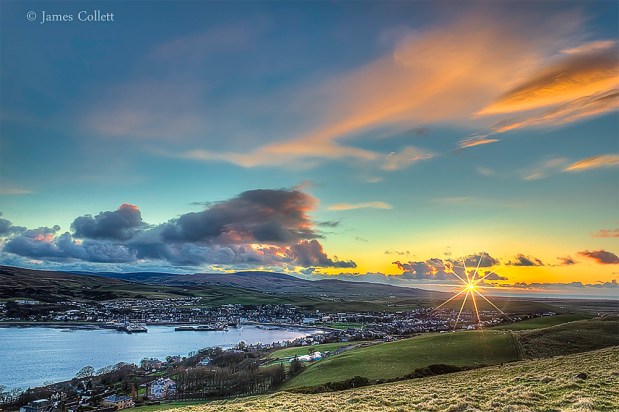
Gorgeous photo of Ian’s hometown. It brings to mind an excerpt from Ian’s memoir: “From Poverty to Poverty: A Scotsman Encounters Canada.” We plan to reblog this and add an excerpt from Ian’s memoir that describes Campbeltown Loch, Andy Stewart’s song “Campbeltown Loch, I Wish Ye Were Whisky” and an encounter Ian had with Andy Stewart after a concert in Canada.
Blogging
HUMOR AND A GOOD LAUGH CAN HELP YOU DEAL WITH LIFE — “More Than Slightly Sloshed”
Yesterday we received our copy of 50 Great Writers You Should Be Reading, 2013-2014.
Very nicely done and interesting reading about other writers and how they came to write. Ian is featured among the 50 writers, all chosen by public vote after reading writer’s essays about “How I Write”. The writers had all previously been interviewed on The Authors Show about a specific book they had written. Ian’s interview was about his memoir published in 2012 entitled From Poverty to Poverty: A Scotsman Encounters Canada. In the media release about Ian’s win, Ian is quoted as saying:
“The central message of my book is that it is possible to overcome a negative lifestyle like poverty. However, in order to do so, one has to have grit, perseverance, sometimes luck and even humor to get through it all. I’ve tried to look for humor in each and every situation. When all else fails, a good laugh and then, determining to pick yourself up and start anew, will help you deal with most things that life throws at you.”
Another blogger – Kev – sent us a comment a short time ago remarking that he enjoyed some of our pictures from book readings and noted “Beautiful pic…some great laughter going on there.
.
Here is our favourite photo from a book
reading, showing some of Gayle’s relatives enjoying a humorous story from Ian’s book, From Poverty to Poverty: A Scotsman Encounters Canada. (Thanks for your hearty enthusiasm, cousin Janice! The menfolk all look amused as well, but quite a bit more subdued.)
Gayle’s reply to Kev was: “Your nice comment about the pictures and laughter has inspired me to put on a future post a humorous excerpt from Ian’s memoir. I think the excerpt that generated most of the laughter came from Ian’s story which he calls “More Than Slightly Sloshed.” Look for it in the next few days – as soon as I have time to put it on this website.”
Well, those “next few days” have grown to several weeks so it is high time that I (Gayle) fulfill my promise. So here is the excerpt from Ian’s story.
To set the scene, the year is 1950. Eighteen-year-old Ian has just completed his “square bashing” (basic training) with the Royal Air Force in southern England and tells of his disastrous first leave home to Campbeltown in southwest Scotland.
Then I got one week’s leave and was given my travel warrant to go home. From there I was to go to RAF St. Athens in Wales, about 17 miles west of Cardiff, not far from Bridgend. It was hardly worth going home, as it meant two days’ traveling time each way. I just got there and it was almost time to head out again. As things turned out, I really shouldn’t have gone at all! Here’s why. I call this story, “More Than Slightly Sloshed!” I arrived at our house in Campbeltown at 9:30 in the evening after being on trains or waiting for connections in train stations for a total time of about 20 hours. I found two of my mother’s Salvation Army lady friends visiting her, the three of them huddled around a roaring coal fire. Noticing a strange smell, I asked my mother what was causing it. She replied, “Oh it’s Bill; he’s makin’ whisky in the wee room.” (To us Scots, a “wee room” is a wee bit wee-er than a small room!) My Irish stepfather Bill was not of the Salvation Army persuasion! Very often in the years since he’d married my mother, he’d told stories of how he and his buddies would go up into the hills at Antrim and make poteen, the Irish equivalent of “moonshine” or home brew. Even then I had no idea that it was close to 100% alcohol! I had heard him remark that he was going to make some “one of these days.” I’d heard it so often that I was sick and tired of hearing it, as well as many other of his stories of this, that and the next thing that might or might not have been true. Well, when my mother said that Bill was making poteen, I couldn’t believe it. I thought he was doing his usual bragging with no truth to it—and that wouldn’t have been unusual! As I sat talking with the women, basking in their remarks such as, “Oh, Ian, don’t ye look handsome in your Royal Air Force uniform,” my mother tried to get me to eat something. I told her that I was dead beat and just wanted to go to sleep. At this point, Bill came through, said hello to me and asked me to taste his “brew.” What he handed me was a glass tumbler with about four or five ounces of clear liquid in it. Not knowing it was so strong, I had almost downed the lot when Bill shouted, “Stop, stop, that’s all I’ve got.” Because it looked so much like water, I had had no hesitation in drinking it. Remember, I was not accustomed to alcoholic drinks of any kind. I didn’t know at the time that I was drinking pure alcohol! There was about an ounce left for Bill after all his hard work. It had taken him two days to distill that small amount. Shortly after this I started feeling a bit woozy, especially as I had virtually an empty stomach. A little while later I said “goodnight” to everyone and took myself off to bed. Stumbling to my room, I stripped off, hopped into bed completely naked and was asleep almost immediately. The next morning I got up, surprisingly clearheaded, and wandered into the living room. There was a fine, white dust everywhere and I said to Mother, “What is this white powder all over the place.” “Oh, that was ye last night, ye daft bugger,” she replied, in the middle of trying to clean things up. “Ye came through here aboot an hour after ye had gone to bed, absolutely naked, walked in between my two friends and peed all over the fire.” “You mean that Ah came through here, sleep-walking, stark naked, in front of Mrs. Campbell and Mrs. MacGregor? Me with no clothes on?” I was horrified! My mother continued. “Ye should have seen the steam that ye created, plus all the ash that went up into the air with it. There was a stifling white cloud all over the house, not to mention all over the three of us, and Ah think Ah’ll be dusting here for a month. We were afraid to waken ye in case we did something wrong!” To add to my embarrassment was the fact that both of Mother’s visitors were strict Salvation Army believers. I realized that what they thought about my imbibing—my getting fully pissed—well, that was certainly somewhere above the forgiveness level. By then I must have been the talk of the town! Even a long time later, whenever I was home on leave and I saw either of those women on the street and heading my way, I would cross over to the other side—just a wee bit more than slightly embarrassed! Strangely, no one but Mother ever mentioned the incident to me. Somehow, it seemed, my Salvation Army days were really over. To quote my mother, “Since ye joined the Royal Air Force, ye’ve gone tae the Devil!”— quoted from “From Poverty To Poverty: A Scotsman Encounters Canada,” p. 96-98, copyright © 2012, Ian Moore-Morrans.
Collaborating with a 4-year Old
Gayle’s Comments on this blog post:
Your post was wonderful. I am at present enhancing/editing some illustrations for my husband’s new children’s book( “Jake, Little Jimmy and Big Louie” about a boy and two birds) that I have edited. Our illustrator is our eight-year-old great-granddaughter. We don’t have the luxury of living in the same place but Hannah’s grandmother (our daughter) has read through the draft chapters with her and then oversees her drawings for each chapter, scans them in and sends us the JPGs. Sometimes the main characters look different from picture to picture so I am now using Microsoft Paint to adjust them for a uniformity of sorts without losing that special child’s perspective. What fun! I will then rescan the edited pictures at a resolution high enough for printing in the book. I also blogged most of the chapters little by little as they were being edited (leaving out the last chapter). The ensuing comments were helpful We will blog news on the future publication.
I urge you to use at least some of your wonderful collaborations in a children’s book that perhaps you can write together. What a terrific contribution to children’s literature that could be!
One day, while my daughter was happily distracted in her own marker drawings, I decided to risk pulling out a new sketchbook I had special ordered. It had dark paper, and was perfect for adding highlights to. I had only drawn a little in it, and was anxious to try it again, but knowing our daughter’s love of art supplies, it meant that if I wasn’t sly enough, I might have to share. (Note: I’m all about kid’s crafts, but when it comes to my own art projects, I don’t like to share.) Since she was engrossed in her own project, I thought I might be able to pull it off.
Ahhh, I should’ve known better. No longer had I drawn my first face (I love drawing from old black & white movie stills) had she swooped over to me with an intense look. “OOOH! Is that a NEW…
View original post 904 more words
BEQUEATHING OUR HEIRLOOMS – A BLENDED FAMILY’S SOLUTION AND AN AUTHOR’S SOLUTION
*Heirloom = (1) Any piece of property that goes to an heir as part of an estate; or
(2) Any treasured possession handed down from generation to generation.
(* from New World Dictionary of the American Language, Second College Edition)
We hope to avoid any haggling over the “heirloom bones” by our descendents after we have passed away. Just reading about what is going on now in South Africa over the literal bones of Mandela’s relatives and, probably, over Mandela’s eventual burial place gives us the creeps. That news has been timely as we’ve immersed ourselves in research and discussions about end-of-life decisions this past month. Being a blended family brings some unique considerations to the fore. Both of us were previously widowed after long first marriages and have now been married to each other for almost ten years. At 70 and 81 years of age, having both experienced some serious health crises in the last several years, we found that it was time to re-do our wills and also to complete Enduring Powers of Attorney (granting financial control to a trustee if we became incapable of handling our affairs) and Representative Agreements (the name for “living wills” or end-of-life directives in our province of British Columbia).
This brings up a special problem that many blended families face, especially those of us who had a second marriage later in life, have grown children (grandchildren and even great-grandchildren) from our previous marriages and have brought a significant amount of “items” into our joined household from our previous households. What happens to those items we each brought into the marriage, especially those items that one would consider a family heirloom? Normally, if one spouse dies, everything remains with the surviving spouse. However, for us, we needed to consider what would happen to the “Morrans family items” for instance, if Ian should die and Gayle survive? Or what would happen to the “Johannesson family items” if Gayle should die and Ian survive? These items do not have a great financial value; however, we and our families attach a great deal of sentimental value to them. Our solution was to specify in our wills that when each of us dies, those items that were brought into our marriage from the previous marriage be given to our own children from that marriage at the time of our death and not be retained by the surviving spouse. We feel that can avoid potential problems for all parties in the future.
A second problem was what to do about copyrights that belong to an author of published or unpublished works when that author dies. Thirdly, because Gayle has specific religious concerns, she also wanted to completely plan out her funeral and we both wanted to leave specific instructions for disposal of our bodies. We will share our solutions to the blended family problem first.
When we married in September 2003, Ian had been retired for several years but Gayle was still working, not yet having reached retirement age. She continued to work until taking an early retirement in July 2004. We had sold Ian’s house just after our marriage and Ian had moved into Gayle’s house with some of his furniture and household items but had given a lot of such items to his family members who lived in the same town. We had bought a large motor home and planned to drive it to Mexico to see if we wanted to retire there permanently. Thus, we decided to sell most of the furniture and household items, retaining those most important to us which we put into storage, intending to have it sent to Mexico if we decided to stay there permanently. After a year we decided that we preferred to return to Canada but to another province where the weather was more desirable. It took another year and a half to get organized, put our Mexican house up for sale and finally sell it. Now, here we are in British Columbia with a house full of “his”, “hers” and “our” stuff. We wanted to be sure that the “his” and “hers” stuff would eventually be given to “his” or “her” appropriate family members.
Gayle worked for several long days going through everything and making two lists of the appropriate items. Then we worked together to designate how the items would be divided amongst our various family members.
This is the wording with which we began our list:
LIST OF ARTICLES AND BENEFICIARIES* – For Wills of Gayle & Ian Moore-Morrans *This is an addendum to the Wills of Gayle Irene Moore-Morrans and Ian Moore-Morrans. We are listing only those items that we wish to bequeath which we each brought into our marriage in September 2003 from the families of Gayle Irene Moore Johannesson and Ian Morrans. Any items not listed here are to be considered Moore-Morrans estate residue. A list of family members to whom we wish to bequeath these items is on page X.
The following headings were listed at the top of each page:
ITEMS FAMILY ITEMS BENEFICIARY LOCATION Johannesson Morrans
The following categories were used to list the items:
FURNITURE CARPETS & FLOOR COVERS HOUSEHOLD LINEN CLOTHING & SHOES DISHES, CHINA, FLATWARE, SERVING PIECES JEWELRY/WATCHES ARTWORK HEIRLOOMS COLLECTIONS (BOOKS, COINS, CDS, DVDS, ETC.) TOOLS
At the end we listed the designated recipients of each family’s heritage item and their family relationship to us plus their date of birth:
Example:
Daughter of Gayle Moore-Morrans: Jane Ann Doe, neé Johannesson, DOB Jan 00, 1977
On another subject, that of choosing our trustees (for the wills) or attorneys (as our representative is listed for the Enduring Powers of Attorney) or “representative” (for the Representation Agreement), we decided to each list each other as first trustee/attorney/representative and then, if we were unable to act for the other as in the case of death or disability, to name Ian’s son-in-law for him and to name a local friend for Gayle as she has no direct relatives in Canada.
As a proper Lutheran Celebration of Life (funeral) is important to Gayle, she has also added as an addendum to her will complete instructions for such a service plus a service of committal and disposal of her body.
Ian has left the choice of funeral or memorial service and disposal of his body to Gayle, if she survives him, and to one of his daughters should Gayle not survive him.
We both have included in our wills instructions that our bodies be cremated and have designated appropriate urns to be used from Gayle’s vase collection.
As Ian has published a number of works and written a number of others which he hopes to publish, his will designates that all copyrights, including moral rights, to all his published and unpublished works as defined in the Copyright Act, RSC 1985, c D-42, be transferred to Gayle or, if she does not survive him for 30 days, then to his daughters in equal shares or to their children if one or both of his daughters do not survive him. A list of his published and unpublished works is added as an addendum to his will.
We want also to point out a particular blogger who has two very informative sites about end-of-life topics which we have found valuable. Julie Hall’s two sites are:
http://www.estatelady.wordpress.com The Estate Lady Speaks: Compassionate Advice for Dealing with a Lifetime Accumulation of Stuff
http://www.alzheimercaregiver.wordpress.com In the Trenches: The Alzheimer’s Support Blog for Caregivers
Shine On Award and Kilts
Our blog was recently awarded a “Shine On” award from Shaun, a fellow Scotsman who lives with and blogs about chronic pain. The young man has been an inspiration to many and we recommend his blog at prayingforoneday.wordpress.com.
THE “SHINE ON AWARD” RULES ARE:
1. Display the award logo on your blog.
2. Link back to the person who nominated you.
3. State 7 things about yourself
4. Nominate 15 other bloggers for this award and link to them.
5. Notify those bloggers of the nomination and the award requirements.
Seven things about Ian
1. He is a proud Scot, even though also a Canadian for many years.
2. He loves to wear his kilt at any occasion he can.
3. He started wearing a kilt at age 15 while a member of the Army Cadets in Campbeltown, Argyll, Scotland.
4. In Army Cadets he learned that he was not allowed to wear underwear under the kilt.
5. That was okay as, at the time, his family was so impoverished they didn’t have underwear to wear anyway.
6. Since entering adulthood he has continued to wear a kilt but refuses to answer the question: “Do you wear anything under your kilt?”
7. Ian is intrigued (and so is his wife Gayle) by the fact that invariably whenever he wears his kilt, someone (usually a woman) asks him what he is wearing under it.
You may ask why the facts about Ian are all about him wearing a kilt. It is because Shaun (who nominated Ian for this award) made the following remark to Ian on May 22, 2013: “A man in a kilt is always a brother to me.”
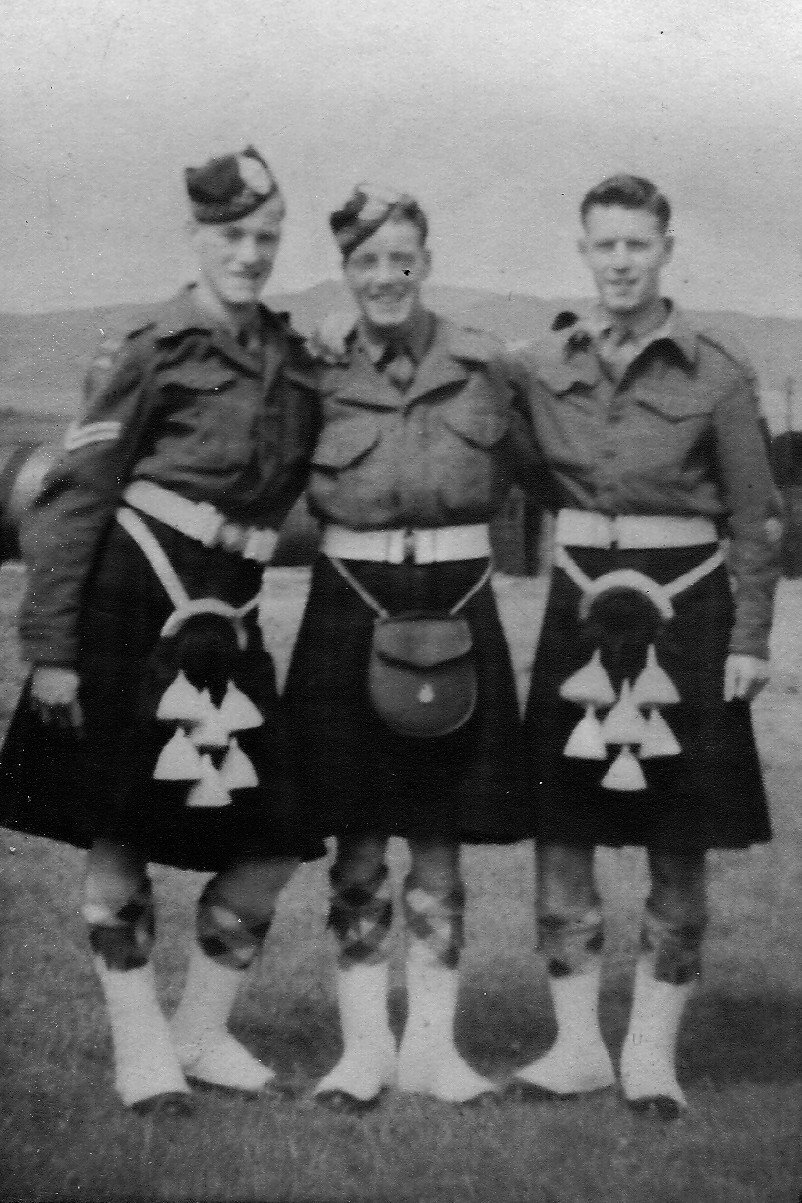
Then, just as we were preparing to pass on this Shine On Award, we got another comment to a post of Ian’s from October 2012 entitled “Answering a Question Regarding Kilts” in which we quoted a paragraph from Ian’s memoir “From Poverty to Poverty: A Scotsman Encounters Canada.” There Ian relates that, as a teenager in the late 40s in Scotland he joined the Army Cadets, was issued a kilt and was inspected to be sure he hasn’t wearing anything underneath the kilt. Incidentally, here is a vintage photo of Ian and two Army Cadet buddies in their kilts.
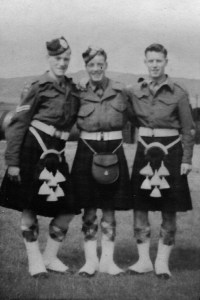
Campbeltown pals at Army Cadet Camp, Dunoon, 1948. I’m in the middle. Ian Brodie is on the left and Charlie Martin (I think) is on the right.
On June 6, 2013, Shawn Bird commented: “I understand that current kilt rental businesses in Scotland request renters to wear undergarments, or they face a hefty fee for additional cleaning. I don’t understand why regimental rule was no undergarments. Was the possibility of windy revelation likely to demoralize the enemy?”
We have just replied to Shawn’s comments” “Good point, Shawn. I think you have hit upon a likely explanation. Perhaps you have read about the Scottish regiment in World War I which the Germans called “Die Damen aus der Hoelle” or the “Ladies from Hell.” They were said to have struck fear into the enemy because of their ferocious fighting, even though they wore what the Germans called “skirts.” But who knows, maybe it was what the wind whipped up that did it!”
We now nominate 15 other bloggers for the Shine On Award:
1. thepublicblogger.com
2. bookhubinc.wordpress.com
3. claudebeccai.com
4. charlieandpearl.wordpress.com
7. flammeusgladius.wordpress.com
8. patinspire.org
9. cancerkillingrecipe.wordpress.com
10. urbanwallart.wordpress.com
12.sicsiclasic.wordpress.com
13. wethekeepers.wordpress.com