Touring the Royal Canadian Mint

royal-canadian-mint-winnipeg

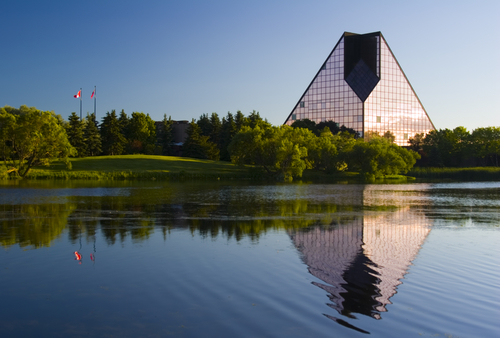
According to its website at mint.ca, the Royal Canadian Mint decribes its Winnipeg location as “… our high-tech, high-volume manufacturing facility. Every single Canadian circulation coin is produced here – literally billions each year. Established in 1976, the Winnipeg plant occupies a 14,864 m2 state-of-the-art facility.” Ian has a special connection to Winnipeg’s Mint since he worked in that architectularly-beautiful and important building for three years shortly after it opened.

Gayle’s editing of our next book, Ian’s second memoir entitled Came To Canada, Eh? Continuing A Scottish Immigrant’s Storyis finally back in full swing after about a three-month hiatus to pack up and move into a larger apartment in our seniors’ lifelease building in Winnipeg. Finding appropriate photos to include with a story about one of the unique jobs Ian held has proved an impossibility until today. Camera in hand,  we made a trip to Winnipeg’s Royal Canadian Mint where Ian had worked from 1977 until 1979.

Though having lived in Winnipeg twice for a total of about 22 years and often having seen the beautiful Royal Canadian Mint building from the highway, Gayle had never toured the facility. Ian hadn’t been back to the building for 37 years. What a fun tour we had yesterday!

Included below is a portion of our book’s fifth chapter which Ian calls, “Heading A Wee Bit Back East-Winnipeg, Here We Come.”

“As I wasn’t too satisfied in the job I first had in Winnipeg, I applied for and got a job in the new “money factory” that had opened in Winnipeg in 1976. I should maybe explain that the “money factory” was the Royal Canadian Mint (certainly the most impressive-looking building I’ve ever worked in). The Mint building is a large, shining triangle rising up out of the surrounding prairie with a small picturesque lake at its side populated by a flock of Canada geese and an occasional pelican or two. Whenever anyone asked me what I worked at, I would say that I made money. Actually, I worked in the die production department,  using a lathe and a milling machine to make some of the dies that were eventually used to stamp images on the coins.

(If you happen to have any 1977-1979 Canadian coins in your pocket, there’s a possibility that they were stamped with dies that I made. Incidentally, the Royal Canadian Mint also produces coins for about 75 other countries as well.)

“The public was regularly invited to take tours of the mint so they could see the process by which Canadian coins were produced. You might say that I became a bit of a ‘tourist attraction’ during those tours. No one ever commended me for making the tours a bit more colourful, but I believe I did. You see, I love to whistle and have found that whistling makes the work go faster and also makes it more interesting. So there’s me, merrily whistling along (probably a Scottish folk tune) when I overheard a commotion on the catwalk above our work station. A small crowd of tourists had stopped and were pointing down at me while commenting on the ‘happy work atmosphere.’ Well, I couldn’t ignore them, so I gave them a wee wave and a bow. From then on whenever a tour came by, I would wave at the group and give them a nice whistled tune. They could have called me the Mint’s version of one of the seven dwarfs of Snow White fame (probably “Happy”) performing “Whistle While You Work.”

“[While this book was going through its final edit in 2016, my wife/editor thought we needed to add a few photos of the mint as I didn’t have any in my photo collection. We decided to take a tour of the mint, to educate her on the minting process and help me reminisce a bit, all the while taking a few photos. This time I was an 84-year-old tour participant, listening to a guide, peering from the catwalk and straining to see the process from my wheelchair. I didn’t hear any whistling or see any workers waving; but considering that the catwalk over the working floors has been  glassed in, I’m not sure we could have heard someone whistling anyway. The tour is still interesting, though; at least for anyone curious about the minting process. We were fascinated to learn of the two-metal process that was developed for the “toonie” ($2 dollar coin) that is made of a steel ring around a brass disc. Both the “loonie” ($1 coin picturing the North American bird, the loon) and the “toonie” were introduced long after I had left the mint job.]”

Copyright © 2016, Ian Moore-Morrans

Below you can check out some of the photos Gayle took yesterday of the “Parade of Nation’s Flags”along the entrance to the Mint representing some of the 75 nations for whom the Mint produces coins; a front view of the Mint location; a view of the machine shop where Ian used to produce dies for coins; and two photos of Ian sitting on his wheelchair in the lobby where he enjoyed posing with a unique “Mountie” and an antique minting machine, as well a mint.ca website photo of some beautiful Canadian coins made right at the Royal Canadian Mint in Winnipeg.

This slideshow requires JavaScript.

UNIQUE SUMMER ACTIVITIES: MOVING; SINGING; SAYING GOODBYE TO A PET; SAYING HELLO TO FAMILY; FINDING HELPS FOR EDITING A MEMOIR AND DRAWING INSIGHTS FROM “DEMENTIA AND THE ARTS”

UNIQUE SUMMER ACTIVITIES: MOVING; SINGING; SAYING GOODBYE TO A PET; SAYING HELLO TO FAMILY; FINDING HELPS FOR EDITING A MEMOIR AND DRAWING INSIGHTS FROM “DEMENTIA AND THE ARTS”

Gayle has been remiss in writing any new blog posts for the past two months as we have been traveling after moving out of our house in Vernon, British Columbia on May 11. We spent another almost-two weeks on the other side of town at an apartment borrowed from friends where we had a beautiful view of the sprawling town below and the area we used to live in around Okanagan Lake in the distance.

IMG_3564

We had delayed our departure so that Gayle could attend a wonderful and challenging three-day Chorfest sponsored by the British Columbia Choral Association. The choir festival was held in Vernon this year, so it was too good an opportunity to pass up. Here is our whole group rehearsing for the finale of our final concert – a lively and moving African number.

11267552_974809505871426_7894150334320687081_o

Then we headed east for a grueling three-day car trip through eastern BC and the Rocky Mountains, past the Badlands in Alberta, where we had a stop to photograph Ian and our dog Misty posing with a dinosaur at Drumheller. This time we didn’t tour the Dinosaur Museum as we had done some years ago.

IMG_3574

Continuing northeast through the expanse of Saskatchewan prairies, we finally crossed the Saskatchewan/Manitoba border into the northern Manitoba mining town of Flin Flon, built almost entirely on rock and surrounded with forests and lakes. There we had three weeks to recover and relax with Ian’s daughter and her family.

100_0782 100_0735

Our little Shihpoo, Misty, had not been a happy doggie for the past months, sensing some big change was coming as soon as Gayle had begun to pack up our books in early April. She commenced to show us her anxiety by starting to pee on the carpet in the library/sewing room/second bedroom where the packing was taking place. Unhappily, this continued in our borrowed apartment so that we finally bought her doggie diapers for the trip east. Once we got settled in Flin Flon, however, most of her household “accidents” abated. She spent her time those three weeks (when she wasn’t ensconced on Ian’s lap) getting acquainted with daughter Shirley, her house, husband and their dog, Daisy, a Boston terrier. She also met our married grandchildren and their four toddlers. Below is a photo of the 14 of us (including dogs) one afternoon when we all managed to get together at the same time and place.

The extended Morrans/Lee/Falk Family

Luckily, our grandchildrens’ four dogs weren’t present or we might not have got all of us into one photo. Beside the fact that our new apartment in Winnipeg wasn’t ready for occupancy until June 19th, our ulterior motive for staying in Flin Flon for three weeks was to be sure that Misty would be happy there. You see, we can’t have a pet in our new home, a seniors’ life-lease apartment. Misty was already warming up to her new “parents” by the time we left, although she and Daisy still are a bit wary of each other. Time will tell whether they ever become friends, though they are now “sisters.” Ian, especially, misses her terribly but realizes our parting was necessary.

Previously, we had only met one of these great-grandchildren. Brayden who is now approaching his 4th birthday, introduced us to Lexi, 3, Haylee and Alex, both going on two and just learning to walk. We presented them with copies of our latest book, Jake, Little Jimmy & Big Louie, which had been dedicated to the youngsters in our blended families and were delighted when Lexi eagerly opened her copy to give it a once-over, while her little brother looked on. She also enjoyed being read to.

Lexi reading JLJBL        IMG_3615

While in Flin Flon we took the opportunity to go through some boxes of photographs we had brought along. As Author Ian has been finding it difficult to answer Editor Gayle’s many questions while she is editing our next book: Ian’s second memoir entitled Came to Canada, Eh? Continuing a Scottish Immigrant’s Story, Gayle was hoping to jog his memory through old photographs.

100_0828

She also enlisted daughter Shirley, who had experienced the immigrant situation with her dad, mom and sister, to identify some of the people and places in the photographs. This was a big help. We plan to repeat the experience now that we are settled in Winnipeg and can rely on the memories of Ian’s other daughter living nearby. Some of Gayle’s questions, however, may never be answered. Though she is still enjoy the editing, this book is proving more of a challenge than past books have been.

Below you will find a link to an article in The Guardian that we have found helpful in understanding the dilemma of memory loss that so tragically accompanies cognitive impairment and how that specifically affects artists. How grateful we are that Ian wrote so much and so well while his memory was good.

Words Fail Us: Dementia and the Arts. http://gu.com/p/4ajmv/sb/

BODY AND SPIRIT: LIFE’S LESSONS REINFORCED

BODY AND SPIRIT: LIFE’S LESSONS REINFORCED

Through the years, Gayle has shared the following with friends who are recovering from accidents or lengthy hospitalizations. Sunday she learned another friend was coping with a fractured ankle after falling on skis as she was getting off a chair lift and was jostled or startled by an over-anxious skate boarder. Here’s to a good healing, Pat! Gayle can’t blame a skate boarder for a previous accident she experienced. She was the over-anxious one wanting to spy a bird building a nest on her roof. And she never did see the darn bird! Perhaps this is what it looked like.

Bird building a nest on roof-bartramsgarden.org

Life’s Lessons Reinforced by Gayle Johannesson (later Moore-Morrans)
adapted from an editorial originally published in Esprit magazine, 1999, presented at a Lake Chapala Society Writer’s Group in Ajijic, Mexico, 2005

One fine Manitoba day in early May 1999, I eagerly awaited getting home after a long day at my editing job. After seven months of winter, Winnipeg was a glorious place to be and I planned to spend a long evening on my deck enjoying the warm air, extended sunshine and birdsong. As soon as I walked in, my daughter excitedly shouted, “Mum, you should check it out. I think a bird is building a nest on our roof.”

Of course, I can never leave well enough alone, so had to immediately trot out to the deck to investigate. I jumped up onto one of the benches surrounding our hexagonal deck table and then onto the table, but wasn’t close enough to view the roof. Jumping down, I hauled the table and bench closer and again hopped up onto the bench and then to the table. This time, however, I landed on a corner where there wasn’t a table leg. Down I crashed—all of three feet, mind you—slamming my right leg on the bench and landing wedged against the railing of the deck on my back with my right arm pinned under me. My frantic screams quickly brought my daughter and next-door neighbours to the scene. Soon the fire department and ambulance service arrived. I have little recollection of their rescue other than a vague feeling of horror as they threw all the furniture off our high deck and struggled to get me into a neck brace and stretcher, down the ten steep steps to the back yard and into the ambulance.

All this resulted in seven and a half hours of emergency surgery to repair what turned out to be seven breaks in the right ankle, knee and upper arm. I woke up in considerable pain with 17 pieces of metal in me—a rod and screws through the humerus, a four-inch plate in the fibula, bolts to try to hold the crushed tibial plateau at the bottom of my knee together, numerous screws to keep all these things in place, and, of course, a huge leg cast and arm immobilizer. Because of the multiple breaks it was a long time before I could get out of a wheelchair and onto crutches. My doctor declared me “architecturally challenged” because my bi-level house necessitated going down eight steps to the lower level or up eight steps to the upper level. Thus, I was destined to spend three and a half months in hospital, only being discharged in mid-August when I could finally maneuver steps on my crutches.

Most of my fourteen weeks was spent in a rehabilitation hospital, braving four hours of physiotherapy daily and gradually adding occupational and hydrotherapy sessions. I learned quickly, however, that my injuries were minor compared to most of my fellow patients, the majority of whom had suffered severe strokes, spinal cord injuries, complications from multiple sclerosis or loss of limbs due to accidents or diabetes.

What kept me relatively sane throughout all this was my editorial job. Luckily, my quarterly magazine was due to go to press a week after my accident and most of my work had been done. Our publisher quickly secured the services of one of our writers to complete my editorial and put the thing to bed. One week later I started serious work on the next issue, clumsily using my left hand and the telephone. Soon I became a one-hand whiz on my laptop computer, with the modem enabling me to communicate with writers, the office, our art designer and printer, aided by daily visits from our secretary who delivered papers back and forth. The hospital staff got quite used to me burning the midnight oil at the computer, probably considering me a bit nuts though they were very supportive as long as I didn’t keep my three roommates awake.

I’d like to share with you my editorial for the Fall 1999 issue of Esprit, the magazine of Evangelical Lutheran Women. The magazine is thematic and, as coincidence would have it, the theme for the issue which was finishing up just as I left hospital was “Body and Spirit.” I entitled it, “Life’s Lessons Reinforced.”

“Beginning to write this column brings me full circle since the last issue of Esprit. Then, my horrendous fall and seven breaks in right leg and arm bones resulted in the need for someone else to write this column. Now, after 14 weeks in hospital (most of it in rehabilitation), I have two more days before going home and this editorial is due. What a place this has been to glean ideas for the topic, “Body and Spirit!” I would not have chosen the classroom, but every minute in this environment has reinforced some important lessons in life.

“Lesson #1: I am a combination of body and spirit—an integrated whole that cannot be divided into neat categories of spiritual, emotional or physical. Wound the body and the spirit is wounded. Wound the spirit and the body is often equally affected.

“Lesson #2: It’s OK to cry. Roommates or caregivers need to allow one the chance to release emotions without feeling that the crying has to be explained or “fixed.” And, I needed to give myself permission to cry without feeling guilty or “stupid.”

“Lesson #3: Private moments are precious. I only realized how much so when I didn’t have any. Grasp them, however and whenever they come.

“Lesson #4: The social part of my humanity is equally important. The need for others is as basic as food, water or shelter. The warmth and touch a person receives or doesn’t receive from family or friends can have a profound impact on healing. What a contrast I saw in the progress of two roommates who had had similar strokes. One had no family present. Her four children, in another province, neither visited nor wrote. One son called a few times, promised the doctor he’d visit and take her home with him and then never showed up. Only one friend ever visited and then rarely. Her body healed enough to leave hospital but her spirits were low. The other woman, an Inuit from the far north, arrived with eight family members in tow. They attended therapy sessions with her, assisted in her care and kept her in their midst except for sleeping. Despite considerable disability and almost complete lack of English skills, she progressed with a cheerful demeanor, appearing confident and content.

“Lesson #5: Communication is a wonderful release. If someone will listen, it’s good to be allowed to unload a frustration, share a pain or rejoice in an improvement. When I’m the one feeling up to it, it’s also important to allow the other person to unload on me.

“Lesson #6: God loves a cheerful caregiver—and so do patients. Caregivers love a cheerful patient as well—but patients often find it hard to be cheerful all by themselves. Cheer travels, though, so let’s start with the caregiver.

“Lesson #7: Many of us who have prided ourselves as caregivers have a hard time accepting having to be cared for. It’s a humbling experience to have to ask for everything one needs. Proverbs tells us “humility goes before honour.” However, it sometimes takes a little assertiveness to make your needs known—one shouldn’t be too humble to ask.

“Lesson #8: The little things in life can give the greatest pleasure. When progress towards healing is slow, it’s important to note each little step forward. How uplifting it can be to have a therapist point out the centimeter improvement in bending or straightening a broken knee or the slight movement of a stroke-paralyzed hand. A woman I’ll call “Jane,” silenced by brain injury, one day surprised us by suddenly singing out, “When you’re smiling, the whole world smiles at you!” How we celebrated those words, even though it might be a long time before she could repeat them.

“Lesson #9: The spirit of God dwells within me. The chances for meditation and interaction with the source of my being are endless. The Lord’s presence is there whether I’m lying on a stretcher in a speeding ambulance; being anointed with oil in a healing ritual before surgery; chanting silently God’s assurance from the book of Isaiah, “You are precious in my sight, and honoured and I love you” (Isaiah 43:4a) while painfully trying to turn the arm ergometer; anxiously taking the first steps on crutches; talking about losses and gains with my roommates; suffering neglect from too-busy medical staff; receiving a hot pack or massage from caring medical staff; praying behind curtains closed around my bed nook; or lying sleepless gazing at God’s beautiful night of moon and clouds outside my window. God is always there to sustain and comfort me. It’s good to be healing in body and spirit. Praise the Lord!

Gwynne & Gayle on crutches-Aug 1999_edited-1August 1999, Finally home after 3 1/2 months in rehab. Gwynne, just back from a summer in Norway and Gayle on her crutches. At left is part of our high deck and the steps I had to be carried down on a stretcher in May.

And they didn’t live Happily ever after … An Alzheimer Story

Yesterday our community in Vernon, British Columbia, observed a Walk for Alzheimer Research and for those who are living with Alzheimer Disease and their families. The Ukeleles for Fun band for which I usually play percussion performed for the walkers as they rounded the arena track. I wasn’t able to participate this year as I had an important commitment at my church, but I was there in spirit. I also contribute regularly to the Alzheimer Society’s research campaign and have been doing so for many years. I urge everyone to consider regular donations of whatever they can afford to Alzheimer research. The main reason I am so committed to this worthy cause is that my late husband, Gus Johannesson, had early onset AD, was diagnosed at age 58 and died four years later. At the time of his diagnosis our children were 12 and 17 years’ old. Now my present husband, has been diagnosed with mild cognitive impairment and is getting some help from an Alzheimer drug that wasn’t available when Gus needed it back in 1992. It is not a cure, but can hold off many of the complications from AD for a length of time. I’m hoping and praying that a cure may be found in the near future. In remembrance of Gus, I am sharing a copy of the letter that Alzheimer Manitoba asked me to write for their 1994 campaign.

Gayle Moore-Morrans


Alzheimer   Manitoba     

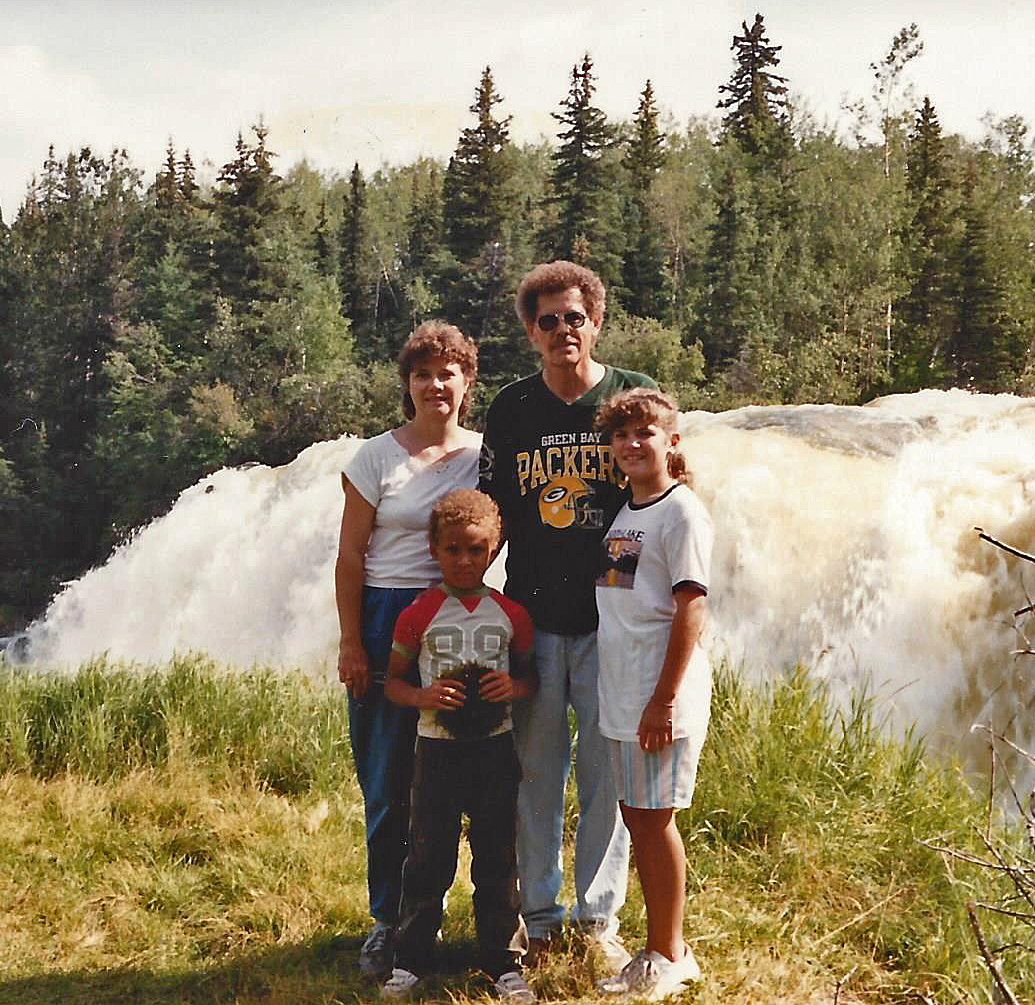
Johannessons at Pishew Falls MB 1988

And they didn’t live Happily ever after . . .

November 7, 1994

Dear Friends,

This September my husband Gus turned sixty. We wanted to celebrate as many families do, but the plans for our party were a bit different. His 60th “Toast and Roast” became the retirement party he never had and an affirmation of what he has meant to his family and friends while he is still able to appreciate it.

On the day of festivities we presented him with a book of remembrances gathered from friends and relatives around the world. This book is a tribute to Gus’s life as well as a tool for memory as he copes with his illness.

Two years ago Gus was diagnosed with Alzheimer Disease. I can’t say that our lives immediately changed. The disease doesn’t change your life overnight, but has over a number of years changed every aspect of our lives. To date, the cause of AD is unknown, there is neither cure nor definite treatment; it is progressive and will eventually be terminal.

It is incredible the emotional upheaval we all have been through these past years. All four of us have had counselling and hope that it remains available whenever we need it. The family has found comfort, relief, professional information and fellowship in support groups for adult caregivers, a children’s support group, the early stage support group, numerous educational sessions, and from Alzheimer staff and volunteers.

The Alzheimer Society of Manitoba has been able to provide these services because of people like you. I am happy to have this opportunity to personally thank you and let you hear firsthand how meaningful your help is for my family and many others.

It took a long time to really recognize that something serious was happening as Gus has always been a bit of the “absent-mined professor” type and we just figured he was getting more-so with age. This is not the situation. A man admired for his keen mind, having studied at the doctoral level in systematic theology has now forgotten how to tie a tie or manage the simple task of handling a sandwich. In happier days Gus was a Lutheran pastor giving support and guidance to others. Today he is on the receiving end.

Alzheimer Disease attacks the whole family. We are all hurting, angry, frustrated, scared; dealing with a tremendous loss.

Your roles change. I have had to become in as many ways as possible mother and father to my children and husband, directing all my energies outside of the workplace to the family. The children and I have become caregivers, not easy for an adult, let alone a twelve-year-old and seventeen-year-old. A caregiver’s day is often referred to as the “36-hour day.” That is how we live, each and every day.

As is typical with early AD, symptoms come and go resulting in good and bad days. So far Gus’s skills that are totally gone are writing, public speaking, driving, anything mathematical, and many deductive reasoning processes.

We thank God for the good days, for the patience that we are learning, for on-going medical research, for the help offered by the Alzheimer Society and most of all, for the prayers, love, help and support of family and friends.

Our family includes you when we say “Friends.” You probably don’t know us personally, but as a supporter of the Alzheimer Society you help make each and every day a little bit brighter, a little bit easier.

Once again, thank you for making our lives happier. Please continue your needed support. It is your caring and generosity that makes the difference!

With our sincere appreciation,

Gayle Johannesson

P.S. The number of families coping with the devastating reality of Alzheimer Disease is expected to at least double in the next decade.


CANADIAN EX-PATS AND A POODLE CELEBRATE ROBBIE BURNS’ DAY IN MEXICO

CANADIAN EX-PATS AND A POODLE CELEBRATE ROBBIE BURNS’ DAY IN MEXICO

This slideshow requires JavaScript.

Robbie Burns’ Day is fast approaching on January 25th. I (Gayle) dug out my file and photos from an article I originally wrote in February 2005 when Ian and I were on our two-and-a-half year sojourn in Mexico. I’ve been put into a Scottish mood, having convinced Ian that we should attend this year’s Robbie Burns Dinner on Saturday, January 24th at the Ian at book reading in McKinnon kiltVernon Rec Complex sponsored by the Kalamalka Highlanders Pipe Band and the Arran Campbell Memorial Pipe Band here in Vernon, British Columbia. Last year Ian just didn’t feeling up to attending even after I altered his fairly new but way-too-big kilt (McKinnon clan tartan: McKinnon is the clan to which the Morrans family is a sept). The kilt was tailored for him several years ago when Ian had gained about 40 pounds while being treated with prednisone for almost five years. Once he went off the medication the pounds literally dropped off, which is what happened to his kilt as well once he tried it on for the second time! The above photo shows him in the McKinnon tartan kilt while it still fit. In the story that follows Ian is wearing his old kilt, a hand-me-down in the Royal Stewart tartan that Ian received from his former sister-in-law. (Not the correct tartan for him, but a Scotsman can’t pass up something free, and he was thrilled to get his own kilt at the time.)

This time it is I (Gayle, the blogger) who is acting as the Scottish Canadian author. To set the scene, we had set up temporary quarters at a small RV park on the shores of Lake Chapala, Mexico’s largest lake, in the mountainous part of central Mexico south of Guadalajara. It just so happened that all the other RVers in that park were fellow Canadians and a few of them had Scottish heritage as well. We met weekly for a specially catered dinner in the RV park’s lounge and had decided that it would be fun to have a Robbie Burns’ Dinner on a day close to his birthday. Ian and I had brought our kilts with us and the rest of the company improvised. You will note that I refer to Ian as “Scotty”, the name he became known as amongst our Mexican and ex-pat friends. After the event we met the editor of a local ex-pat on-line magazine and she asked me to submit an article telling of our unique evening. Here is the result, completed  by the slide-show of photos at the start of this blog post to document our party.

Article originally written for  an e-zine: Mexico Insights, published in Ajijic, Mexico, February 2005.

Roca Azul RVers Celebrate Scotland’s Robert Burns
by Gayle Moore-Morrans

Throughout the world on Robbie Burns’ birthday, (January 25), Scots, those of Scottish ancestry, various Scottish “wannabees” and poetry enthusiasts gather to celebrate the immortal memory of Scotland’s national bard. Not to be outdone, 18 Canadians residing at or near the Roca Azul recreational vehicle (RV) site on the western shore of Lake Chapala enjoyed a traditional Burns’ Night complete with tartans, pipe music, haggis and Scotch whisky, as well as recitations and singing of some of Burns’ famous poems.

Our illustrious director and entertainer was none other than fellow RVer Ian “Scotty” Moore-Morrans, sometimes known as “Winnipeg’s Mr. Scotland.” Originally from Campbeltown on the Kintyre Peninsula, Argyll, Scotland, Scotty welcomes any excuse to don his kilt, sporran, skean dhu (Gaelic for “black knife”, worn in the stocking) and Argyll jacket, and break into a Scottish/Gaelic ballad or spin a highland tale. He has entertained at Robbie Burns’ Nights and other Scottish-flavoured gatherings over the years, including last year at the prestigious Fort Garry Hotel (Winnipeg) for the Cameron Highlanders 2004 Burns’ Supper. He is also an enthusiastic member of the international Robbie Burns’ Society.

A neighbour, Carmelina “Carmie” (McPherson) Bourner who hails from “New Scotland” (Cape Breton, Nova Scotia) and has spent a lifetime enjoying Scottish music, dance and tradition, agreed to serve as mistress of ceremonies for the evening. Other campers good-naturedly agreed to recite a Burns’ poem, give a traditional toast, bring along some appropriate recorded music or just come and participate in the festivities. The contributors quickly got down to business, digging through their CDs, writing up their pieces or rehearsing their poems while enduring Scotty’s coaching if they wished to attempt reading with a Scottish “burr.”

Then it was my turn. As Scotty’s fairly new wife, I’d been indoctrinated into the glories of my previously little-known Scottish heritage. After I’d learned countless Scottish tunes and attended various Scottish events over the past two years, Scotty called me to the ultimate task! “I’ve got a great idea, Gayle; you can make the haggis!” Okay, I’m a fairly accomplished and adventuresome cook – but, HAGGIS? I’d eaten some samples (one very good, some not so memorable) while trying not to dwell on a few of the traditional ingredients – namely, mutton, suet, sheep’s heart and “lights” (lungs) and the non-eaten casing which consisted of a cleaned-out sheep’s stomach! But I’m usually up to a challenge. Obviously, the one cookbook I had in the motorhome did not contain a recipe for haggis. So, laptop computer in hand, I headed for an Internet café and did a search for “Robbie Burns.” An array of sites appeared with all sorts of instructions for hosting a Robbie Burns’ Night, biographies of the bard, the texts of his poems and a section on haggis. After downloading and printing the haggis section, I studied the various recipes, ranging from an excerpt from The Scots Book of Lore and Folklore to “Lady Logan’s Receipt from 1856” to a beef haggis and an “Americanized” recipe that could be baked in a meatloaf pan. The latter sounded more to my liking. I headed for a carniceria (butcher shop) searching for ground lamb and lamb’s liver.

“No, Señora, we don’t carry ground lamb. But you could buy a five-pound leg of lamb and we can grind it for you.” I declined, saying I only needed two pounds of lamb so perhaps I’d have him grind up 1/2 pound of lamb chops and would substitute ground beef that I already had for the rest. With a sudden, “Uno momento,” he disappeared into the back room, shortly reappearing with a partial leg of lamb that could be ground and would make about 2 pounds! Then I asked for lamb’s liver and was informed that the farmer who supplied their lamb meat sold all the innards to someone else. Okay, did they have any pork liver then? No, they had only beef liver (which I’ve been warned against in Mexico) and chicken liver (which I hate). My eyes rested on some pork pâté and I decided that would make a good substitute. With an added pound of not-so-lean hamburger (my “acceptable” substitute for suet), my meat supply was complete. To that I added minced onion, egg, oatmeal and about 4 times the amount of paltry spices that the recipes called for – nutmeg, ginger and cloves. The day of our Burns’ “do” the campground was treated to a delicious aroma emanating from the motorhome that flew the rampant lion flag of Scotland. At least we would be treated to something authentic in the way of a traditional menu for a Burns’ Supper.

That brings up the problem that Pat, our weekly communal dinner organizer, faced in trying to communicate with the Mexican cook about the proper menu for such an occasion. Most Burns’ suppers start out with cockaleekie soup. Then roast beef is served along with the haggis, complimented by “tatties” (potatoes), a rich beef gravy, green peas and “neeps” (mashed turnips). A typical dessert would be a fruit/cream/whisky-laced trifle. Pat and I were pretty sure that turnips were not available in Mexico so our recommendation was for the cook to prepare a chicken soup, some sort of beef, potatoes and other vegetables and leave the dessert up to her. The results proved interesting – but I’m getting ahead of the story.

Dressed to the nines in our kilts and laden with haggis and whisky, Scotty and I arrived at the clubhouse to the “oohs” and “aahs” of the other campers.  Pat had decked out the table with red and white flowers and a big tartan bow. Matching them was Carmie, our MC, dressed all in white with a nice Royal Stewart tartan sash. After seeing that all had a toast glass of Scotch, she invited us to the table. With her opening remarks she explained the background of Burns’ Suppers, that we were joining people all around the world on this day to commemorate Scotland’s most venerated poet in celebrations, poetry readings and song. We were invited to receive the haggis by standing and clapping time to the pipe music. Then Carmie joined our four-person parade to “Pipe in the Haggis.” As the “chef,” I had the privilege of carrying in the haggis, followed by everyone else present who wore a tartan – in this case, Scotty, Carmie and her husband Richard in his version of a Scottish RVer, resplendent in shorts, white shirt and tartan tie. At the “skirl” of the pipes, we did a complete circle of the banquet table and then took our places at its head. Then began the most important element of a Burns’ supper – the recitation of Burns’ “Address to the Haggis.”

Knife poised in mid-air, Scotty began: “Fair fa’ your honest, sonsie face, Great Chieftain o’ the puddin-race . . .!” A few verses later he enacted the verse while stabbing into my luscious creation: “His knife see rustic-labour dicht, An’ cut you up wi’ ready slicht, Trenching your gushing entrails bricht, like onie ditch; And then, O what a glorious sicht, warm-reekin, rich!” Finally ending this slightly unintelligible (for most of us) poem with “Auld Scotland wants nae stinking ware that jaups ‘n’ luggies; But, if you wish her gratefu’ pray’r, Gie her a Haggis!” he lifted his whisky glass and invited everyone to stand and toast the haggis. “To the haggis, Slainte Bha!”  (pronounced Slanje va – Gaelic for “good health!”)

Next on the program was Richard Bourner who imparted some brief but witty remarks about the manufacture of single malt Scotch whisky, to which we also stood for another wee dram and “Slainte Bha!”

After Scotty prayed Burn’s “Selkirk Grace” (“Some ha meat and canna eat; Some wad eat but want it. But we ha meat and we can eat and tae the Lord be thankit.”), “The Meal” followed.

We first enjoyed a delicious tomato soup while our hosts tended the outside barbeques – roast beef had become Biftec. That’s where any similarities to the traditional meal stopped. The steaks were accompanied by prickly pear cactus leaves and a medley of creamed, cubed white vegetables – probably peeled zucchini and celeriac. The meat varied from nearly tender to “shoe leather quality.” As each plate was served I went around the table to add a small portion of haggis. Some were a bit hesitant at first, having heard all sorts of disparaging remarks about it. After tasting the steaks, however, the haggis became more popular. In fact, the dish went around the table three times and I finally put the last two pieces aside so that Scotty could have a “wee drop” for breakfast the next day!

Following our fruit cup dessert, we retired to the camper’s recreation room to begin our ceilidh (pronounced kaylee), a Scottish celebration where everyone has a chance to contribute to the program – through song, dance, recitation or whatever. Al Laplante gave the traditional speech “To the Immortal Memory,” in which he outlined how Robbie Burns’ deep love for Scotland fired his ambition to write in the Scottish vernacular, resulting in the creation of a unique brand of poetry, full of character, integrity, humour, satire and lyrical harmony. Even though he only lived from 1756 – 1796, his popularity is still on the increase two centuries after his poems first appeared.

After Scotty treated us to a musical rendition of Burns’ well known, “Flow Gently, Sweet Afton,” it was time for Bryan St. George to present the “Toast to the Lassies.” He mentioned that, though we women present came from a variety of different backgrounds, for this evening we were all “lassies” – more specifically “RV lassies” – and that we were particularly to be recognized for making comfortable homes for our men despite our small living quarters. Then it was time for the “Response to the Laddies.” Linda Rae responded by inviting all the lassies to raise their glasses in toast to all the men present who had such good taste in women!

Continuing on with our poetry readings, Pat Laplante gave a good attempt at a Scottish “burr” while reading “Coming Through the Rye.” Ian Rae followed with a rendition of “For a’ That an’ a’ That,” Burns’ tribute to universal brotherhood which ends with the ringing, “It’s comin’ yet for a’ that, that man to man, the world o’er shall brithers be for a’ that.” Scotty and I sang, “Ye Banks and Braes o’ Bonnie Doon” and then we heard, “To a Mouse,” in which Burns, a farmer by trade, apologized to a wee mouse whose wee house his plow had disturbed – a good example of Burns’ search for universal meaning in the commonplace.

The evening concluded as Scotty led us through a singalong of Scottish songs, followed by some Scottish country dancing, an impassioned speech by Ross Hamilton about brotherhood and understanding amongst people and his demonstration of hand puppet “dancing” to a Scottish reel.

In the words that my hometown newspaper used to end all party reports: “A fine time was had by all!” Oh – I almost forgot! Our wee dog, Peppy, who accompanies us almost everywhere, joined us for the ceilidh portion of the evening. He slept through most of it but when it came time to join hands around a circle to sing “Auld Lang Syne,” Peppy decided to participate. Trotting into the circle, he took up his begging stance on hind legs with front paws pleadingly chopping the air. Scotty and Ross separated their hands, each taking him by a front paw, and we continued our singing and circling. As the Brits would put it, Peppy was “as happy as Larry!” Another Scottish wannabee!