The Scottish Roots of Curling

The Scottish Roots of Curling

Andrew McDiarmid has shared on his Simply Scottish blog this fascinating account of the origins of the sport of curling. Thanks for posting this Andrew. We are also enjoying tuning in to your “Sport in Scotland” series on your PodOmatic broadcasts on Simply Scottish.

It has been great watching both the CANADIAN MEN’S AND WOMEN’S OLYMPIC CURLING TEAMS take the GOLD MEDALS at the Sochi Olympics. We are also sharing this in honour of our son-in-law, Eugene (Carl) German of Winnipeg who is also a champion curling skip.

Andrew McDiarmid's avatarThe Simply Scottish Blog

Like a number of sports, the origins of curling are up for some debate. After all, who can say which person or people group were the first to enjoy skimming stones across frozen water? Because of the conditions needed, it seems a sure bet that it originated in a northern European country. Wherever it began, few will dispute the fact that the pastime developed into a modern sport in Scotland.

The first evidence of such a game in Scotland was uncovered when an old pond was drained in Dunblane. Two curling stones were found bearing the years 1511 and 1551 on them. Written evidence from 1540 records what seems to be a legal dispute that was settled on the ice between John Sclater, a monk in Paisley Abbey and Gavin Hamilton, a representative of the Abbot. The word curling appears in the work of Scottish poet and historian Henry Adamson…

View original post 433 more words

An “Eye Opener” Review of “From Poverty to Poverty”

An “Eye Opener” Review of “From Poverty to Poverty”

The following review appeared on Amazon.ca for Ian’s memoir, “From Poverty to Poverty: A Scotsman Encounters Canada.” Thanks to author Harry G. Kapeikis for his “eye-opening” review. (The emphases below are ours.)

4.0 out of 5 stars Harry G. Kapeikis October 13, 2013Cover full size
 
I thought I had it tough as a boy refugee during, and as a displaced person after World War II. Peanuts on that!
 
Just read Moore-Morrans’ memoir of his growing up years in Campbeltown, on the Kintyre peninsula, Argyllshire on the west coast of Scotland during the Great Depression. Ian adds or better said, subtracts from my concept of poverty to give it horrifying dimensions. “Yes, we were destitute!” he writes. “…we were, without doubt, the poorest family in that little town. – “…we were the poorest, by far, for no one else in our town lived in such pathetic conditions as we did.” Home, was a 10 foot square room in an attic of a run down house, practically unfurnished and most of the time unheated. Clothes? Best described as rags. It was not until Ian enlisted in the Royal Air Force at age 18 that he discovered “what it was like to have a full belly of half-decent food”. Get away from it all. Australia? Best to go to Ontario? Canada? Yeah, sure. Be brave and read on.
 
My immigration to North America was like a Cinderella experience but Ian’s more like a nightmare. Starting with misunderstanding and misrepresentations of what to expect in Canada from certain Ontario government agents to watching their belongings get dropped to the ground by a malfunctioning crane, smashed at their port of entry, all in all made Moore-Morrans’ immigration a “…Poverty to Poverty” ordeal. The Morranses, a family of four now, Mom (Mary), Dad and two daughters (Audrey and Shirley) finally did manage to purchase a new home at Hillsburg, Ontario in 1970.
 
“We’ve come a long way,” he writes. Indeed they had come a long way in many and varied ways on a road resembling an obstacle course. I was fortunate, but many an immigrant will identify with Moore-Morrans’ experience. I dearly recommend Ian’s book. An eye opener for sure.
 

Note: Harry G. Kapeikis, a fellow British Columbian, immigrant to Canada and self-publisher, is the author of two excellent published memoirs entitled “Exile from Latvia: My WWII Childhood from Survival to Opportunity” and “Beyond All Dreams: Coming of Age in Post-War America.”

Tracing Your Ancestry – Start with an old family photo

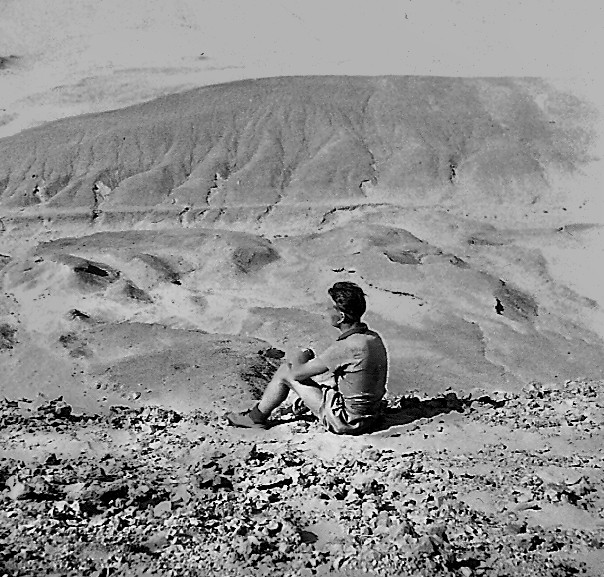
In my opinion, Egypt consisted of nothing but a whole lot of dirty sand. I'm looking over the sand dunes, 1951.

In my opinion, Egypt consisted of nothing but a whole lot of dirty sand. I’m looking over the sand dunes, 1951.

How exciting to have strangers check us out online!  It’s even more exciting when they write to us out of the blue, assuming that we might be able to give them some guidance on a subject that drew them to us and that is of interest to them. Ian received such an email this week because he has written in his memoir “From Poverty to Poverty: A Scotsman Encounters Canada,” about his time serving in the British Royal Air Force in pre-Suez Canal Egypt, 1951-1953. We’d like to share some of this correspondence in case others are thinking about searching out their family history and are wondering where they might start.  Luckily, Ian and I both have cousins who have done considerable research on some of our family histories – in both cases, those of our mothers’ families. We are grateful for all the work these cousins have put into answering a lot of questions about our heritage. Here is the gist of this most recent correspondence:

From ‘A.’ in West Kelowna, British Columbia:

“Hi Ian. I just happened upon your site and book title in the beginning of my search for my family history – all generated by finding a 3.5×5″ photo of my Great Grandmother immigrating to Vancouver, Canada from Aberdeen, Scotland in 1925. On the back of the photo, is written that she came (along with her husband and two small children) aboard the Montcalm freighter ship through the Suez Canal.

 “I’m wondering if by chance you could advise or direct on where I might find more information on the Montcalm. Also, where am I able to purchase your book? I would like to be able to put this photo into some sort of context, though I realize she came to Canada 40 years before you did. .…

 “Thank you for your time and I love the photo of you and your wife on your profile page. 🙂

 Sincerely, ‘A.’”

And, here is our answer:

“Dear ‘A.’

“This is Ian’s wife, Gayle answering. Ian is 81 years old and not in the best of health, so I do most of the work on editing his yet-to-be-published books, negotiating with the publishers, publicizing and marketing and also maintain our blog at www.http://ianmooremorrans.com.  You can order any of his books by going to that listed blog and being directed to the proper site for ordering. You could also take a drive north to Vernon to visit us and buy the book from us, signed by the author – your choice. The cost from us is $20 (no postage, if you pick it up). Thanks for your interest.

“What a pleasant surprise your email was! It sounds like the photo you found has opened up a whole new world of discovery of your family history. I’d recommend you google the Library & Archives Canada site and then go to the passenger lists for ships arriving in Vancouver in 1925. They are on microfilm and you can access them right on the internet.      

“For information on travel on the Suez Canal, google something like “travel through the Suez Canal in the 1920s” or even “British travel through Suez Canal to Canada.”

“I think you’d find Ian’s memoir “From Poverty to Poverty: a Scotsman Encounters Canada” quite interesting and maybe enlightening on the period when Britain was controlling the canal. Ian was there while serving in the Royal Air Force from 1950-1953, just before the Suez Crisis when the canal was seized by the Egyptians under Nassar. There, Ian had a unique view of the tensions involved with the Brits controlling the canal in someone else’s country. He also has quite a few photos in the book connected with his time in Egypt – and a few rather wild stories!

“All the best for your research on your family history. Perhaps we will have an opportunity to meet you sometime in the future. Feel free to write again if you wish.

 “Regards, Gayle Moore-Morrans”


Now, if you are interested in researching your family story and if you are lucky enough to have access to photos of, letters by or documents concerning those ancestors who might have been immigrants to the country you live in, dig those photos, letters and documents out of their resting places and have a go at the internet. The quest can be quite enlightening, satisfying and addictive. Your local genealogy society is a good source of guidance as well.

ALL ABOUT THE “REAL” JIMMY, AN EXCERPT FROM “CAME TO CANADA, EH?”

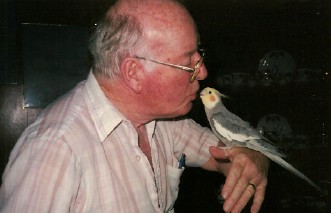
As I (Gayle) am preparing chapters of Ian’s children’s chapter book “Jake, Little Jimmy and Big Louie” to blog, I’m also working on my second (and I hope final) edit of the sequel to Ian’s already published memoir: “From Poverty to Poverty: A Scotsman Encounters Canada.” I’ve already blogged an excerpt from the sequel which we have named” “Came to Canada, Eh? Continuing a Scottish Immigrant’s Story.” Today I’ve just completed editing a section in which Ian describes receiving his real-life bird, a cockatiel he also named “Jimmy.” I thought it might be appropriate to blog this section to give readers an insight into some of the things Ian learned about raising a bird and teaching it to speak and whistle. He later added some of these ideas to the children’s story that is now “Jake, Little Jimmy and Big Louie.” You will notice that certain things Ian experienced with his cockatiel Jimmy later were used in the characterizations of Little Jimmy and also of Big Louie. I’m also including a 1998 photo of Ian and Jimmy, the cockatiel.

Ian and Jimmy

Excerpt from “Came to Canada, Eh? Continuing a Scottish Immigrant’s Story”

by Ian Moore-Morrans

edited by Gayle Moore-Morrans

Copyright © 2013

“Mary and I went down to Winnipeg to spend Christmas with Audrey and Eugene and our three grandchildren, Tammy, Calan and Ainsley in 1997. Then, since Mary and I had been married on the 29th of December, we returned home to Creighton to celebrate our anniversary. We were at Shirley and Brien’s house for a quiet evening on our wedding anniversary when Shirley suddenly appeared carrying a great big bird cage.

” Inside was a beautiful, young cockatiel. He and the lovely cage were being presented to us from our two daughters, their husbands and all five grandchildren, including young Ian and Tiffany. I was invited to take the bird out of its cage and hold him on my hand. He came with no bother and Shirley asked me what I was going to call him (it). Without any hesitation I said ‘Jimmy’ (after the little budgie in my unpublished children’s book, not caring what sex the bird was!). He was such a lovely surprise gift for both of us. And he really was a ‘he’, we found out later.

“Jimmy took quite a lot of looking after, for I had to feed him egg almost continuously, and clean his cage almost continuously, too! He was on the egg diet a long time, longer than he should have been. Brien had obtained Jimmy from a friend at work who bred them. From what Brien learned, Jimmy should have been on seed when he was still enjoying his egg. I had bought some seed for him, but he didn’t seem ready for it. When I was cooking for him, I would generally put two, sometimes three eggs in the pot and boil them hard, storing them in the fridge, for Jimmy seemed to be always hungry. I would cut off a little bit and wrap the remainder for later, making sure that Jimmy also got some of the yolk (that is what he went for first) along with some white.  In the beginning I’d chop the egg up for him, but I soon found that doing so was a complete waste of time, for his little sharp beak would slice through the soft egg just like butter.

“Soon I set about teaching the bird things to say and whistle. Being a musician, I don’t think it is bragging to say that I’m a pretty good whistler as I’m able to do quite a bit of fancy stuff like grace notes, triplets, warbles and different things—a lot of stuff that I did on the trumpet.  Soon our bird was saying ‘Jimmy’s a good boy’ (just like in my little story), ‘Hi Ian, wot’s up?’, ‘Hello, Mary’, ‘I love Shirley’ and so forth. He also started whistling the verse of “Bonnie Jean” from Brigadoon that I was rehearsing for my solo at our upcoming concert in Flin Flon. (I didn’t teach him this, he just picked it up while I was whistling it around the house and going through the words in my head.) In addition, I taught him to whistle the first part of ‘The Mexican Hat Dance’; the bugle call that goes, ‘You gotta get up, you gotta get up, you gotta get up in the morning’; a series of notes from a ‘custom’ car horn, and a silly something we used to sing in Scotland when I was a wee boy that ended with ‘Wee Bobby Geachy’s……white drawers.’ The latter bit used the popular rhythm that everyone knows: ‘Dah Dahdah  DAH  DAH…dah dah!’ However, what I taught Jimmy varied in that I substituted a wolf whistle for the last two notes (the last ‘dah dah’). Jimmy really did it superbly. (Sometimes I would whistle the first bit and he would answer with the wolf whistle and other times it would be reversed, with Jimmy starting it off.)

” Jimmy really performed to perfection the day I was dressed in my kilt just prior to leaving the house for the dress rehearsal of the show I was in. Jimmy’s cage was in the dining room and as I passed the door opening that would allow him to see me, he went, “Wheeet-wheeoo”—a perfect, long, wolf whistle.  I burst out laughing. It was like he did it intentionally, his timing was so right. My answer was, ‘Hey, funny guy. You’ve never seen a Scotsman in a kilt before?'”

Installment 7 of “Jake, Little Jimmy and Big Louie,” a Children’s Chapter Book

Thanks to everyone who has contacted us through WordPress or email saying that they are enjoying our blogging of Ian’s children’s chapter book, “Jake, Little Jimmy and Big Louie.”  We’re still glowing from our great-grandson’s very positive endorsement of the book so far. I, Gayle, will try to be more diligent in getting the rest of the book’s chapters blogged (now that I am off crutches and my new hip is healing nicely) so that we will be able to get into production of the children’s book, hopefully by late spring.

At the same time as this book is being blogged, I’m deep into editing the next volume of Ian’s memoir or autobiographical stories which we are calling “Came to Canada, Eh? (Continuing a Scottish Emigrant’s Story.)” Those of you reading this blog would perhaps be interested in reading an excerpt from that as-yet-unpublished book which tells of Ian’s beginnings as a writer. He began with this very children’s book that we are now blogging.

To set the scene, Ian and his late wife have just moved back to Winnipeg (again). Ian is 63 years old and deciding to finally do what he has always wanted to do but never before found time for. Here’s a excerpt from “Came to Canada, Eh?”

“My whole life I had always wanted to write stories, but the situation was never the way I wanted it to be. Whenever, for example, I wrote a letter to anyone in the Old Country, I would end up sending about 14-16 pages—and I would get one page in reply. Finally, at age 63, I said to myself, ‘Ian, if you don’t start to write now, then you’ll never do it.’ So I sat down and, over a period of three evenings, wrote ‘My Friend Jimmy’. It was a children’s story about a budgie that had no wings—just 16 pages. But I had to write everything longhand. I asked Audrey [our daughter] to keep her eyes open for an old, cheap electric typewriter for me.

“’What do you want an electric typewriter for, Dad? You’ll be wasting your time. Why don’t you get a cheap computer; that’ll do the same thing only better for you?’

“Oh, that was a terrible word to use in front of an old codger like me—a computer? Sudden terror at the thought of even having one in front of me! Well, she eventually managed to convince me that that is what I should get. ‘You can pick one up dirt cheap, Dad. Do you want me to look for one for you?’

“It was a 286, black and white monitor, no hard drive, just two 3.5” floppy disks; but it was a start. I then became a little more ambitious—going to the library and getting out one of those foldout learn-to-type books that stands upright on edge (like a pyramid) and I started to learn to touch type. Me, an old . . . well, something. And I was improving too—starting to type simple sentences without looking at the keyboard. Pretty soon I got myself a 386 computer, then later it was up to a 486, and then a Pentium! Hey, who was that guy who said that the 286 was all he would ever need? I got the Mavis Beacon typing course (on a CD) and was able to calculate that I was up to more than 20 words a minute, even allowing for errors! ‘Not bad for an oldie,’ I thought.

“While I was improving on my typing, I rewrote my children’s story, and kept editing it until it started to look a lot better. I changed some of the contents and then sent it away to a publisher, knowing full well that he would grab it and tell me that it was the very best children’s story he had ever read. … Some hope! Soon I could just about paper the wall with rejections. ‘Never mind,’ I thought, ‘where there’s life, there’s hope.’ I put the story on file and went on to write other stories, thinking that I’d give “My Friend Jimmy” a try again at a later date. (Little was I to know that the later date would be lots later—about 17 years!)”

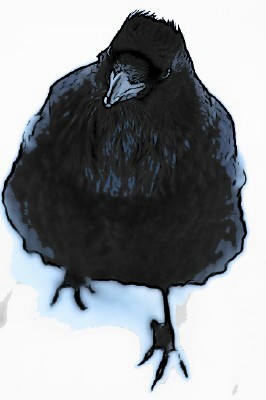
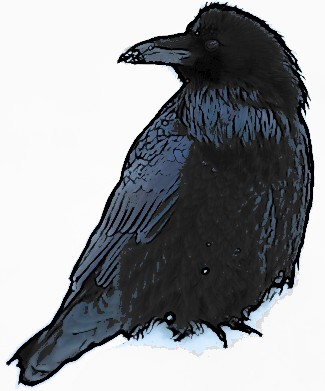
Much has happened since the years those words were written. Since then Ian was widowed, then remarried – this time to me (an editor). So we’ve now published three books and hope to have this children’s book finally published before long. Below is our blog of Chapter 7 plus two drawings we found on the computer of an “adolescent” raven whom Louie might have resembled.

Raven 1 Raven 2

“JAKE, LITTLE JIMMY AND BIG LOUIE”

by Ian Moore-Morrans

edited by Gayle Moore-Morrans

Copyright © 2012

CHAPTER SEVEN

Louie Gives Jake a BIG Problem

The next day was Saturday. Jake was at his local library first thing in the morning, waiting for the doors to open. Once inside, one of the staff helped him look for books about birds.

(The rest of the chapter’s content has been deleted prior to publication.)

* ~ * ~ *

Picture suggestions:  Louie standing on the ground and “talking” while looking up at Jake and Jimmy, who is on Jake’s shoulder.

Louie flapping his wings.