“Why I Write – My Writing Journey” – AN INVITATION TO VOTE AGAIN FOR IAN MOORE-MORRANS, A FINALIST IN THE AUTHOR’S SHOW CONTEST “50 GREAT WRITERS YOU SHOULD BE READING”

Seal-2013Finalist-300On September 18, 2013 we blogged an invitation to vote for Ian Moore-Morrans as he entered the first phase of The Authors Show 2013-1014 contest “50 Great Writers You Should Be Reading” which ended on November 1st.  We greatly appreciate any and all votes cast. Enough of you did vote for him so that now Ian is a finalist in the second (and final) phase of the contest. This is an invitation to AGAIN VOTE FOR IAN in this final phase.

Here is the information from Danielle Hampson, Executive Producer of The Authors Show:

The final phase of our contest is now open for voting through December 1, 2013. The top fifty authors with the most votes will be included in the 4th edition of  “50 Great Writers You Should Be Reading” to be published in January 2014.  A special prize will also be awarded to the top winner in each book genre: Fiction, Nonfiction, Children and Christian.  To view the names of all the finalists and to vote for your favorite author in our final phase, go to: 

http://www.wnbnetworkwest.com/WnbAuthorsShow50Writers2013-Contest-Finalists.html.”

Thanks in advance to those of you who will cast a vote for Ian. We are including a copy of Ian’s entry into the contest which asked for him to write about his journey as a writer. We hope you will enjoy it.

Best wishes,

Ian and Gayle Moore-Morrans

Why I Write – My Writing Journey

by  Ian Moore-Morrans

Author of From Poverty to Poverty: A Scotsman Encounters Canada

Folks remark that I have a gift for gab and storytelling. However, whatever free time I had was taken up by music-making. Important as it was to me, writing took a back seat to making music.

Though growing up in abject poverty in Scotland during the Great Depression, I was fortunate to attend school until I was 14. I liked learning and tried my best to do well in my class work. My English teacher had remarked about the quality of my essays and compositions. When she mentioned that I should become a journalist after I finished school, I found it an intriguing but totally impossible suggestion. I could only conclude, ‘What a picture that would be—me sitting at a desk with holes in my shoes and no underwear!’

When schooling was over, I had to find a job. Working as an apprentice to a local blacksmith, I had neither time nor energy to write, though I earned some money and built up muscle. My free time was spent learning to sing and play an instrument as part of the Salvation Army. Music-making became my passion.

Four years later I joined the Royal Air Force. Finally I had decent food, clothing and living conditions plus an opportunity to learn a trade—Flight Mechanic Engines—and to continue to play in a band. I served in England, Wales, Scotland and the Suez Canal Zone in Egypt. Being far away, I enjoyed writing letters home and hearing remarks about how exciting I made my life sound and how much folk learned from reading what I wrote. I was to benefit most by corresponding with my pen-pal. Mary and I kept up a steady correspondence and then met in Glasgow just after I returned to Britain. We were soon married.

Whenever I had a chance at work or leisure, I told stories when I wasn’t singing songs or playing my trumpet. I fancied myself an entertainer but never thought of trying to earn a living at it. After five years’ service, I left the RAF. Not only did I have a wife to support; we were soon blessed with two daughters. I found work as a machine fitter in the steel industry around Glasgow. After awhile I applied for a clerk’s job in a big steel company. When interviewed, the supervisor mentioned that one of the biggest problems in the job was reading what someone had written. He asked me to write the numbers from 1 to 10 and also spell each one out in longhand and then print the words in capital letters. “Very good” he said, “at least we’ll have one person whose writing is legible. When can you start?” I couldn’t believe that was the test! Soon, my “penmanship” earned me a better job as a shift scheduler.

Having been misled by the inflated promises of an unscrupulous Ontario official, we got “itchy feet” and headed for Canada. Arriving in 1965, we soon found that my promised machining job was not available, nor were we in a financial position to buy a house as we had been led to believe. After five years of misadventures finding and keeping jobs and suitable homes, we finally reached the level of prosperity we had had in Scotland.
My family and I continued to live and work in Canada, moving almost every year to a different house, town or province (and different band) as jobs came and disappeared. I never seemed to have time to write down my stories, though I told plenty of them, both true and made-up. Finally, in 1995 at age 63, I decided if I didn’t start writing, I’d never do it.

In longhand over three evenings, I wrote “My Friend Jimmy,” a children’s story about a budgie that had no wings. Then I bought a simple, used computer and studied a learn-to-type book. I rewrote my children’s story and sent it away to a publisher, thinking full well that he would deem it the very best children’s story he had ever read! Soon I could just about paper the wall with rejections. ‘Never mind,’ I thought, ‘where there’s life, there’s hope.’ I went on to write others, thinking that I’d give “My Friend Jimmy” a try again at a later date. (Now, 17 years later, my wife/editor is starting the layout for “Jake, Little Jimmy and Big Louie,” a highbred of the original story!)

Next, I tackled my life’s story. Several times I’ve encountered people who heard my Scottish “burr” and then told me of Scottish ancestors. After inquiring, I would hear they had died and the family didn’t even know where in Scotland they had originated. Finally, I vowed to write my life story to avoid that state. Thus began the long process of remembering and writing into the wee hours of the night over the course of several years. I ended up with two volumes called “From Poverty to Poverty” and “Came to Canada, Eh?” Again, I submitted manuscripts which were politely rejected.

In 1984, I taught an adult class for men who had metal-cutting lathes and wanted to learn how to better use them. I loved this first and only experience of formal teaching. Later, I wrote a “how-to” book about machining steel, written for the type of people I had been teaching. Completed in 1998, I called it “Metal Machining Made Easy.” I did all of the 60-odd illustrations by hand. This was published in 2002 through Writers Exchange in Australia.

Shortly thereafter, my wife Mary died. I vowed to go on with life, continue to write but also to socialize and enjoy what time I had left. Then came the most significant encounter of my life. I started a conversation with an attractive widow about the eclectic assortment of stories I had begun writing after retirement. When I learned that Gayle was working as a magazine editor, I began to envision a future of our living and working together. We married in 2003 and, after she took an early retirement, we bought a motor home and set out to explore Mexico. While basking along Mexico’s Pacific coast, Gayle started editing my stories while I sat at the laptop and did re-writes, as well as writing a story of revenge called “Legal Hit Man.” Later moving inland to the mountainous north shore of Lake Chapala, we became residents of the world’s largest community of English-speaking expatriates. We joined the local writers’ group and met some wonderful writers from around the world. Soon my short story, “The Moonlit Meeting,” was published in a local magazine.

We returned to Canada in 2007 and now live in British Columbia. We have since published two books with a Scottish flair—a novel of adventure and time-travel, “Beyond the Phantom Battle: Mystery at Loch Ashie” and my memoir “From Poverty to Poverty: A Scotsman Encounters Canada.”

Age has caught up with me. When I first started seriously writing, I sketched out a few notes and went to work with everything flowing fairly smoothly. I kept going at all hours and wherever I was. At present, after over five years of illness, it’s becoming harder to find the energy to write. Luckily, I have a number of manuscripts waiting for Gayle to work on. Then I read through edits, give my approval or comments, and let her do the rest. Aren’t I fortunate?

AN INVITATION TO VOTE FOR IAN – 50 GREAT WRITERS YOU SHOULD BE READING

50 GREAT WRITERS YOU SHOULD BE READING – An Invitation to Vote for Ian Moore-Morrans

We are posting today because you may have received word in the past of our publication of Ian’s memoir, From Poverty to Poverty: A Scotsman Encounters Canada. Perhaps you have ordered a copy of the book, received it as a gift, attended one of our book readings, read a borrowed copy, intended to buy a copy and never got to it, heard about it on Facebook or on this blog, and/or listened to Ian’s interview on The Author’s Show radio program online. Now we are announcing that Ian has entered a contest through The Author’s Show entitled 50 Great Writers You Should Be Reading. We invite you to go to the following link:    http://www.wnbnetworkwest.com/WnbAuthorsShow50Writers2013-Contest-submissions.html     and check out Ian’s essay. The entries are listed alphabetically. Then, if you wish (and we hope you do) click on the voting link and vote for Ian.

Voting for the finalists phase is on now and will end on November 1, 2013. These votes come from the public that is being made aware of the contest through the combined efforts of The Authors Show’s ongoing marketing campaign and word put out by the authors themselves – in other words, by us. Our friends and family members are, of course, allowed to vote, as well as anyone else who wishes to do so. Both of us would really appreciate your vote.

Those named to the 50 Great Writers You Should Be Reading for 2013/2014 will have their essays published in a book with that title. We’ve checked out some of the essays in the 2012 edition and find them fascinating, a great way to get introduced to a new book and a unique way to find out all about what makes authors tick and why they write. After conducting hundreds of interviews, it became apparent to the producers of The Authors Show that the number one issue common to most writers is the marketing of their books, rather than the writing and the production of the book itself. Boy, have we ever found that to be true! At least Gayle has. (Ian is sitting back and resting on his laurels, if that’s what you want to call it!)

As “THE AUTHORS MARKETING POWER HOUSE”, The Authors Show prides itself in giving authors a number of tools, many of which are free, to give their work the exposure they need.  50 Great Writers You Should Be Reading, gives these writers an added element for their book marketing campaign tool box, and presents to the reader some of the best writers this new world of publishing has to offer.

On a further note, we haven’t posted for quite a long time as Gayle has been in Norway visiting her family there and Ian has been in respite at a local care home. Now we are back at home and Gayle is beginning the layout of Ian’s children’s book, Jake, Little Jimmy and Big Louie which we have posted chapters of on this blog and which we hope to publish soon. If she works hard and fast enough it might even be ready for Christmas. We’ll keep you posted.

Best wishes to all,

Ian and Gayle Moore-Morrans

Tracing Your Ancestry – Start with an old family photo

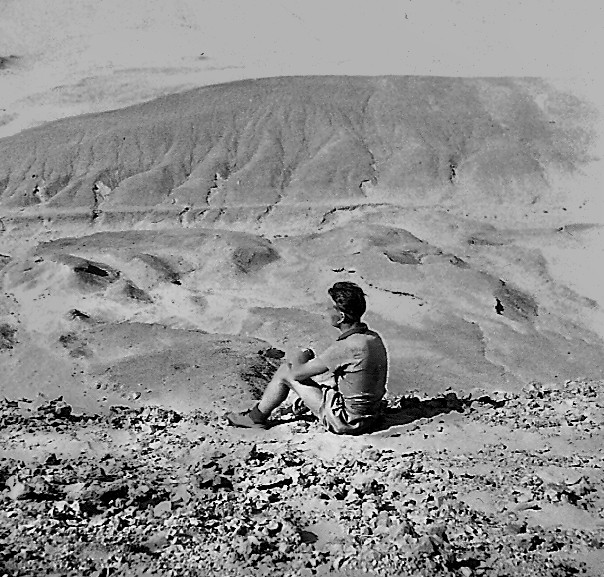
In my opinion, Egypt consisted of nothing but a whole lot of dirty sand. I'm looking over the sand dunes, 1951.

In my opinion, Egypt consisted of nothing but a whole lot of dirty sand. I’m looking over the sand dunes, 1951.

How exciting to have strangers check us out online!  It’s even more exciting when they write to us out of the blue, assuming that we might be able to give them some guidance on a subject that drew them to us and that is of interest to them. Ian received such an email this week because he has written in his memoir “From Poverty to Poverty: A Scotsman Encounters Canada,” about his time serving in the British Royal Air Force in pre-Suez Canal Egypt, 1951-1953. We’d like to share some of this correspondence in case others are thinking about searching out their family history and are wondering where they might start.  Luckily, Ian and I both have cousins who have done considerable research on some of our family histories – in both cases, those of our mothers’ families. We are grateful for all the work these cousins have put into answering a lot of questions about our heritage. Here is the gist of this most recent correspondence:

From ‘A.’ in West Kelowna, British Columbia:

“Hi Ian. I just happened upon your site and book title in the beginning of my search for my family history – all generated by finding a 3.5×5″ photo of my Great Grandmother immigrating to Vancouver, Canada from Aberdeen, Scotland in 1925. On the back of the photo, is written that she came (along with her husband and two small children) aboard the Montcalm freighter ship through the Suez Canal.

 “I’m wondering if by chance you could advise or direct on where I might find more information on the Montcalm. Also, where am I able to purchase your book? I would like to be able to put this photo into some sort of context, though I realize she came to Canada 40 years before you did. .…

 “Thank you for your time and I love the photo of you and your wife on your profile page. 🙂

 Sincerely, ‘A.’”

And, here is our answer:

“Dear ‘A.’

“This is Ian’s wife, Gayle answering. Ian is 81 years old and not in the best of health, so I do most of the work on editing his yet-to-be-published books, negotiating with the publishers, publicizing and marketing and also maintain our blog at www.http://ianmooremorrans.com.  You can order any of his books by going to that listed blog and being directed to the proper site for ordering. You could also take a drive north to Vernon to visit us and buy the book from us, signed by the author – your choice. The cost from us is $20 (no postage, if you pick it up). Thanks for your interest.

“What a pleasant surprise your email was! It sounds like the photo you found has opened up a whole new world of discovery of your family history. I’d recommend you google the Library & Archives Canada site and then go to the passenger lists for ships arriving in Vancouver in 1925. They are on microfilm and you can access them right on the internet.      

“For information on travel on the Suez Canal, google something like “travel through the Suez Canal in the 1920s” or even “British travel through Suez Canal to Canada.”

“I think you’d find Ian’s memoir “From Poverty to Poverty: a Scotsman Encounters Canada” quite interesting and maybe enlightening on the period when Britain was controlling the canal. Ian was there while serving in the Royal Air Force from 1950-1953, just before the Suez Crisis when the canal was seized by the Egyptians under Nassar. There, Ian had a unique view of the tensions involved with the Brits controlling the canal in someone else’s country. He also has quite a few photos in the book connected with his time in Egypt – and a few rather wild stories!

“All the best for your research on your family history. Perhaps we will have an opportunity to meet you sometime in the future. Feel free to write again if you wish.

 “Regards, Gayle Moore-Morrans”


Now, if you are interested in researching your family story and if you are lucky enough to have access to photos of, letters by or documents concerning those ancestors who might have been immigrants to the country you live in, dig those photos, letters and documents out of their resting places and have a go at the internet. The quest can be quite enlightening, satisfying and addictive. Your local genealogy society is a good source of guidance as well.

ALL ABOUT THE “REAL” JIMMY, AN EXCERPT FROM “CAME TO CANADA, EH?”

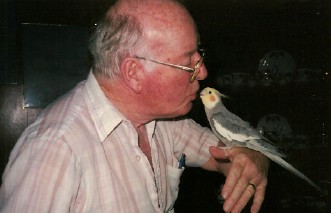
As I (Gayle) am preparing chapters of Ian’s children’s chapter book “Jake, Little Jimmy and Big Louie” to blog, I’m also working on my second (and I hope final) edit of the sequel to Ian’s already published memoir: “From Poverty to Poverty: A Scotsman Encounters Canada.” I’ve already blogged an excerpt from the sequel which we have named” “Came to Canada, Eh? Continuing a Scottish Immigrant’s Story.” Today I’ve just completed editing a section in which Ian describes receiving his real-life bird, a cockatiel he also named “Jimmy.” I thought it might be appropriate to blog this section to give readers an insight into some of the things Ian learned about raising a bird and teaching it to speak and whistle. He later added some of these ideas to the children’s story that is now “Jake, Little Jimmy and Big Louie.” You will notice that certain things Ian experienced with his cockatiel Jimmy later were used in the characterizations of Little Jimmy and also of Big Louie. I’m also including a 1998 photo of Ian and Jimmy, the cockatiel.

Ian and Jimmy

Excerpt from “Came to Canada, Eh? Continuing a Scottish Immigrant’s Story”

by Ian Moore-Morrans

edited by Gayle Moore-Morrans

Copyright © 2013

“Mary and I went down to Winnipeg to spend Christmas with Audrey and Eugene and our three grandchildren, Tammy, Calan and Ainsley in 1997. Then, since Mary and I had been married on the 29th of December, we returned home to Creighton to celebrate our anniversary. We were at Shirley and Brien’s house for a quiet evening on our wedding anniversary when Shirley suddenly appeared carrying a great big bird cage.

” Inside was a beautiful, young cockatiel. He and the lovely cage were being presented to us from our two daughters, their husbands and all five grandchildren, including young Ian and Tiffany. I was invited to take the bird out of its cage and hold him on my hand. He came with no bother and Shirley asked me what I was going to call him (it). Without any hesitation I said ‘Jimmy’ (after the little budgie in my unpublished children’s book, not caring what sex the bird was!). He was such a lovely surprise gift for both of us. And he really was a ‘he’, we found out later.

“Jimmy took quite a lot of looking after, for I had to feed him egg almost continuously, and clean his cage almost continuously, too! He was on the egg diet a long time, longer than he should have been. Brien had obtained Jimmy from a friend at work who bred them. From what Brien learned, Jimmy should have been on seed when he was still enjoying his egg. I had bought some seed for him, but he didn’t seem ready for it. When I was cooking for him, I would generally put two, sometimes three eggs in the pot and boil them hard, storing them in the fridge, for Jimmy seemed to be always hungry. I would cut off a little bit and wrap the remainder for later, making sure that Jimmy also got some of the yolk (that is what he went for first) along with some white.  In the beginning I’d chop the egg up for him, but I soon found that doing so was a complete waste of time, for his little sharp beak would slice through the soft egg just like butter.

“Soon I set about teaching the bird things to say and whistle. Being a musician, I don’t think it is bragging to say that I’m a pretty good whistler as I’m able to do quite a bit of fancy stuff like grace notes, triplets, warbles and different things—a lot of stuff that I did on the trumpet.  Soon our bird was saying ‘Jimmy’s a good boy’ (just like in my little story), ‘Hi Ian, wot’s up?’, ‘Hello, Mary’, ‘I love Shirley’ and so forth. He also started whistling the verse of “Bonnie Jean” from Brigadoon that I was rehearsing for my solo at our upcoming concert in Flin Flon. (I didn’t teach him this, he just picked it up while I was whistling it around the house and going through the words in my head.) In addition, I taught him to whistle the first part of ‘The Mexican Hat Dance’; the bugle call that goes, ‘You gotta get up, you gotta get up, you gotta get up in the morning’; a series of notes from a ‘custom’ car horn, and a silly something we used to sing in Scotland when I was a wee boy that ended with ‘Wee Bobby Geachy’s……white drawers.’ The latter bit used the popular rhythm that everyone knows: ‘Dah Dahdah  DAH  DAH…dah dah!’ However, what I taught Jimmy varied in that I substituted a wolf whistle for the last two notes (the last ‘dah dah’). Jimmy really did it superbly. (Sometimes I would whistle the first bit and he would answer with the wolf whistle and other times it would be reversed, with Jimmy starting it off.)

” Jimmy really performed to perfection the day I was dressed in my kilt just prior to leaving the house for the dress rehearsal of the show I was in. Jimmy’s cage was in the dining room and as I passed the door opening that would allow him to see me, he went, “Wheeet-wheeoo”—a perfect, long, wolf whistle.  I burst out laughing. It was like he did it intentionally, his timing was so right. My answer was, ‘Hey, funny guy. You’ve never seen a Scotsman in a kilt before?'”