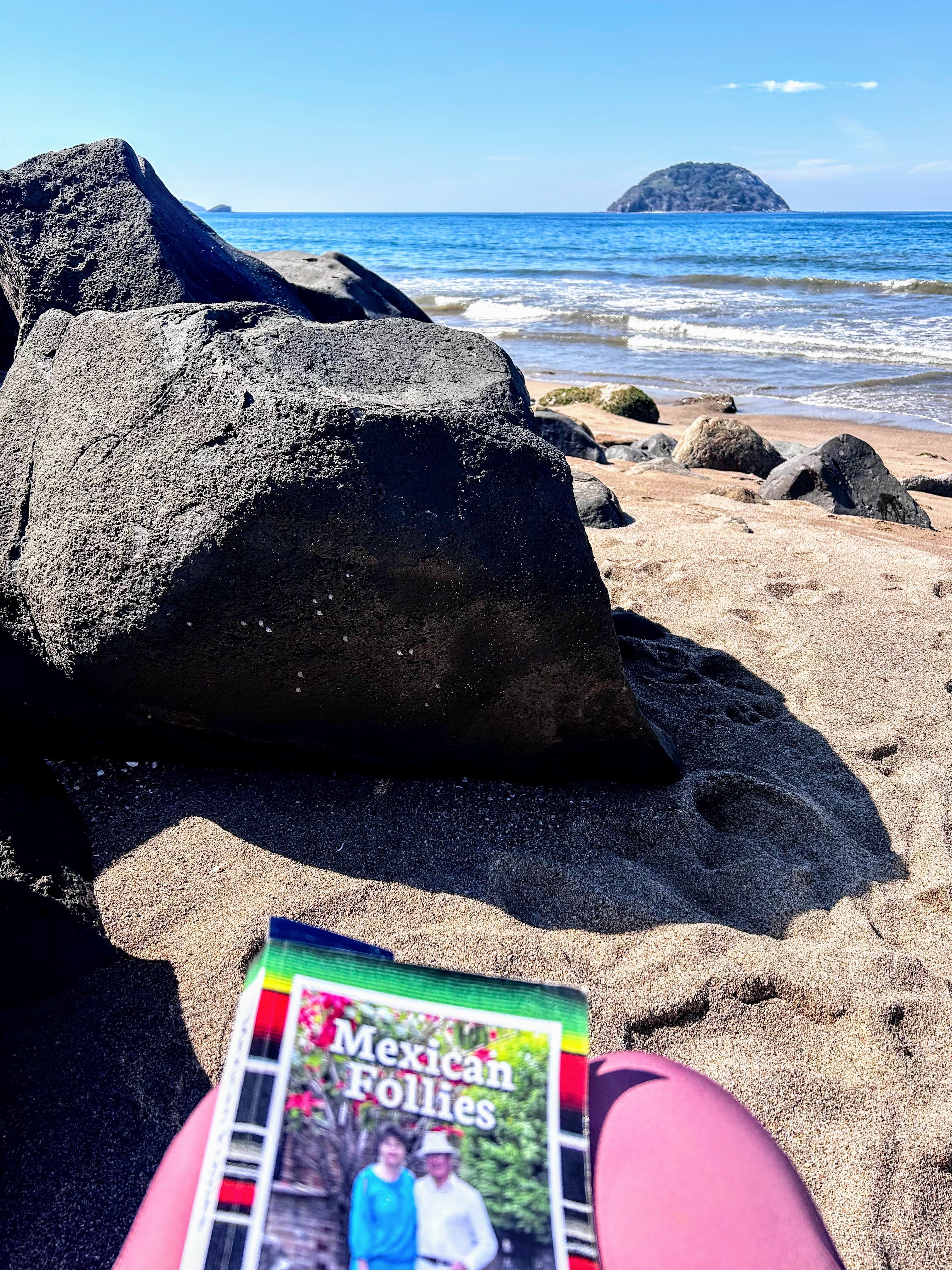
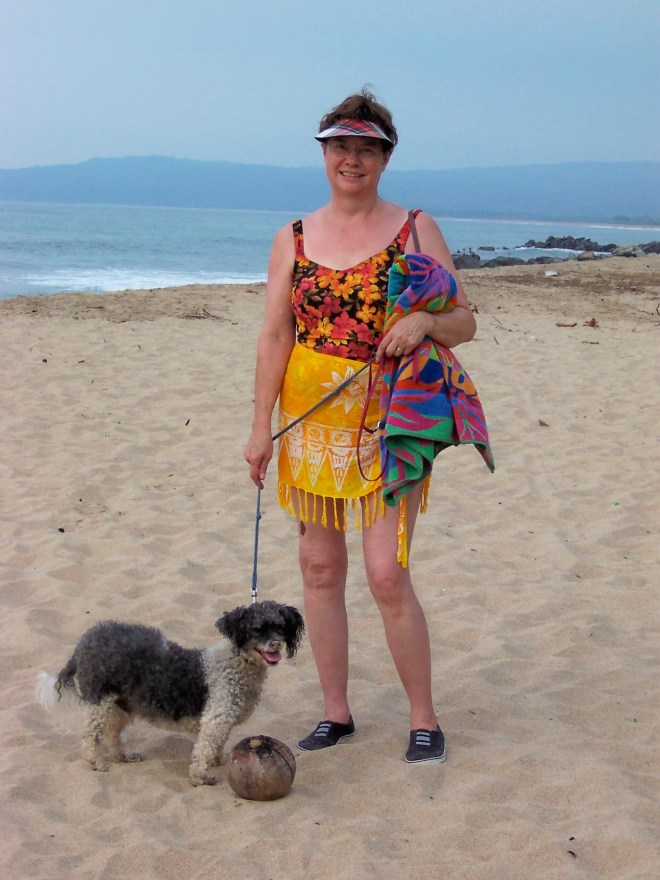
Canadian friends from our Mexican days are back in Mexico as snowbirds and spending some time in La Peñita on the Pacific where we RV’d for some time in 2004 and wrote about in our newly published book, Mexican Follies. Here’s our recent message exchange and the accompanying photo they sent. What a nice gift!
“Hola Gayle, We are enjoying the wonderful weather in La Penita and meeting some of the many Canadians wintering here. I saved your book to read while I was here, so this is my view while reading on the beach. I like your writing and can relate to many of our shared experiences.”
Here’s Gayle’s reply to her:
“Reading about our adventures in La Peñita while in La Peñita must be quite unique! Thanks for sharing this and for the photo. Would love a review of the book on Amazon if you feel so inclined. I’m into the writing of my own memoir right now that I’m calling “My Life With Gus: Memoir of a Marriage.” Much work and much fun. Hugs to you two. Hope you are keeping well. Enjoy Mexico for me!
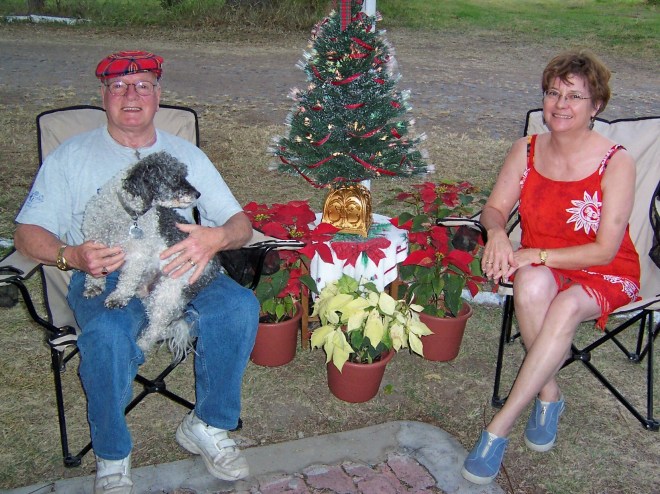
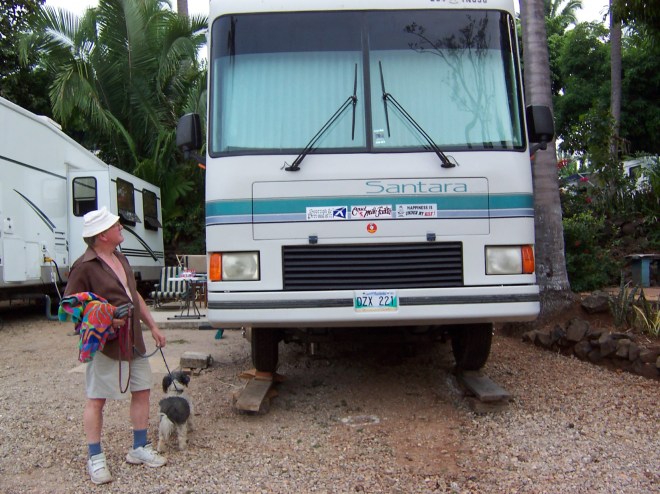
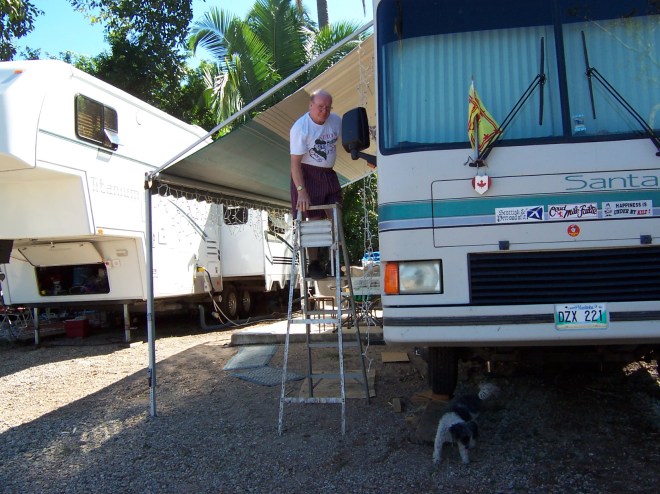
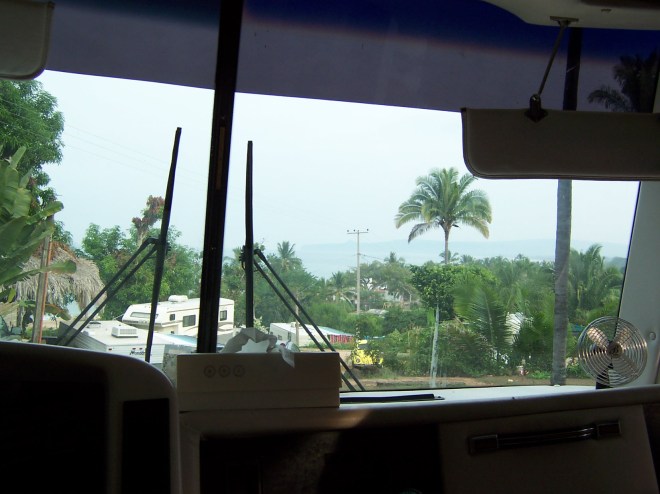
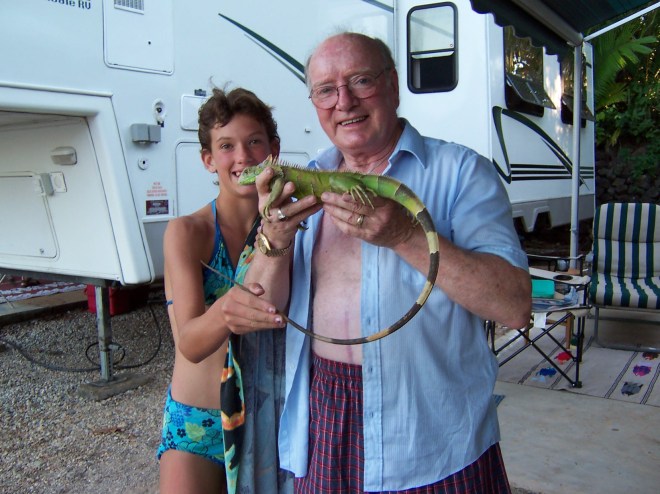
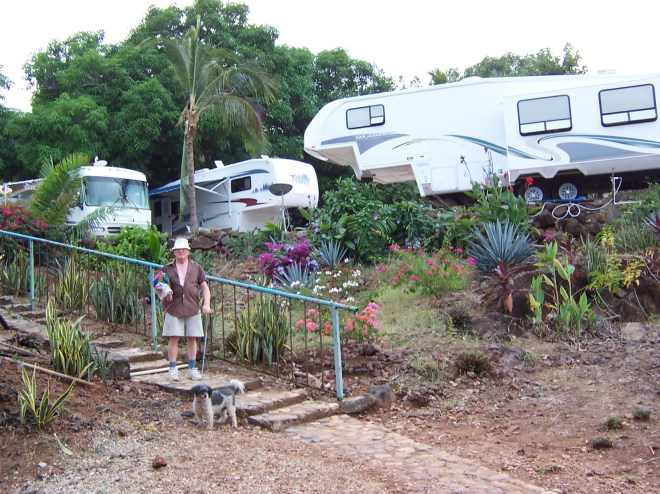
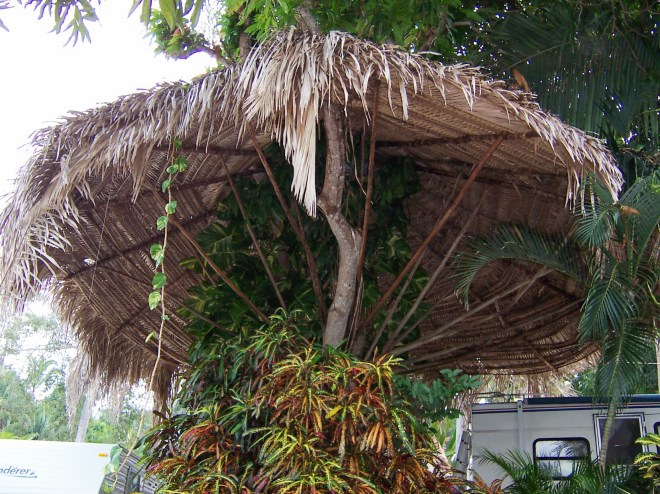
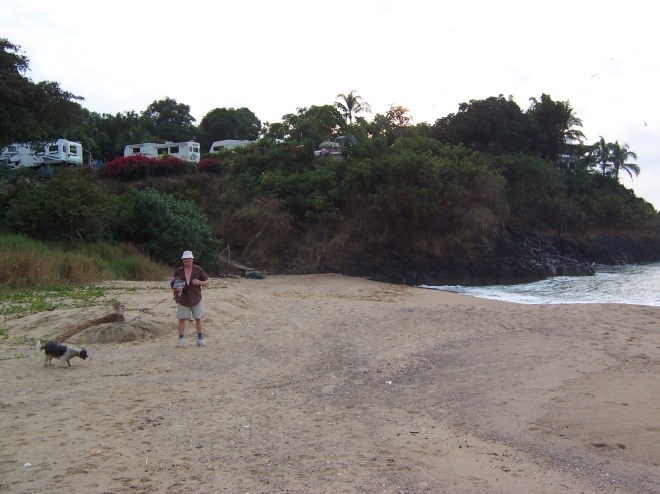
Shown below is a slide show of some photos we took during our weeks spent in our motorhome at the large La Penita campsite described in our book as “an absolutely beautiful trailer park on the edge of the town of La Peñita, built on several levels going down to a Pacific Ocean beach.”
As of October 23, 2024, MEXICAN FOLLIES, Moomor Publishing’s sixth book, is now available for purchase worldwide on all amazon sites. Just go to your local amazon site and search for “Mexican Follies” and the book’s details should come up on your screen.
As of November 12, 2024, an eBook version is also available on Amazon sites. For Winnipeg readers who might like to buy paperback copies directly from me (Gayle Moore-Morrans, the author/editor), a book launch was held on Saturday, November 9 at Fred Douglas Place in downtown Winnipeg. Those who were not able to attend and want to obtain a copy should email me at: gayleian@gmail.com to make arrangements.
Here is the back cover blurb describing the book: A dual memoir and travelogue, Mexican Follies follows the adventures and misadventures of Ian, 72 years young, and Gayle, 61 years young, as they embark in October 2004 on a tour of discovery from Winnipeg, Manitoba, Canada to Mexico. Married just a year, Ian and Gayle sell their Winnipeg house and celebrate her retirement by fixing up a used 35-foot motorhome and heading for southern climes. Their goal is to escape the northern winters and maybe find a permanently warm and peaceful place to settle down and enjoy togetherness and independence, now that Gayle’s young adult children are finally off on their own. Readers of Ian’s two previous memoirs, From Poverty To Poverty: A Scotsman Encounters Canada and Came To Canada, Eh? Adventures of a Scottish Nomad, will have become familiar with his musical talents as a Scottish entertainer and his penchant for moving (from Scotland to England to Wales to Egypt, back to Scotland and then, with a young wife and two children, on to Canada). There he moved back and forth over a period of almost four decades within multiple provinces, but often managed to wind up in Winnipeg where he was eventually widowed. Ian soon met Gayle, also widowed, who had immigrated to Winnipeg from the USA after spending 18 years in Germany. By then Ian had retired from his machining career and had begun to write stories while continuing with his avocation of making music. Shortly after meeting, writer Ian and writer/editor Gayle began to plan a life of producing books and making music together in what they hoped would be their own little corner of paradise. They initially loved living in Mexico and eventually bought a house in the world’s largest English-speaking expatriate community in the mountainous region of Central Mexico along the shores of Lake Chapala, started singing together as Scottish entertainers and joined a writers’ group. But read along as their excitement and Follies-like experiences turn into Folly after Folly, including house break-ins/robberies, the murder of friends, partial wreckage of their motorhome and many other disappointments. Ian and Gayle finally conclude that, after all, returning to Canada is the best way for them to fulfill their dreams. Were the Follies worth the many types of Folly they encountered? You decide.
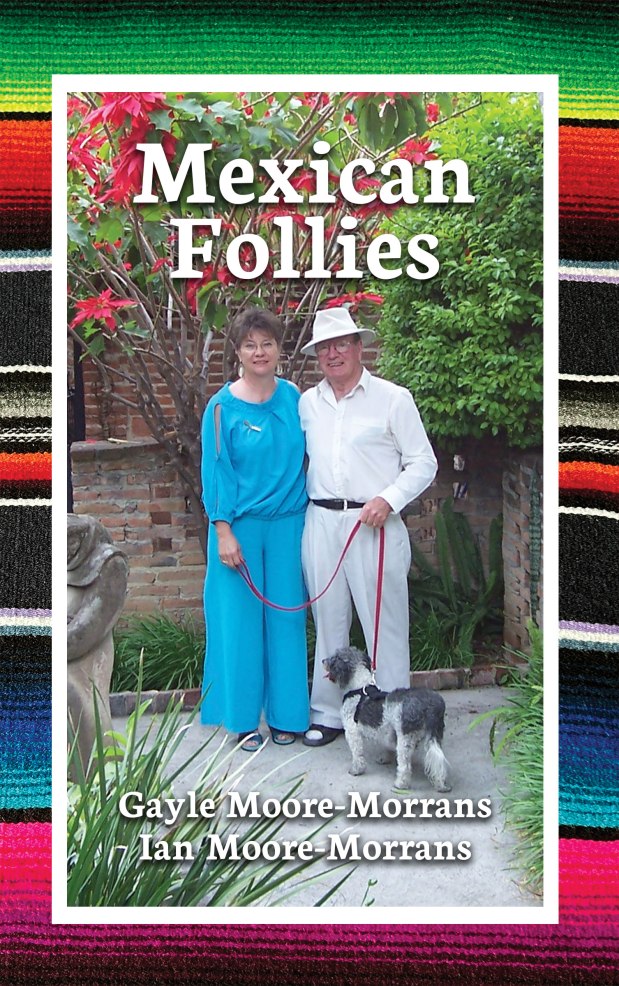
Cover photo: Gayle and Ian Moore-Morrans with their terripoo Peppy in the gardens of the Lake Chapala Society, Ajijic, Jalisco, Mexico, November 2006. The background surround is from a colourful Mexican blanket they bought in an open-air market in Ajijic, woven by Huichol indigenous artisans who still inhabit the area and maintain their ancient Uto-Aztecan language along with their bright bead and textile arts.
“Contrasting the personalities of the writers in their letter writing and subsequent narratives was a very interesting concept and they certainly achieved what they were trying to convey to this reader. I especially enjoyed the many descripie passages. In “An April Swim in Paradise” I was along in that pool. I could really smell those flowers and feel that warm sun on my back. What a beautiful piece of writing!
“The writers’ changing perspecties on Mexico and Mexicans throughout the book was handled well. I really didn’t feel any resentment on their part until the last chapters. What happened to them both should colour someone’s ideas of a “Safe Mexico.” Their last comments in the Penticton Herld were certainly warranted and I hope they both were ale to finally get some satisfaction from them.
“I very much enjoyed the good read. I could really feel how much the writers enjoyed each other. Both of them had made many moves before they met, so I could see how they thought it would be easy to move to Mexico but !! Mexico???”
Five star review on Amazon.ca:
*****Engaging, Absorbing, Rewarding
Reviewed in Canada on October 28, 2024 by James Osborne
“This is a warm and engaging story with three compelling dimensions: It is a deeply sensitive love story, it is a delightfully entertaining tour-de-force of popular destinations in Mexico, and it is firmly rooted in the authors’ devout spirituality. A rewarding read for those with an affinity for one or more of those three dimensions.
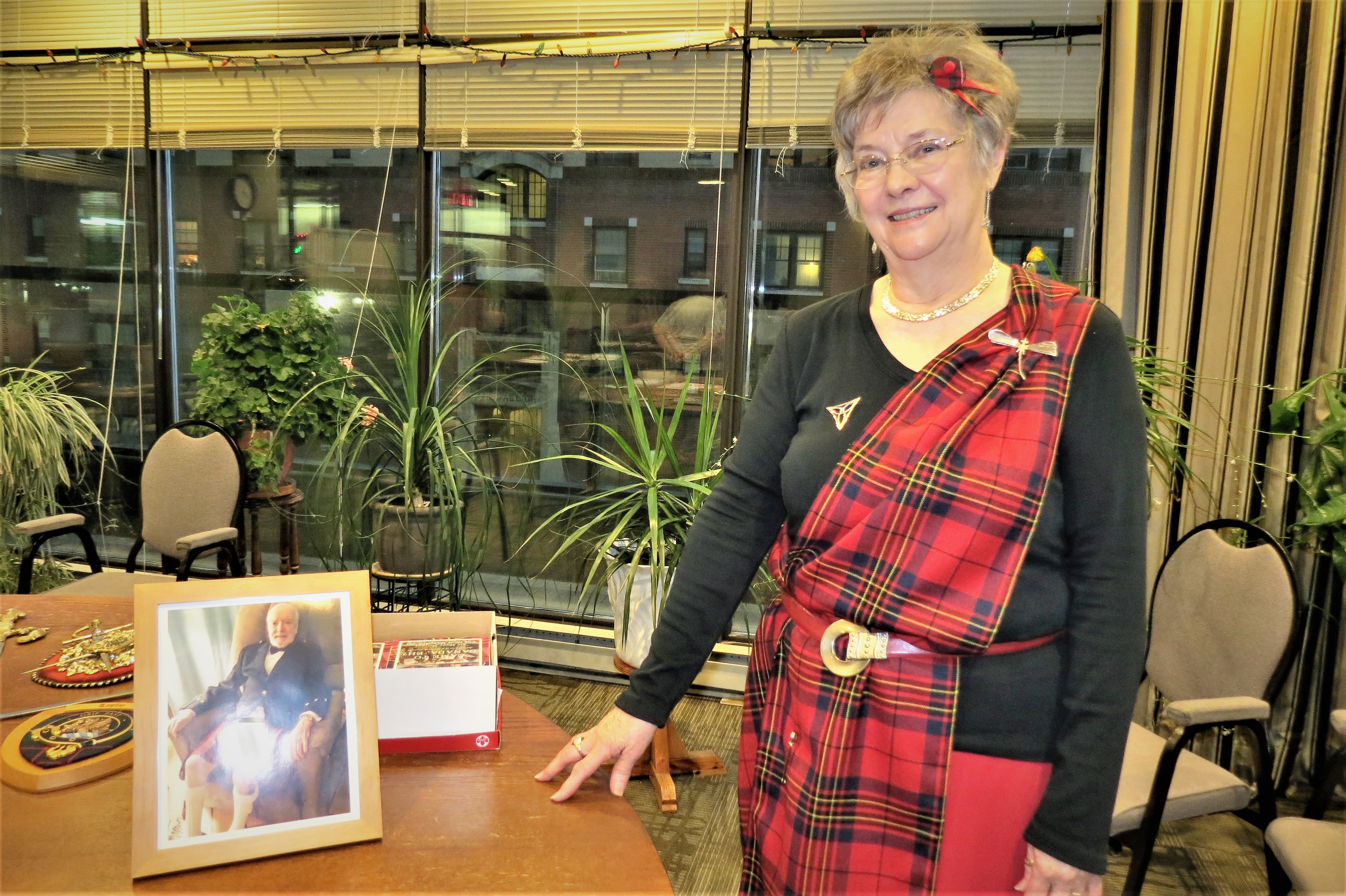
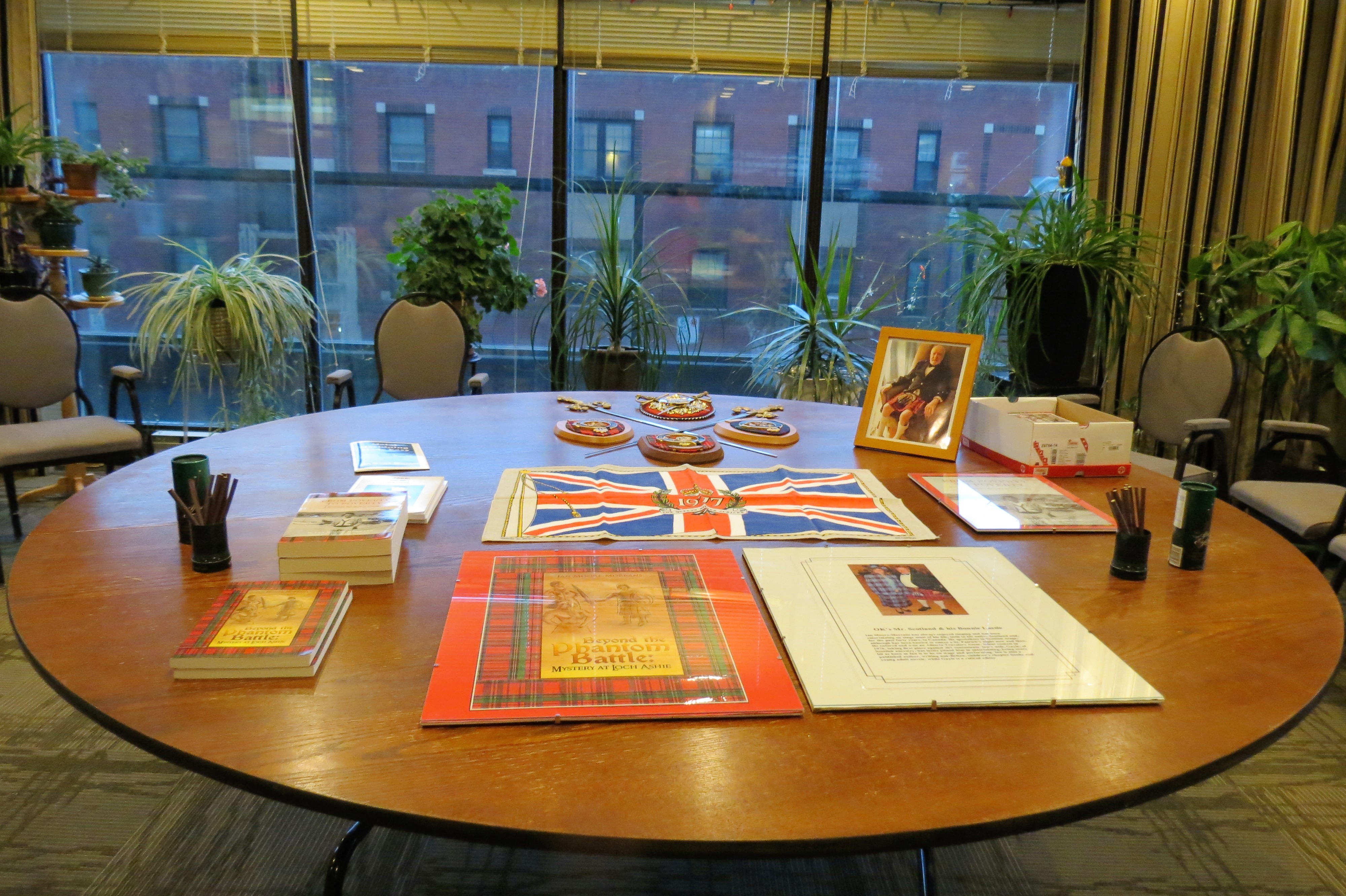
Gayle poses during her book launch beside a photo of her late husband Ian Moore-Morrans who was the main author of the memoir, Came To Canada, Eh? Adventures of a Scottish Nomad.
FINALLY: A BOOK LAUNCH!!!! Co-Author/Editor Gayle Moore-Morrans celebrated as she launched Moomor Publishings’ latest book on the Amenities Floor at FRED DOUGLAS PLACE, her seniors’ residence in Winnipeg, on September 10, 2021, almost 11 months after the book had first been published. Due to the restrictions of the pandemic, it had not been possible to have an in-person launch for the book until then. There was a good turnout of residents eager to hear about Gayle’s insights (some of them had already purchased and read the book in months past), an interview of Gayle as co-author/editor, a book signing/sale and a chance to watch a video of Ian reading a story from the book, plus a number of videos of him singing as a Scottish entertainer in years past. More book readings are being planned: A zoom presentation across all five Canadian time zones, sponsored by the Facebook Group LUTHERAN WOMEN CONNECTING on November 6th at 3 p.m. Central Time (plans are to record the presentation for later sharing online) and a live presentation for members of the ROBERT BURNS CLUB OF WINNIPEG on November 20th.
Gayle introduces a video sampling of Ian singing in scenes related to stories in the book.
Reviews of Came To Canada, Eh? Adventures of a Scottish Nomad, by Ian Moore-Morrans with Gayle Moore-Morrans
From James Osborne, author of Amazon #1 bestseller, The Ultimate Threat:
“Came to Canada, Eh? is a brilliant and beautifully told story of the journey through life by a newcomer to Canada, at once both candidly disarming and brutally honest. This book is an important contribution to Canadian heritage.”
From Charles H. Cameron CD, Past President, Robert Burns Club of Winnipeg:
“Mr. Ian Moore-Morrans, in my humble opinion, reminds me so much of aPoet/Song writer in Scotland, each travelling the countryside in search of employment and happiness to better his life and that of his family. A paraphrase of Robert Burns’ poem, Rantin’, Rovin’ Robin could aptly describe Ian’s story: “Ian was a rovin’ boy, Rantin’, rovin’, rantin’, rovin’, Ian was a rovin’ boy, Rantin’, rovin’ Ian! He’ll hae misfortunes great an’ sma’, But ay a heart aboon them a’, He’ll be a credit till us a’ —We’ll a’ be proud o’ Ian.”
From Liz Olson, award-winning short story writer, occasional editor/copy editor and former editorial assistant for Canada Lutheran magazine: “Put down that celebrity bio and pick up Came to Canada, Eh? Ian is the real deal, the most relatable Everyman you will ever meet. Circumstances don’t allow for fame or fortune, despite his remarkable gifts, but nothing keeps this guy down for long. His indomitable spirit and quirky humour sustain him through a rollercoaster of adventures and tragedies, and the ride even leads him to a second chance at love at the end of the road. Don’t miss this!
From ARK on amazon.ca, 4 out of 5 stars:
“Never a Dull Moment. Ian’s experience as an immigrant to Canada with the attendant challenges of employment are possibly representative of the challenges faced by many immigrants now, and in times past. Ian’s experiences will likely resonate with immigrants especially, as well as with those who have felt like an ‘outsider’. Ian’s determination in the face of obstacles will be an inspiration to many readers. Very readable and enjoyable chronicle.”
By Amazon customer on amazon.ca: 4 out of 5 stars:
“Ian is a story teller. Reading the book I can hear Ian telling the stories and the book is full of his storied life. There is a chuckle on every page.”
From Pat, a Winnipeg reader and a fellow resident at author’s senior housing. “Dear Gayle, I did enjoy reading Ian’s book “Came To Canada, Eh?” It was a hoot! But I was again struck by his unskeptical and unsuspecting manner as I earlier evidenced in his first memoir “From Poverty to Poverty: A Scotsman Encounters Canada.” As I had indicated, an alternate title might have been – “Innocents Abroad.” However, when I read the Epilogue and noted that Ian had chosen ‘honesty’ as (what he thought) his most important characteristic, it somehow all fell into place! Because he was such a generous, trustworthy person, he trusted others to be as open and honest as himself. What a guy!”
From Editorial Evaluator at Friesen Press prior to publication:
“First off, I found Ian to be an incredibly strong storyteller, very direct, down-to-earth, and relatable. His writing style is straightforward and easy to read, even when “speaking” with the Scottish burr.
More importantly, he truly lived an extraordinary life. Although the individual moves and layoffs, for example, are fairly commonplace, when told en masse, in this sort of personal narrative, I found it incredibly impressive that he managed to maintain his hope and optimism. I can’t imagine that, in his shoes, I would have shown even a fraction of his determination.
Overall, he is a very sympathetic and likable character, even when occasionally coming across as a bit grouchy―and I like the fact that he actually acknowledges this likelihood.
In a personal memoir, unless one is famous, it is very important that the main “character” is compelling, likable, three-dimensional, and flawed. I never got the sense that he was painting himself as a victim or a hero. Instead, it seemed like a very honest retelling of the events that made up his Canadian experience.
I appreciated the way he retained his connection to his Scottish roots, and found it particularly interesting when he felt the need to defend England and Queen Elizabeth from his German colleagues. When combined with the various historical facts that are shared within the narrative, I found it very impressive that he was able to put his natural Scottish biases aside in order to speak to the larger picture.
The inclusion of his essay, “Destroy the Scots: A Brief History of the Peoples of the Highlands of Scotland and their Desperation in Trying to Exist,” really added a great deal of depth and gravitas to the narrative as a whole, and gave the reader a clearer insight into not only a historical period that most non-Scots are unaware of but into his character as well.
His deep roots were clearly a large part of the man he was, and influenced the way he interacted with the world around him, balking at injustice, appreciating practicality, and standing strong against anything that threatened to get in his way.
I very quickly felt like I knew him, and was enjoying following him on his various moves around the country. I also found it sort of refreshing, in an odd way, that he came across so many dishonest, unpleasant Canadians. As an editor, I have evaluated many of these sorts of stories, and in almost all of them, we Canadians are portrayed almost universally as polite, generous, kind, and so on. And on the whole, I think we are. But at times, one starts to wonder at the almost total absence of jerks. I have certainly come across plenty of those in my life, all of them born and raised in Canada. By including these negative representations, I found the story seemed somehow more real and relatable. His love of Canada, and its people are showcased as well, but in a seemingly more realistic way.
With so many changes of setting and scenery, the pace of the narrative was good, always moving forward. It also afforded him the chance to introduce many interesting people, and does an excellent job of keeping them recognizable and individual.
While his writing is generally very simple in style, he also showed a real knack for capturing a moment. For example (from his essay): “Even today, over 250 years later, one can feel an air of mourning that persists in Scotland’s Culloden Moor. No birds sing; no heather grows on the mounds of earth that cover the many mass graves.” One can almost feel the haunted stillness of the place. This is very good writing.
Lastly, the organization is very effective. Largely chronological, and interspersed with pictures, poems, song lyrics, articles, and so on, as well as the lovely eulogy and epilogue. I found the narrative flowed very organically and kept my attention right through to the end, with the elements written by you, Gayle, fitting seamlessly into the story, never detracting or distracting from the rest but actually adding greatly to it.”
The Editor’s Manuscript Evaluation written for Friesen Press before publication: “A sequel to From Poverty to Poverty: A Scotsman Encounters Canada, this story follows Ian Moore-Morrans’ continuing experiences in Canada, endeavouring to survive and thrive in his new country, while facing and overcoming recurring professional and financial setbacks, as various recessions lead to lay-offs and dozens of relocations around Canada―with his wife, children, and pets―in search of new opportunities. Through all the ups and down, he and his family manage to stay positive and hopeful, overcomingthe hardships, supporting each other, and always staying open to whatever life has to offer next. This story follows his personal and professional adventures through his retirement, the death of his first wife, and to his second marriage, during which he is finally able to focus his energies on singing, dancing, writing, and basically enjoying his life to its fullest until his passing in 2019.
At left you’ll see a photo of “editor me” at my desk on one of the last days before retirement (in 2004) as Editor of Esprit magazine and Program Director for Evangelical Lutheran Women at our office on the second floor of Portage Place in Winnipeg. In addition I’ve included a photo of the gift I received at my retirement party in July 2004. As Ian and I were preparing to take off for a retirement adventure driving down to Mexico in our newly acquired 35-foot motorhome, my boss chose to wrap an assortment of “helps” for that trip inside or underneath a large box decorated to look like our motorhome – complete with photos of Ian as driver and me as passenger.
After several years in Mexico, with trips up to Manitoba to maintain our Canadian residency, we returned to Canada for good. I hope to start blogging about our Mexico sojourn in the near future. Time will tell if I ever get to it. While there in Mexico I began editing Ian’s writings and am continuing that in our present home in British Columbia, as well as now contributing to his writings. Here my desk is in our little den and I look out the window at the low mountains surrounding our part of the Okanagan Valley. The desk is different from the one at ELW, but just as messy. That’s the way I work. I do not like a messy final product, however, and decided that it was time for me to have an editor’s rant about what I am seeing on some web blogs and in many comments that come into our site.
I don’t think I’m unique in claiming frustration when reading some comments on web blogs or even some particular web blogs which are so full of errors in grammar, spelling, punctuation or just plain English that I feel compelled to edit them as I’m reading. Sometimes even understanding them is impossible, so I quit reading and trash the comment or close the web blog.
As I routinely check out other web blogs, I am more-often-than-not impressed by so many varied topics and excellent writing, but am also occasionally appalled by the lack of English writing skills by some bloggers. In those cases, I cross those web blogs off the list of ones I want to follow, no matter how interesting the topic might be. I find it painful to read something when I feel a need to correct practically every sentence. (As an aside: I lived in Germany for 18 years and ended up speaking passable German but would never in my life think of hosting a blog in German! I wouldn’t feel confident enough to do a decent job of it. My late husband who worked in a profession there, could easily have hosted a blog in German. Obviously his language skills were much superior to mine.)
My motto is: “check, double-check and recheck anything you post”, for it is easy to miss a word here or there if one doesn’t do so. I always try to self-edit any of my blogs and usually have Ian read through them before posting. That isn’t to say that I might not post a small grammatical or spelling error from time to time. It happens to the best of us. Almost inevitably after checking and re-checking the magazine I edited and having our executive director and a professional copy editor go over everything before publishing, I would find some little thing wrong when reading the issue after publication.
In the past I’ve found myself editing a lot of comments that come in on this web blog so that they can be understood. I conclude that quite a few of those who comment on posts do not have English as their first language and are obviously using an English-to-another-language dictionary when they make their comments. Perhaps they are taking an ESL course and have been given an assignment to comment on specific web posts. (Comments often come from the same site with different email addresses.) If that is the case, how I wish the instructor would at least give them some help in making the comments understandable. It is nice to get compliments or constructive criticism, but not if the comment cannot be readily understood and if the blogger receiving the comment has to edit it extensively in order to print it. WordPress usually identifies these type of comments as “spam”; in the past I’ve looked at every comment and sometimes chose to “un-spam”a few because I’d like to honour the intent. I have edited them for comprehension, though. I’m wondering if other bloggers have chosen to do this or if these type of comments simply get trashed. Here’s an example of one comment we recently received, showing the places where I have cut out more than half of the words and added clarifying words in order to get what I think the commenter intended.
“Attractive section of content. I just stumbled upon your web site and in accession capital to assert that I acquire in fact enjoyed account your blog posts. Any way I’ll be subscribing to your [web blog.] augment and even I achievement you access consistently fast.”
Another recent commenter asserted that, though our blog’s content was good, many of the posts were “rife with spelling issues.” Well, that got my dander up! I did, however, calm down and try to address what I thought might be the problem. Here’s my answer:
“We’re surprised to hear that you find several of our posts ‘rife with spelling issues’. We are wondering if you might be pointing out our use of the British way of spelling English words, as opposed to the American way. (An example would be the use of “ou” in place of “o” as in “neighbour.” We are Canadians and so use the British way of spelling. I (Gayle) am the blogger and, though American-born, changed my way of spelling sometime after I emigrated to Canada and became editor of a Canadian magazine. I’ve kept up that way of spelling in retirement and, as Ian is British-born and I edit his writing, that method has worked out well for us. Then, too, Ian speaks Scottish-English so when he writes about Scotland in either his novels or memoirs, he uses what I call “Scottishisms.” Some of those words are only found in Scottish-English or may mean something entirely different in Scotland than they do in other countries where English is spoken. We’ve pointed that out in some of our posts about his memoir, “From Poverty to Poverty: A Scotsman Encounters Canada.” I had quite an education in “Scottishisms” when editing that book! In addition, I had to turn off the spell-check as my word-processing program gave up on providing corrections! Of course, even editors sometimes need to be edited; however, I try to double-check whatever I post. We’d be interested in hearing from you further so that you could point out some examples of those spelling issues. Looking forward to hearing from you.” To date, we have received no further communication on this subject.
That brings up the challenge when commenting on web posts of exactly what to say. Sure it is nice to have affirmation that someone “enjoyed” a post or found it “awesome” or “educational” or “informative.” But does that really help the blogger to know how they are connecting with the reader? In haste I, too, sometimes choose to just give kudos by checking the “like” button on a post; but if I take the time and REALLY like or dislike something I try to comment on it. How did I feel when I read the post? Intrigued? Scared? Amused? Why and how? Perhaps the blogger was promoting a book, a picture, a poem or a piece of music that he/she had written, drawn, photographed or performed. Did the blog catch your interest so that you plan to order the book or picture, quote the poem or obtain the recording? Did the post remind you of a happening in your own life or a person you met or an emotion you felt? Then describe that connection. You might wish to reblog the post, giving credit to the writer and quote your reaction to it on your own blog or on Facebook, Twitter or the like.
Conversely, if a post draws a negative response from me and I think it can be constructive, I’d like to think that I would be willing to document why I had that response. Although I didn’t post the following comment on a novel writer’s blog but instead posted it on Amazon after reading the novel, here is an example of how I could make both a positive and, I hope, constructive negative response to the novel on a writer’s blog:
“You have written a well-rounded story about a group of characters, each flawed in a unique way, all seeking redemption. Your background in counseling is evident throughout; perhaps that is what makes your story so believable. Your prose is clear, yet poetic. Your descriptions of both characters and scene are captivating. I would have given this book five stars had it not been for the unnecessary profanity which I felt cheapened the narrative, especially those instances when the name of Jesus was invoked through cursing.”
I send a challenge to bloggers and commenters alike: If you can’t edit your own postings, please, please find someone who can do the edit for you.
Please and thanks in a spirit of kindness and mutual understanding. Keep the relevant and understandable comments coming!
Gayle Moore-Morrans
P.S. In the meantime we have recently received a comment (perhaps sent in error?) which went on for several hundred words. The comments were obviously a multiple choice list of helps for would-be commenters who needed guidance on how to word comments they wanted to make on various posts. In the past the comments we received from that particular commenter had included, solely or partly, promotions for his web blog that included little or nothing about the post he was supposedly commenting on. Many of the multiple-choice comments he included sounded similar to many of the comments we have received from a number of people over time. Thus, in the future I intend to honour Word Press’ use of Akismet to check incoming comments and rate them as “spam”, then delete the spam comments without reading them. Most of us writers and editors who blog find it difficult to have enough time to do our writing or editing what with all the other duties and distractions of life. We don’t need 276 comments in our “Spam Comments” section. That is the number I encountered last week after not checking the comments for about a week’s time. For the first time, I chose to permanently delete all those spam comments without even looking at them. I truly appreciate the efforts a number of commenters make in sending in compliments or kudos on our posts, or even criticisms when they are constructive. However, I’m trying to promote our books or share views on writing, photographing, reminiscing or life in general and am hoping to glean relevant information from other bloggers instead of spending valuable time reading, rewriting, replying to or trashing umpteen comments a day. I am sharing these words in hopes that others will understand my frustrations and those of other bloggers who are surely having similar problems with unwarranted comments. Perhaps some of them will attempt to correct their comments or have them edited by someone else or those who just want to advertise their own blogs will cease and desist. At least I won’t have to relate to them if I trust Akismet’s weeding out those comments.
I (Gayle) thought it was about time I got around to reviewing Ian’s autobiography, volume 1, for the Goodreads site. I listed it, recommended it and gave it 5 stars some time ago, but, with developing this blog, I haven’t had time to get a review written until now. It is posted below.
*****”I highly recommend “From Poverty to Poverty: A Scotsman Encounters Canada” to anyone interested in:
• Biography
• Scotland during the Great Depression, World War II and the post-war years
• A teenager’s life in the Salvation Army in the late ’40s
• Music making, especially Scottish folk music, brass band music and tunes of the ’40s, ’50s and ’60s
• Life of a common airman in the Royal Air Force of the early ’50s
• British military life in Egypt during the pre-Suez crisis days
• Emigration from Scotlandandimmigration to Canada in the mid-’60s
The writing style is folksy, humorous and honest. Ian tells it like it was!”







 MOOMOR PUBLISHING