THE CHRISTMAS STORY ACCORDING TO GWYNNE

THE CHRISTMAS STORY ACCORDING TO GWYNNE


“Last year it was Ian’s turn to share some excerpts from his book, From Poverty to Poverty: A Scotsman Encounters Canada, about his “non-Christmases” as a child as well as a very special New Year’s Eve in Scotland when his prematurely-born daughter’s life was saved by a bottle of Scotch whisky.

This year it is Gayle’s turn to share some of her holiday writings. She has been super-busy these last months putting the final touches on our next-to-be-published book, Jake, Little Jimmy & Big Louie, plus rehearsing for the various musical groups she belongs to and then singing in their concerts or caroling at seniors’ or nursing homes and at Silver Star Mountain Village. Those duties are winding down now and so she has found time to offer her special holiday gift to readers, a play entitled “The Christmas Story According to Gwynne.”

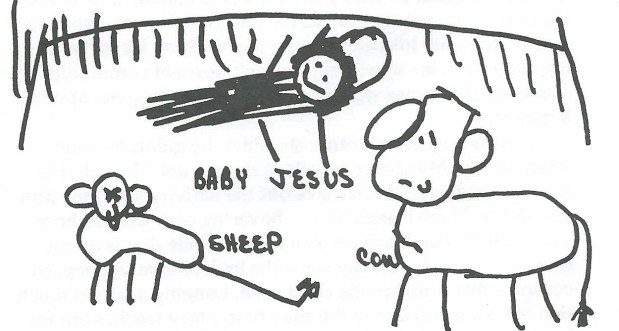
This play originated in 1981 when Gayle, her late husband Gus and daughter Gwynne were living in Frankfurt am Main, Germany. Gus was serving as a Lutheran pastor to a German parish and Gayle was enjoying her role as homemaker and mother. Their daughter Gwynne was a precocious four-year-old who kept her mother hopping. She talked almost non-stop in what her parents called “Gerglish,” a unique combination of German and English. Mama usually spoke English with her and Papa almost always spoke German with her; thus Gwynne understood both languages, spoke pretty good German but found it hard to express herself totally in English. She loved to have books read to her in either language and soaked up knowledge like a sponge. When the spontaneous play that follows began, Gayle realized that Gwynne had grasped the main aspects of the Christmas story but had added some unique twists to relate them to her own life and understanding. That evening, when Gayle related the story in great detail to Gus, he encouraged her to write it all down before the nuances of the story faded from her memory. She did so that very evening. To aid in the reader’s understanding, however, she “translated” everything into English. Other than that, however, the story is as exact to how it actually played out as Gayle’s memory could make it. The drawings we include with this story are Gwynne’s, drawn at her mother’s urging in the days following the play’s inception. We are also including a photo of Gwynne at age 4 dressed as St. Lucia, prepared to make the rounds of our apartment house to bring Saffronsbrod and Pepparkakor (Swedish treats) to our neighbours on the morning of St. Lucia Day, December 13th. That date is the start of the Swedish Christmas season and Gayle’s family heritage on her mother’s side is Swedish. (Yes, those are real lighted candles on the Lucia crown she is wearing! Because of that, Gwynne did this duty rather reluctantly.)

Gwynne as Lucia - age 4

Now, many years later, Gwynne lives in Norway, with her Norwegian husband, their three-year-old son and one-year-old daughter. She is employed as a teacher/librarian in a British International School, where they also celebrate St. Lucia Day. As an adult, Gwynne continues to nurture her unique imagination, teaches Sunday School, loves to play with and read to her children and has a house full of more books, toys and craft projects than one can imagine.


The Christmas Story According to Gwynne

By Gayle and Gwynne Johannesson, Winnipeg, Manitoba

Reprinted from a 1981 Johannesson Christmas letter and later from Esprit, the magazine of Evangelical Lutheran Women, November/December 1993 issue. Copyright © 1981 Gayle Johannesson; 2014 © Gayle Moore-Morrans.


Characters:

Gwynne (G) who also plays the Angel, Joseph, Pastor, and King Herod (in turn)

Mama (M) who also plays Mary, Joseph, Innkeeper (in turn)

Scene:

Gwynne, age 4, a budding actor, plays while Mama sews. Since early in Advent she has become fascinated with the Christmas story, has had it read and told to her, has seen it in pictures and manger scenes, has sung of it and heard it sung—at home, in church, in kindergarten, on television and at the Frankfurt Christmas Market. Now she wants to act it out—in her own unique way.

INTRODUCTION

G: Mama, let’s play “When Jesus was a Little Baby.” I’ll be the angel and you be Mary. (Exits the room in which Mama is sewing; re-enters, flapping arms.)


SCENE 1 – Mary’s garden, Nazareth

G: Fly, fly, fly. (pause) Hi, Mary!

Mary for Christmas Story

M: Hello! Who are you?

G: I’m the angel. I have good news for you. God sent me to tell you you’re going to have a baby in your tummy and he’s going to be the Messiah and save everyone from their sins. I think you better name him Jesus.

M: What wonderful news! You tell God I’m very happy to be chosen to be Jesus’ mother and I’m ready to do whatever God says.

G: Okay. ‘Bye now. Fly, fly, fly. (Exits, flapping arms.) (aside) Now you be Jofes. I’m still the angel.


SCENE 2 – Joseph’s home, Nazareth

Mr

G: (Enters, flapping arms.) Fly, fly, fly. Hey, Jofes, wake up! I’ve got good news for you. God is giving Mary a baby in her tummy and then you have to both go to Bethlehem to be counted. The baby’s name is Jesus and he’s going to be the Messiah and save you from your sins.

M:  That’s great! I’ll get ready to travel right away.

G: Bye. Fly, fly, fly. (Exits) (aside) Now you’re Mary and I’m Jofes.


SCENE 3 – Road to Bethlehem

G: Don’t worry Mary; we’re going to soon be in Bethlehem:

M: I hope so, Joseph. I’m very tired and I think the donkey is, too. Besides that, I think it’s soon time for the baby to be born.

G: Look, Mary; there’s Bethlehem: Let’s find a hotel room: (aside) Now you be the hotelman.

G: Knock, knock. Do you have room for us?

M: No, I’m sorry. We are all full.

G: All the hotels are full? Can’t you please find us some room?

M: Well, I have a stable in back where the animals stay. There’s an empty clean stall if you don’t mind sleeping on hay.

G: Well, is it quiet? We’re going to have a baby, you know; so it’s got to be quiet.

M: Oh, yes. There’s only one old cow and a sheep and two lambs and they don’t make much noise.

G: Good. Come on, Mary. Let’s go. (aside) Now you’re Mary again.


SCENE 4 – Bethlehem stable

G: I’ll fix up a bed for us in the hay. (pause) Oh, oh. We’ve got a problem.

M: What’s wrong?

G: There’s no phone.

Mama: Now Gwynne. Don’t you remember, when Jesus lived on earth it was many years ago and they didn’t have telephones. Anyway, why do you need a telephone?

Gwynne: Well, for heaven’s sake, Mama, we’ve got to call a pastor. I just remembered Jofes and Mary didn’t get married. They’re going to have a baby soon so they better get married!

Mama: Can’t you get a pastor in Bethlehem?

Gwynne: Nope. He’s far away. Well, if there isn’t any phone then we can’t play. (pause) I know—the angel can get a phone. (Exits and enters again, flapping arms.)

M: Oh, Mr. Angel, can you get us a phone so we can call a pastor to marry us before our baby is born?

G: Sure. (Exits and re-enters with phone.) Now I’m Jofes.

G: Ring, ring, ring. Hello, Pastor Johannesson? Can you come and marry us? We’re going to have a baby soon. You can find us easy, just follow the star and when it stops we’re in the red house.

Pastor J for Christmas Story

(Angel flies out, removing telephone. Re-enters as pastor, performs ceremony while M. plays Mary and Joseph in turn. G. exits and re-enters as Joseph. Fixes up a bed for Mary in the hay, settles donkey (hee-haws), talks to cow (moos) and sheep (baas). G. exits and re-enters with doll in cradle.)


SCENE 5 – Next morning, Bethlehem

G: Mary, wake up. Look at the nice manger I made for the baby you had in your tummy. Let’s name him Jesus. You wrap him up and I’ll put him in bed.

M: There, he’s sleeping now. Say, do you hear voices outside? It sounds like shepherds talking and they say an angel choir told them to come to see our baby.

G: Yes, and listen to the song they’re singing.

G&M: (singing) Glo-o-o-o-o, o-o-o-o-o, o-o-o-o-oria! Glory to God in the highest!

manger scene for Christmas story

G: Come on in. (Extends hand to imaginary shepherds.) You can see the baby, but be quiet—cuz he’s sleeping. (Gently strokes the doll’s cheek.)  Isn’t he cute? He’s the Messiah and is going to save you from your sins.

Gwynne: Oh no, no, no! (Runs from room, prances around in hallway.) Get that baby out of here! I don’t want a boy baby; I want a girl baby!

Mama: What’s wrong now? Don’t you want to play anymore?

King Herod for Christmas Story

Gwynne: Oh, Mama, can’t you see? I’m the wicked king. I’m going to throw all the babies in the river. (Exits, re-enters flapping arms.)

G: You’re going to have to get out of here and go to Egypt for a while. It’s a long trip so you better pack lots of things. You can have picnics on the way. I’ll tell you when the wicked king is dead so you can come back. Don’t worry; God will take care of you and I’ll get things ready. (Exits, flapping arms.)


SCENE  6 – Somewhere in Egypt

(G: enters pulling a wagon loaded with dishes, doll clothes, tablecloth, cookies, bananas and a pillow.)

G: Now we’re in the camper. (Spreads tablecloth on floor, sets out dishes and food. Sits down with doll on lap.) You’re getting to be a big boy, Jesus. Here, have a cookie. (Turns to Mary) Isn’t it fun to be camping?

M: Yes, it’s nice here; but I’ll be glad when we can go home to Nazareth.

G: Oh, don’t worry. The old wicked king should be dead soon. Hey, I think I hear the angel. (Exits, re-enters flapping arms.)

G: Fly, fly, fly. That wicked king is dead, so you can come back. Your baby’s safe now. (pause) Say, Jesus sure is a big boy now. That’s a long trip and he’ll be too heavy to carry. I know; I’ll help you. You two take the donkey back and Jesus can fly with me. (Exits, flapping one arm and carrying doll under the other.)

MERRY CHRISTMAS!

Weekly Photo Challenge: Extra, Extra – Smiles Are Worth A Thousand Words

Facetiming with Eva Louise

This week’s WordPress’s Weekly Photo Challenge topic is “extra extra.” Gayle calls her submission:  “Facetiming with Eva Louise.” Instead of regretting the fact that her grandchildren are far away in Norway (we live in British Columbia, Canada), she regularly communicates on her I-pad with her grandchildren via her daughter’s I-phone. What a wonderful invention Facetime is for those of us who have family members that live far away. It is wonderful to be able to communicate with them electronically when you aren’t physically present with one another and also great to be able to watch a young child grow and develop. Our “extra” part of the smiling photo of 10-month-old granddaughter Eva Louise is the little insert at the lower right of grinning Grandma Gayle, slightly desheveled since she was awakened by daughter Gwynne’s call at 1 a.m. Pacific Daylight Time. It was 10 a.m. Central European Time so, in contrast, Eva Louise was freshly washed and dressed for the occasion. Thanks to daughter Gwynne’s instructions, Grandma has learned how to snap a photo as she is talking and viewing on Facetime. A great invention!

One Word Photo Challenge: Grey

One Word Photo Challenge: Grey

image

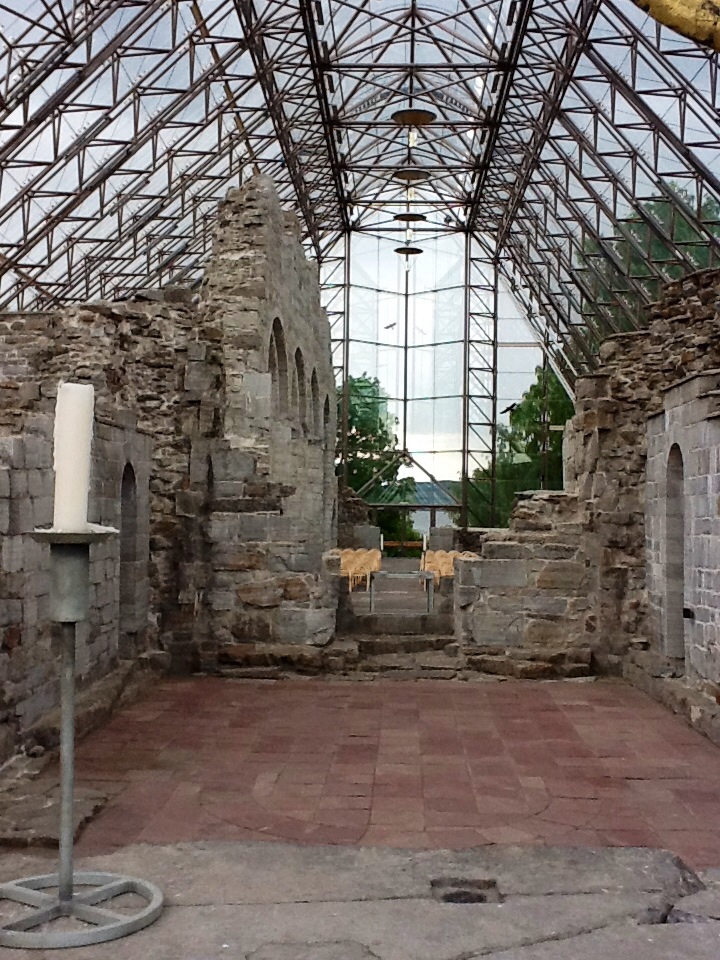
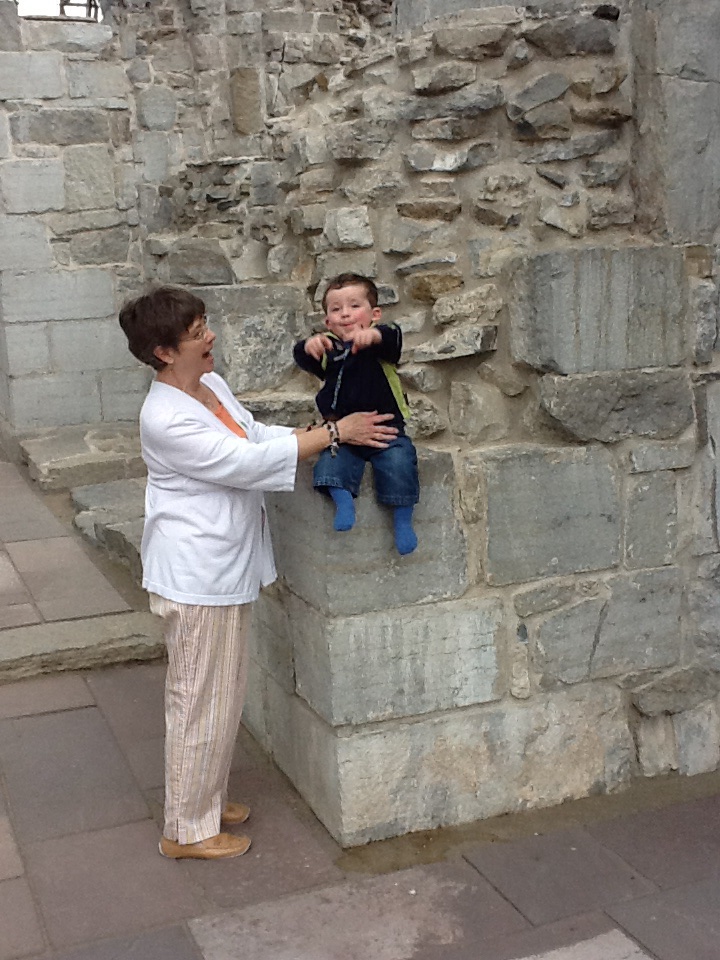
Gayle is on a roll with photo challenges. Here is our contribution to Jennifer’s One-Word Photo Challenge. As in the previous blogged photo challenge, Gayle immediately thought of Norway, but this time the very creative encasing of a ruined medieval cathedral in a new steel and glass structure to protect it from the elements. In 2012 she toured the Cathedral in Hamar, Norway guided by her son-in-law Jørgen and accompanied by her then-13-month-old grandson, Gustav Sebastian.

The cathedral was originally built 1152-1200, demolished in 1567 through a siege by a Swedish Army and subsequent fire during the Northern Seven Years’ War and centuries later was enclosed in this modern protective structure designed by architect, Kjell Lund, completed in 1998. Besides being part of the very impressive Hamar Museum on the shores of Lake Mjösa, the structure now provides excellent acoustics for special religious services and for concerts.

Below are a few more photos we took during our tour of the cathedral, including that of a drawing of the cathedral before it was destroyed.

image
image

image

image

image

imageimage

Celebrating Mothering and Grandparenting

As Mother’s Day approaches I’m enjoying so many uplifting and poignant messages on Facebook regarding motherhood, as well as savouring the sight and smell of flowers that were just delivered to me from my daughter who lives with her husband and children in Norway. I’m also anxiously awaiting a call from my son who lives in California and hearing from my step-daughters in Manitoba. Yes, they are all too far away from our British Columbia home, but I guess that is a common situation in present-day life. Thank God for the modern convenience of Facetime so that we can regularly communicate and even see each other on my ipad and their iphones. (My son and I regularly go for a “walk” in the garden he maintains for the house he lives in and down to the nearby beach to check out the sand and surf.) Since Ian and I live in a popular retirement spot, many of our friends here also have children and grandchildren who are residing in other corners of the earth. Through Skype, Facetime and the like, they also manage to communicate and keep up with distant family members with the occasional long-distance flight to touch base in person.

I’m sharing a Pic Collage photo I compiled on my ipad to commemorate our great-grandchildren and two youngest grandchildren – the youngsters (or “wee’uns,” as Ian would call them in his Scottish vernacular) – the children in our lives who live far away from us (in Saskatchewan, Manitoba and Norway) for whom we are Grandpa and Grandma and to whom we will be dedicating our children’s chapter book, “Jake, Little Jimmy and Big Louie,” for which I am presently doing the layout. Here they are: going around clockwise from the top center: Leland, 13 (our age-appropriate consultant for the book); Hannah, 8 (who did the drawings for the book); then Logan, 4; Brayden, 2; Lexi,2; Eva, 9 months; Gustav, 3; Caleigh, 6; and Madison, 4.  (We also are expecting two more great-grandchildren later this summer. The two photos  in the center show Grandpa Ian at his 80th birthday party in Winnipeg with six of the great-grandchildren and one grandson (Calan) whose daughter wouldn’t pose without him; plus the bottom photo of Ian and me on our 7th wedding anniversary at home in Vernon, September 7, 2010 (on the day he had his heart attack, mind you!)

photo (2)

My husband Ian (the author) just turned 82 last week and is presently in a local care home for a 2-6 week “short stay convalescent care program” to help him regain some strength, balance and walking ability after over five years of serious illness and lots of medications which have saved or bettered his life but also are essentially poisonous and have lots of nasty side-effects, the worst of which has been neuropathy in the feet. I’m happy to say that a set of new orthotics plus the exercises, physio- and occupational therapy he is receiving daily is helping. I’ve seen a lot of progress in just a few days that he has been there.

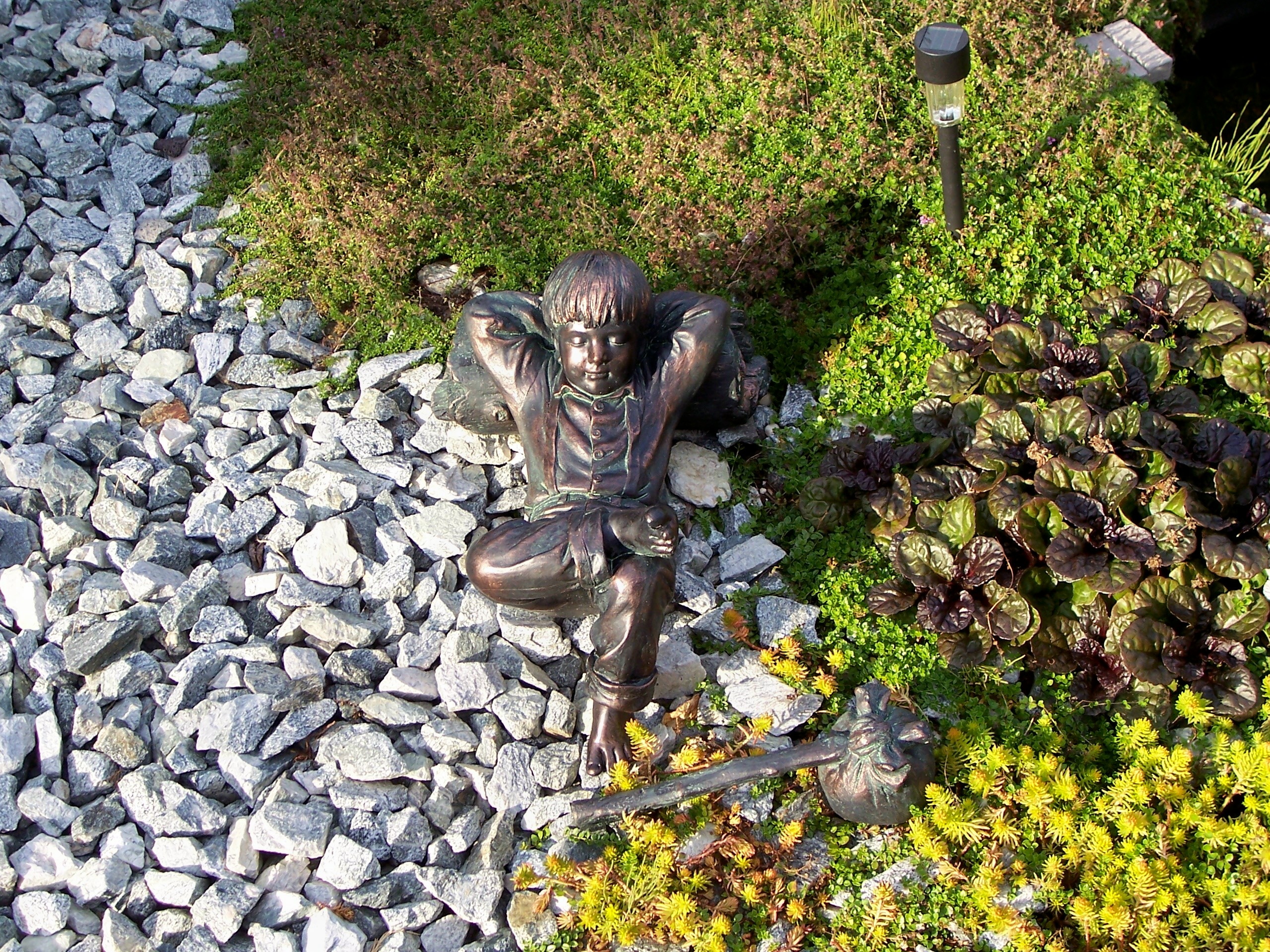
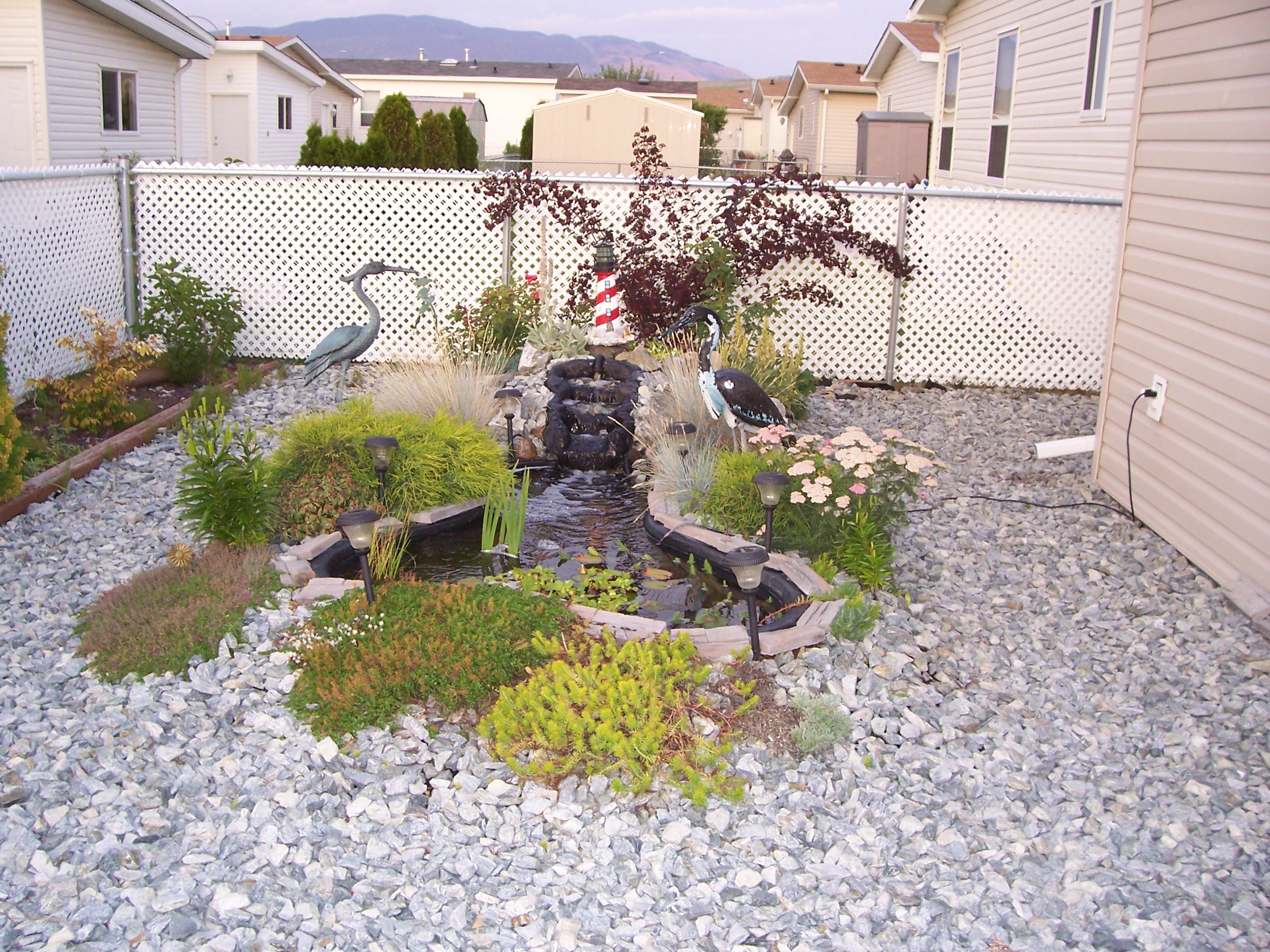
In the meantime I’m enjoying some time alone at home with only the dog to take me away  from gardening and layout duties. Misty supervises me as I plant flowers in boxes and pots on our front porch, prune the shrubs in our front and back xeroscaped gardens, get the gazebo canopy and curtains set up and hire a worker to come in and clean out our pond and waterfall. I did the latter for the first time last year and could hardly stand the sight and stench of an about-two-inch layer of rain worms that had crawled into and died in the pond at the end of last autumn, during part of our mild winter and then so far this spring. I realize they are also God’s creatures, but they are ones I’d just as soon not encounter. I’ve also included some photos of our back yard from last year to share some of the beauty of our surroundings. The first photo is of my “Benjamin memorial” to remember my infant grandson who died in 2011 in Norway at 13 days old, the day after I had arrived there. The other photos show our xeroscaping, gazebo, pond and waterfall. Hopefully, Ian will be home soon to enjoy it all as well.

Benjamin memorial 1 in my garden

Backyard-Another view Patio-pond and Waterfall

We also wish to remember and honour our own mothers who passed away in 1995 at the ages of 86 (Ian’s) and 96 (mine) in 2001. Their birthdates were within a day of each other but a few years apart: Chrissie’s on June 15 (1909) and Mil’s on June 16 (1905).

Chrissie Morrans Moorhead

Ian’s mother, Christina Morrans Moorhead, known  as “Wee Chrissie” and to her grand- daughters as “Campbeltown Gran.”

                   OUR MOTHERS

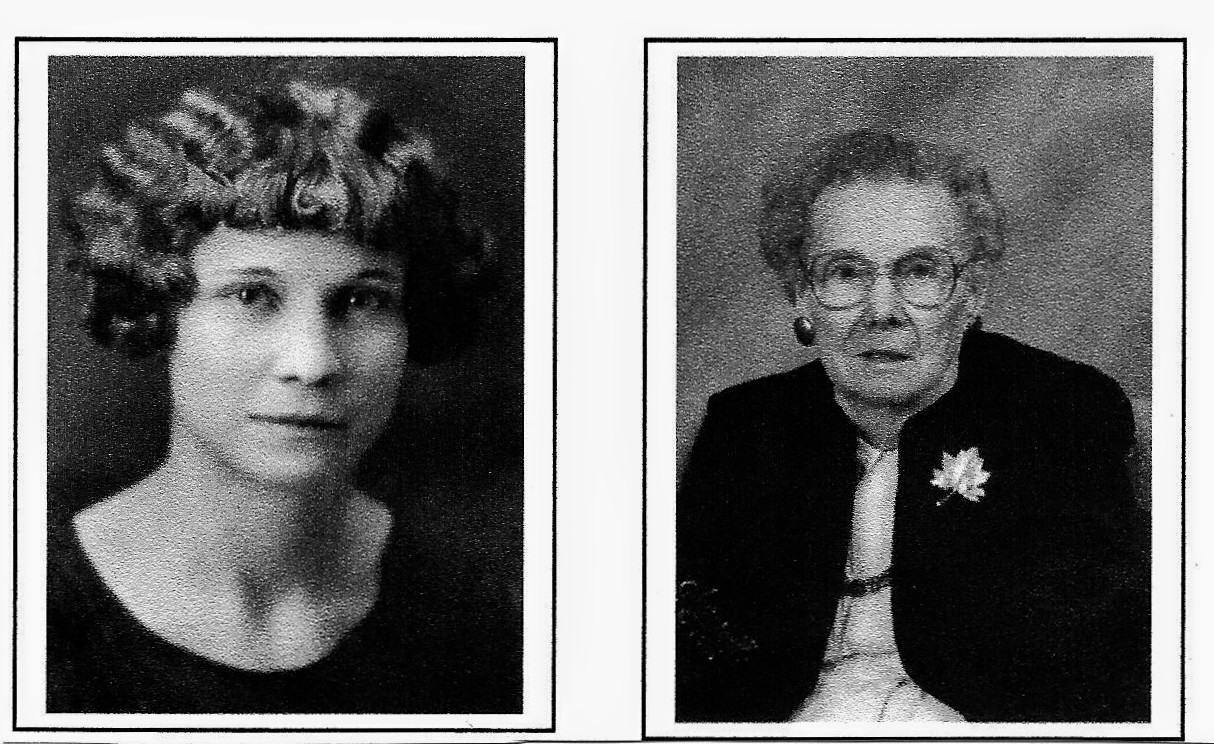
Mildred Nelson Moore at 20 and 90

Gayle’s mother, Mildred Nelson Moore at ages 20 and 90, known as “Mil” and to her grandchildren as “Grandma Mil.”


Happy Mother’s Day to all mothers on your special day on Sunday, May 11th. After church, my friend Jean (whose children are also far away) and I plan to drive up to our neighbouring Davison’s Orchard Farm, have Mother’s Day luncheon at Auntie May’s Cafe and enjoy a walk through the blossoming apple, pear and peach trees before our dog, Misty, and I go to visit Ian. Sounds like a fun day!

Gayle Moore-Morrans

Another Campbeltown Story Inspired by James Collett’s Photography

campbeltown-from-beinn-ghuilean-pano-bw-wm-web

Thanks again to Photographer James Collett for this terrific picture of Ian’s hometown as seen from Ben Guillion, the mountain pictured in our previous post. We have made the following comments on James Collett’s Photography page where we found this photo:

“Another beautiful view of my hometown, Campbeltown, from Beinn Ghuilean (Ben Guillion mountain). I have a story in my memoir “From Poverty to Poverty: A Scotsman Encounters Canada” which takes place after World War II when I, as a boy, “salvaged” a machine gun from the wreck of an aircraft on Ben Guillion and lugged it to a hiding place in the middle of some whin bushes, much like those shown on this picture. I never was able to find it again (probably just as well.) Here’s the story which happened around 1946:

I think I was about twelve when the following happened. Just to the south of the town, and bordering on it, is Ben Ghuilean (the Gaelic spelling; normally now it is referred to as Ben Gullion. The word “Ben” in Scot’s English means “mountain.”) This is a reasonably-sized mountain. I have already referred to a small airfield five miles from town. This airfield was still used after the war to some extent for training Royal Air Force pilots. One foggy day a two-seater aircraft plunged into the side of that mountain, killing both airmen.

It was quite a climb to the crash site and, needless to say, there were lots of (morbid-minded) townsfolk who just had to make the climb, though they would never have considered doing so at any other time. Apart from the strenuous effort, it was well known that there were adders on the mountain. (Adders are a type of viper, a little over two feet long. The bite of this snake, while it wouldn’t kill you, would make you very ill for some time.) This thought didn’t bother us brave (or stupid) lads, as we spent quite a lot of time on various faces of the mountain. (I had killed an adder some time before and preserved it in alcohol in a glass jar to keep in the house. No one objected at first, but later I had to keep it where we kept our coal.)

No one was allowed anywhere near the crash site until the bodies of the two airmen were removed. People were collecting bits of this and bits of that—stuff that probably went into the rubbish bin (garbage) a few weeks down the road after they had lost interest in the incident. Not so with “yours truly.” I noticed that there were two machine guns, one on each wing, and I set about removing one. What did I want a machine gun for? Maybe I was going to take it to class for “show and tell.” Na, we didn’t have that silly exercise in those days. I really had no idea why I was taking it. I guess it is what the modern kids would call “cool.”

Anyway, I struggled with it for ages and finally got it free. Even today, I still marvel at the fact that I got a machine gun from an aircraft without having a spanner (wrench) or even a pry-bar. I carried the heavy thing down the mountainside on my shoulder to the foothills, where I hid it by throwing it into the middle of some “whin bushes” (furze or gorse). These bushes were evergreen, covered all over with long, sharp dark green needles, standing three or four feet high and at least that across, with nice yellow flowers. (They grow wild in Scotland, but I don’t believe they grow in North America, unless maybe on the east coast.)

I hid the gun because it was still daylight and I didn’t want anyone to see me walking into town with a machine gun over my shoulder. Besides, I had to walk past the police station! I would probably have been arrested (or worse still, maybe even talked about). So, what did I do when it was time to retrieve it? Well, I got hold of some old potato sacks (gunnysacks), my friend Ian McKenzie and his four-wheeled cart, and the two of us headed back up to where I had hidden the gun.

What do you know? It wasn’t there! Did I have the correct bush? “Look over there …. No … try this one … .” There were lots of clumps of bushes. We just about went crazy! I was quite sure that I had taken note of where I had hidden it so that I would find it again. It should still have been there. Well, the two of us searched for ages, all around where I thought it should be, but with no luck. Since the bush was very prickly, I had to get flat on my belly, as low as possible to try to avoid the needles and crawl into the bushes at every place I thought the gun might be. It was awful! We got all scratched and thoroughly disgusted before we decided that it wasn’t there. Remember that during this “carry-on” we little boys were wearing short trousers that came only to our knees.

What I finally figured was that someone had seen me hide the gun and, after I had gone, removed it and took it to the proper authorities. Either that, or I had got really screwed up and there is still a machine gun hidden among some bushes for future archaeologists to find a long time down the road. Anyway, it was a very stupid thing to do and I don’t know what my mother would have said if I had walked into the house carrying a great big machine gun. One thing’s for sure—I would have got a thick ear!

Quoted from “From Poverty to Poverty: A Scotsman Encounters Canada” by Ian Moore-Morrans, copyright © 2012. Friesen Press.