Yesterday we received our copy of 50 Great Writers You Should Be Reading, 2013-2014.
 Very nicely done and interesting reading about other writers and how they came to write. Ian is featured among the 50 writers, all chosen by public vote after reading writer’s essays about “How I Write”. The writers had all previously been interviewed on The Authors Show about a specific book they had written. Ian’s interview was about his memoir published in 2012 entitled From Poverty to Poverty: A Scotsman Encounters Canada. In the media release about Ian’s win, Ian is quoted as saying:
“The central message of my book is that it is possible to overcome a negative lifestyle like poverty. However, in order to do so, one has to have grit, perseverance, sometimes luck and even humor to get through it all. I’ve tried to look for humor in each and every situation. When all else fails, a good laugh and then, determining to pick yourself up and start anew, will help you deal with most things that life throws at you.”
“The central message of my book,” Ian continued, “is that it is possible to overcome a negative lifestyle like poverty. However, in order to do so, one has to have grit, perseverance, sometimes luck and even humor to get through it all. I’ve tried to look for humor in each and every situation. When all else fails, a good laugh and then, determining to pick yourself up and start anew, will help you deal with most things that life throws at you.” – See more at: file:///C:/Users/Gayle/Desktop/AUTHORS%20SHOW/MEDIA%20NEW%20RELEASE/Final%20Media%20Release.htm#sthash.CM9gqbAA.dpuf
Another blogger – Kev – sent us a comment a short time ago remarking that he enjoyed some of our pictures from book readings and noted “Beautiful pic…some great laughter going on there.  .
.
Here is our favourite photo from a book 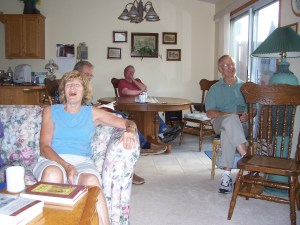 reading, showing some of Gayle’s relatives enjoying a humorous story from Ian’s book, From Poverty to Poverty: A Scotsman Encounters Canada. (Thanks for your hearty enthusiasm, cousin Janice! The menfolk all look amused as well, but quite a bit more subdued.)
Gayle’s reply to Kev was: “Your nice comment about the pictures and laughter has inspired me to put on a future post a humorous excerpt from Ian’s memoir. I think the excerpt that generated most of the laughter came from Ian’s story which he calls “More Than Slightly Sloshed.” Look for it in the next few days – as soon as I have time to put it on this website.”
Well, those “next few days” have grown to several weeks so it is high time that I (Gayle) fulfill my promise. So here is the excerpt from Ian’s story.
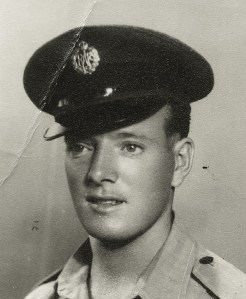
Airman Ian Morrans, Royal Air Force, 1951, RAF photo.
To set the scene, the year is 1950. Eighteen-year-old Ian has just completed his “square bashing” (basic training) with the Royal Air Force in southern England and tells of his disastrous first leave home to Campbeltown in southwest Scotland.
Then I got one week’s leave and was given my travel warrant to go home. From there I was to go to RAF St. Athens in Wales, about 17 miles west of Cardiff, not far from Bridgend. It was hardly worth going home, as it meant two days’ traveling time each way. I just got there and it was almost time to head out again. As things turned out, I really shouldn’t have gone at all! Here’s why. I call this story, “More Than Slightly Sloshed!”
I arrived at our house in Campbeltown at 9:30 in the evening after being on trains or waiting for connections in train stations for a total time of about 20 hours. I found two of my mother’s Salvation Army lady friends visiting her, the three of them huddled around a roaring coal fire.
Noticing a strange smell, I asked my mother what was causing it. She replied, “Oh it’s Bill; he’s makin’ whisky in the wee room.” (To us Scots, a “wee room” is a wee bit wee-er than a small room!)
My Irish stepfather Bill was not of the Salvation Army persuasion! Very often in the years since he’d married my mother, he’d told stories of how he and his buddies would go up into the hills at Antrim and make poteen, the Irish equivalent of “moonshine” or home brew. Even then I had no idea that it was close to 100% alcohol! I had heard him remark that he was going to make some “one of these days.” I’d heard it so often that I was sick and tired of hearing it, as well as many other of his stories of this, that and the next thing that might or might not have been true. Well, when my mother said that Bill was making poteen, I couldn’t believe it. I thought he was doing his usual bragging with no truth to it—and that wouldn’t have been unusual!
As I sat talking with the women, basking in their remarks such as, “Oh, Ian, don’t ye look handsome in your Royal Air Force uniform,” my mother tried to get me to eat something. I told her that I was dead beat and just wanted to go to sleep. At this point, Bill came through, said hello to me and asked me to taste his “brew.” What he handed me was a glass tumbler with about four or five ounces of clear liquid in it. Not knowing it was so strong, I had almost downed the lot when Bill shouted, “Stop, stop, that’s all I’ve got.”
Because it looked so much like water, I had had no hesitation in drinking it. Remember, I was not accustomed to alcoholic drinks of any kind. I didn’t know at the time that I was drinking pure alcohol! There was about an ounce left for Bill after all his hard work. It had taken him two days to distill that small amount.
Shortly after this I started feeling a bit woozy, especially as I had virtually an empty stomach. A little while later I said “goodnight” to everyone and took myself off to bed. Stumbling to my room, I stripped off, hopped into bed completely naked and was asleep almost immediately.
The next morning I got up, surprisingly clearheaded, and wandered into the living room. There was a fine, white dust everywhere and I said to Mother, “What is this white powder all over the place.”
“Oh, that was ye last night, ye daft bugger,” she replied, in the middle of trying to clean things up. “Ye came through here aboot an hour after ye had gone to bed, absolutely naked, walked in between my two friends and peed all over the fire.”
“You mean that Ah came through here, sleep-walking, stark naked, in front of Mrs. Campbell and Mrs. MacGregor? Me with no clothes on?” I was horrified!
My mother continued. “Ye should have seen the steam that ye created, plus all the ash that went up into the air with it. There was a stifling white cloud all over the house, not to mention all over the three of us, and Ah think Ah’ll be dusting here for a month. We were afraid to waken ye in case we did something wrong!”
To add to my embarrassment was the fact that both of Mother’s visitors were strict Salvation Army believers. I realized that what they thought about my imbibing—my getting fully pissed—well, that was certainly somewhere above the forgiveness level. By then I must have been the talk of the town! Even a long time later, whenever I was home on leave and I saw either of those women on the street and heading my way, I would cross over to the other side—just a wee bit more than slightly embarrassed! Strangely, no one but Mother ever mentioned the incident to me.
Somehow, it seemed, my Salvation Army days were really over. To quote my mother, “Since ye joined the Royal Air Force, ye’ve gone tae the Devil!”
— quoted from “From Poverty To Poverty: A Scotsman Encounters Canada,” p. 96-98, copyright © 2012, Ian Moore-Morrans.


 Like a number of sports, the origins of curling are up for some debate. After all, who can say which person or people group were the first to enjoy skimming stones across frozen water? Because of the conditions needed, it seems a sure bet that it originated in a northern European country. Wherever it began, few will dispute the fact that the pastime developed into a modern sport in Scotland.


 MOOMOR PUBLISHING