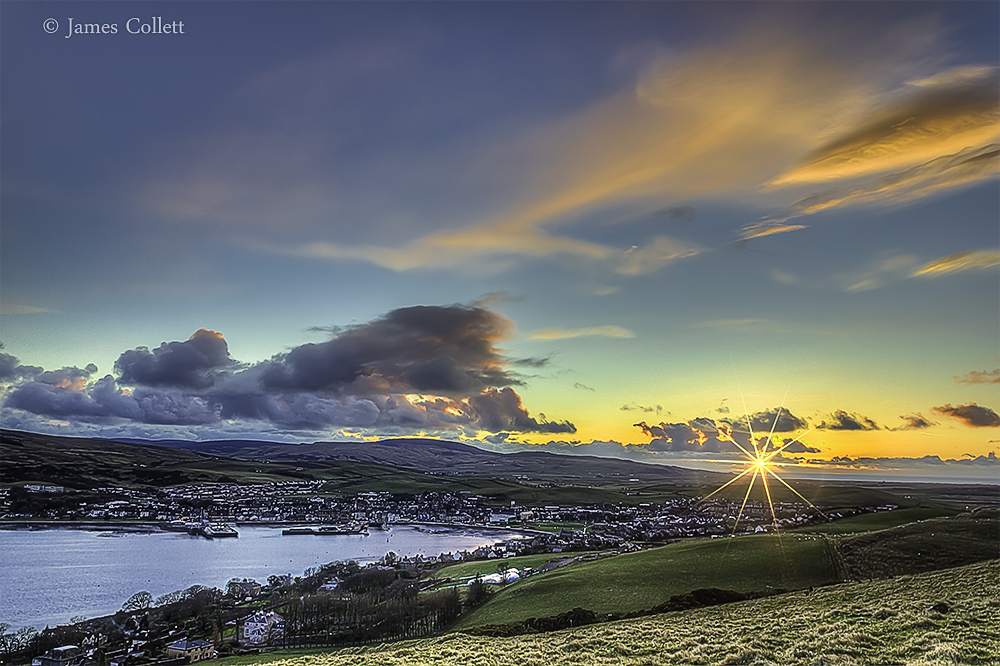
Another Campbeltown Story Inspired by James Collett’s Photography

campbeltown-from-beinn-ghuilean-pano-bw-wm-web

Thanks again to Photographer James Collett for this terrific picture of Ian’s hometown as seen from Ben Guillion, the mountain pictured in our previous post. We have made the following comments on James Collett’s Photography page where we found this photo:

“Another beautiful view of my hometown, Campbeltown, from Beinn Ghuilean (Ben Guillion mountain). I have a story in my memoir “From Poverty to Poverty: A Scotsman Encounters Canada” which takes place after World War II when I, as a boy, “salvaged” a machine gun from the wreck of an aircraft on Ben Guillion and lugged it to a hiding place in the middle of some whin bushes, much like those shown on this picture. I never was able to find it again (probably just as well.) Here’s the story which happened around 1946:

I think I was about twelve when the following happened. Just to the south of the town, and bordering on it, is Ben Ghuilean (the Gaelic spelling; normally now it is referred to as Ben Gullion. The word “Ben” in Scot’s English means “mountain.”) This is a reasonably-sized mountain. I have already referred to a small airfield five miles from town. This airfield was still used after the war to some extent for training Royal Air Force pilots. One foggy day a two-seater aircraft plunged into the side of that mountain, killing both airmen.

It was quite a climb to the crash site and, needless to say, there were lots of (morbid-minded) townsfolk who just had to make the climb, though they would never have considered doing so at any other time. Apart from the strenuous effort, it was well known that there were adders on the mountain. (Adders are a type of viper, a little over two feet long. The bite of this snake, while it wouldn’t kill you, would make you very ill for some time.) This thought didn’t bother us brave (or stupid) lads, as we spent quite a lot of time on various faces of the mountain. (I had killed an adder some time before and preserved it in alcohol in a glass jar to keep in the house. No one objected at first, but later I had to keep it where we kept our coal.)

No one was allowed anywhere near the crash site until the bodies of the two airmen were removed. People were collecting bits of this and bits of that—stuff that probably went into the rubbish bin (garbage) a few weeks down the road after they had lost interest in the incident. Not so with “yours truly.” I noticed that there were two machine guns, one on each wing, and I set about removing one. What did I want a machine gun for? Maybe I was going to take it to class for “show and tell.” Na, we didn’t have that silly exercise in those days. I really had no idea why I was taking it. I guess it is what the modern kids would call “cool.”

Anyway, I struggled with it for ages and finally got it free. Even today, I still marvel at the fact that I got a machine gun from an aircraft without having a spanner (wrench) or even a pry-bar. I carried the heavy thing down the mountainside on my shoulder to the foothills, where I hid it by throwing it into the middle of some “whin bushes” (furze or gorse). These bushes were evergreen, covered all over with long, sharp dark green needles, standing three or four feet high and at least that across, with nice yellow flowers. (They grow wild in Scotland, but I don’t believe they grow in North America, unless maybe on the east coast.)

I hid the gun because it was still daylight and I didn’t want anyone to see me walking into town with a machine gun over my shoulder. Besides, I had to walk past the police station! I would probably have been arrested (or worse still, maybe even talked about). So, what did I do when it was time to retrieve it? Well, I got hold of some old potato sacks (gunnysacks), my friend Ian McKenzie and his four-wheeled cart, and the two of us headed back up to where I had hidden the gun.

What do you know? It wasn’t there! Did I have the correct bush? “Look over there …. No … try this one … .” There were lots of clumps of bushes. We just about went crazy! I was quite sure that I had taken note of where I had hidden it so that I would find it again. It should still have been there. Well, the two of us searched for ages, all around where I thought it should be, but with no luck. Since the bush was very prickly, I had to get flat on my belly, as low as possible to try to avoid the needles and crawl into the bushes at every place I thought the gun might be. It was awful! We got all scratched and thoroughly disgusted before we decided that it wasn’t there. Remember that during this “carry-on” we little boys were wearing short trousers that came only to our knees.

What I finally figured was that someone had seen me hide the gun and, after I had gone, removed it and took it to the proper authorities. Either that, or I had got really screwed up and there is still a machine gun hidden among some bushes for future archaeologists to find a long time down the road. Anyway, it was a very stupid thing to do and I don’t know what my mother would have said if I had walked into the house carrying a great big machine gun. One thing’s for sure—I would have got a thick ear!

Quoted from “From Poverty to Poverty: A Scotsman Encounters Canada” by Ian Moore-Morrans, copyright © 2012. Friesen Press.


A Photo A Week Challenge: Blue and White

Thanks, James, for another fine photo of Ian’s hometown area. He had Campbeltown’s mountain, Beinn Ghuilean (or Ben Guillion as Ian and others sometimes spell it), in mind when he penned his short story “The Moonlit Meeting” which can be read  by going to that section of our blog.

Ian describes the background to his story thus: “I wrote this short story around 2001 when I was living in Pictou, Nova Scotia. It was my first attempt at writing dialect, though this time it wasn’t Scots-English but Irish-English. I heard this dialect a lot as a youngster since my step-father, Bill Moorhead, was from Larne in Northern Ireland.

“When picturing ‘Mary’s Mountain’ I had Ben Guillion in mind, the mountain that I climbed many times just outside my hometown of Campbeltown on the Kintyre peninsula in Argyllshire, Scotland. On a clear day we could see the coast of Northern Ireland from Campbeltown.”

Am I a Co-Author or Just the Editor?

This is Gayle Moore-Morrans blogging. We previewed most of the chapters of Ian’s children’s chapter book, “Jake, Little Jimmy and Big Louie” on this site last year and asked for some feedback from others as well as asking two of our great-grandchildren for input prior to publication – — Now-13-year-old Leland for consultation on the appropriateness of the book’s contents for his age group and now-8-year-old Hannah for some drawings to illustrate the book. In our post of March 21, 2013 I blogged Leland’s review entitled: “Wow!” A Recommendation for Ian’s blogged book, “Jake, Little Jimmy and Big Louie.” I’m now ready to re-scan Hannah’s illustrations for the book as I’ve edited them on Microsoft Paint. Our new printer – an HP OfficeJet Pro 8600 is finally installed and ready for me to do the layout. Here is a preview of the book’s cover illustration showing the boy Jake, and, on his shoulders, his BFFs, Little Jimmy the budgie and Big Louie, the raven.

000-Cover Photo

I’ve usually been identified as Ian’s editor, blogger, publishing and marketing person. How should we recognize my role in this children’s book that has evolved over the years it has been in the making? Am I just the editor or am I also the co-author? In our previous post I re-blogged a very helpful post by Francis Guenette on how she is writing with her mother even though her mother is no longer living. That prompted me to reply to her my thanks for answering a question that my husband Ian and I have been mulling over the past months.

Here are my comments on Francis Guennette’s blog post “Writing with My Mom.”

               Wow, did your blog post on writing with your mother ever resonate with me, Fran! In fact, I feel it has answered a few questions I’ve had in the past year. As you know, our blog is mostly about my husband Ian’s writings. When I started out editing his stories about nine years ago I had just retired from my editing job, we had only been married a year and soon headed for Mexico in our motor home to explore retirement there. I relished getting to know him better through his writings, especially becoming familiar with his impoverished upbringing in Scotland during the depression and war years, his military service with the RAF in Egypt and his early marriage and fatherhood and then immigration to Canada. Editing that book was a true editing job in that I took his words and only changed them for grammatical reasons when necessary but then rearranged large chunks in a much more logical sequence as he had pretty much written it in a “stream of consciousness” fashion. When I found there were gaps or inconsistencies I returned the manuscript to him for additions and clarification. Though Ian was in his early 70s then, he was in robust health and had energy to burn. When he wasn’t writing he was entertaining by performing Scottish songs or teaching me his repertoire so that we could sing and perform together.

                That way of working cooperatively continued after our move back to Canada two and a half years later. But it lasted only for a little over a year when a sudden illness brought him to death’s door and a long hospitalization, much of it while he was in an induced coma. Recovery from the near-fatal illness was a slow process. He was kept alive and healed by over five years’ treatment with prednisone; however, it is basically a poison which wrecked havoc on the rest of his body. A heart attack in 2010 necessitated five stents in his arteries and another regimen of medication, exercise and diet changes. Now at 81, he is pretty much a recluse, rarely sings, no longer writes and rarely even reads. He sleeps a lot and is lucid mostly late afternoons and evenings but doesn’t have the energy to do much with his pile of writings which still need to be published, nor has he been able to do anything about promoting those which have already been published.

               That’s where I come in. I’ve put aside the pile of writing I’ve done over the years, mostly on spiritual insights and family history and feel it is my “labor of love” to try to get the rest of Ian’s writings edited and published. However, as you’ve found with your mother’s writings I have been grappling with the fact that I no longer can ask Ian to do re-writes when I feel they are warranted. Like you said with your mother’s work, “I began to make changes and what I was doing was much more than editing.” Ian and I have discussed how to address the authorship of the next book which I hope will be coming out soon. Granted, he is the main author. He originally wrote the children’s story, nursed it through a number of revisions over the years and had sent it to several publishers even before I met him. It was hung up on the need for editing though. I now have done the editing but have also made a number of changes in the story and added a spiritual component to it which I felt was lacking and needed. It no longer is just the story that Ian wrote. I’ve also recruited our 8-year-old great-granddaughter to do the illustrations for the book and have extensively adjusted those illustrations using Microsoft Paint to make them more consistent and the characters more uniform. So how do we identify the authorship of the book? Ian and I have discussed this and have tossed around listing a co-authorship or a “with” authorship such as “by Ian Moore-Morrans with Gayle Moore-Morrans.” We’ve thought that perhaps the former gives too much credit to me and perhaps the latter makes it look as if Ian had a ghost writer (which certainly isn’t the case).

               I found your remarks helpful when you stated, “I will put the book out in both our names and claim co-authorship for my mom’s stories – though her name will appear first. No matter the work I’ve done, the one who came up with the ideas and the characters deserves first billing.” So I’m feeling more at peace with the “by author with another author” claim.

               What a great legacy your mother has left you and how wonderful that you can keep her memory so alive by working with her writings. I have the added advantage of still having Ian here with me so I can toss ideas and solutions around with him even though he can no longer physically do the re-writes and adjustments. I can even do future book readings and promotions for him without having to take along videos of him reading from the particular book. (Something I did twice in 2012 when I was able to travel to the States to do book readings/sales for Ian when he was unable to travel there because he couldn’t get travel insurance to go out of Canada.)  In addition, Ian has added an addendum to his will granting me full ownership of his writings, both published and unpublished and free rein in pursuing publication of any as-yet unpublished writings of his.

               I wish you well with your co-authorship adventure with your mother and plan to re-blog this latest post of yours on our blog at ianmooremorrans.com. Thanks for your insights.

Gayle Moore-Morrans

The Scottish Roots of Curling

The Scottish Roots of Curling

Andrew McDiarmid has shared on his Simply Scottish blog this fascinating account of the origins of the sport of curling. Thanks for posting this Andrew. We are also enjoying tuning in to your “Sport in Scotland” series on your PodOmatic broadcasts on Simply Scottish.

It has been great watching both the CANADIAN MEN’S AND WOMEN’S OLYMPIC CURLING TEAMS take the GOLD MEDALS at the Sochi Olympics. We are also sharing this in honour of our son-in-law, Eugene (Carl) German of Winnipeg who is also a champion curling skip.

Andrew McDiarmid's avatarThe Simply Scottish Blog

Like a number of sports, the origins of curling are up for some debate. After all, who can say which person or people group were the first to enjoy skimming stones across frozen water? Because of the conditions needed, it seems a sure bet that it originated in a northern European country. Wherever it began, few will dispute the fact that the pastime developed into a modern sport in Scotland.

The first evidence of such a game in Scotland was uncovered when an old pond was drained in Dunblane. Two curling stones were found bearing the years 1511 and 1551 on them. Written evidence from 1540 records what seems to be a legal dispute that was settled on the ice between John Sclater, a monk in Paisley Abbey and Gavin Hamilton, a representative of the Abbot. The word curling appears in the work of Scottish poet and historian Henry Adamson…

View original post 433 more words

Andy Stewart and “Campbeltown Loch, I Wish Ye Were Whisky”

'The Toon'

In our previous post we reblogged this gorgeous photo by Scottish photographer and blogger James Collett from Ian’s hometown area, Campbeltown, Argyll, on the Kintyre peninsula in southwestern Scotland. This has to be one of the most beautiful photos we’ve ever seen and it makes Ian a wee bit homesick.

Below is the promised excerpt regarding Campbeltown Loch and Andy Stewart from Ian’s memoir, “From Poverty to Poverty: A Scotsman Encounters Canada,” pages 31-32, copyright © 2012 by Ian Moore-Morrans.

“The loch at Campbeltown (a sea-loch) is in the shape of a horseshoe lying on its side with the opening facing east. (‘Loch’ is the Scottish word for ‘lake.’ It has a guttural ‘ch’ sound similar to that in the German word ‘ach.’ The sound is made by forcing air between the back of the tongue and the soft palate at the roof of the mouth. This is a totally alien sound to most English-speaking people, who generally manage to say ‘lock’.)

“Campbeltown Loch is about three kilometers (two miles) in length from the opening of the ‘horseshoe’ to the harbour at the western end. Guarding the mouth of this haven for sailors during rough weather is Davaar Island (two syllables, Da-vaar—emphasis on the ‘v’).

“The first lines of a song about Campbeltown Loch, I would like to think “us wee boys’ in Campbeltown gave to a certain wee man as the idea for a hit song he made famous in the 1960s— ‘Campbeltown Loch, I Wish Ye Were Whisky.’ (Some claim it was an old Scots folk song or a song based on an old pipe tune; others that it was written by Andy Stewart.) Whatever the truth, renowned Scottish entertainer Andy Stewart (now deceased) made it a very popular song in Scotland, possibly all over the world. You see, as we were growing up, three or four of us would go arm in arm down the street singing the first few words—’Campbeltown Loch, I wish ye were whisky’—that’s all we knew at the time. I like to think that Andy heard those few words sometime in Campbeltown and created a song around them. ‘Oh, Campbeltown Loch, I wish ye were whisky, Campbeltown Loch, och aye! Campbeltown Loch I wish ye were whisky, I would drink ye dry!” [1]

“The verses cleverly have the singer imagining how nice it would be if the loch were full up to the brim of whisky and he could anchor a yacht in the whisky-filled bay to go in for a nip and a dip ‘by night and by day.’ Clan gatherings would feature wading into the loch with toasts of ‘Slainte Bha’ (pronounced ‘Slanj-eh-vah’—good health). The only problem would be the police showing up in a boat and shouting, ‘Time, Gentlemen, please!’ I find this a fitting tongue-in-cheek ode to a town that once boasted of 30 distilleries and still produces at least two very fine brands of single malt whisky – Springbank and Glen Scotia.

“(I’m going to jump many years ahead now to the time that my wife and I went to hear him when Andy Stewart was performing in Winnipeg, Manitoba. When he was exiting the theatre, I went up to him and asked if I could shake his hand. That got his attention! I thanked him and told him that he had put my little town on the world map. Then I told him the story of us boys singing the only bit that existed away back then. …)”


[1] Chorus of “Campbeltown Loch, I Wish Ye Were Whisky” a Scottish folk song popularized in the 1960s by Andy Stewart (1933-1993).