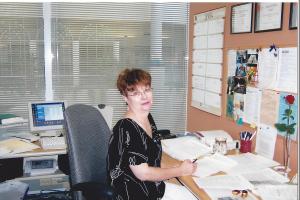
 At left you’ll see a photo of “editor me” at my desk on one of the last days before retirement (in 2004) as Editor of Esprit magazine and Program Director for Evangelical Lutheran Women at our office on the second floor of Portage Place in Winnipeg. In addition I’ve included a photo of the gift I received at my retirement party in July 2004. As Ian and I were preparing to take off for a retirement adventure driving down to Mexico in our newly acquired 35-foot motorhome, my boss chose to wrap an assortment of “helps” for that trip inside or underneath a large box decorated to look like our motorhome – complete with photos of Ian as driver and me as passenger.
After several years in Mexico, with trips up to Manitoba to maintain our Canadian residency, we returned to Canada for good. I hope to start blogging about our Mexico sojourn in the near future. Time will tell if I ever get to it. While there in Mexico I began editing Ian’s writings and am continuing that in our present home in British Columbia, as well as now contributing to his writings. Here my desk is in our little den and I look out the window at the low mountains surrounding our part of the Okanagan Valley. The desk is different from the one at ELW, but just as messy. That’s the way I work. I do not like a messy final product, however, and decided that it was time for me to have an editor’s rant about what I am seeing on some web blogs and in many comments that come into our site.
I don’t think I’m unique in claiming frustration when reading some comments on web blogs or even some particular web blogs which are so full of errors in grammar, spelling, punctuation or just plain English that I feel compelled to edit them as I’m reading. Sometimes even understanding them is impossible, so I quit reading and trash the comment or close the web blog.
As I routinely check out other web blogs, I am more-often-than-not impressed by so many varied topics and excellent writing, but am also occasionally appalled by the lack of English writing skills by some bloggers. In those cases, I cross those web blogs off the list of ones I want to follow, no matter how interesting the topic might be. I find it painful to read something when I feel a need to correct practically every sentence. (As an aside: I lived in Germany for 18 years and ended up speaking passable German but would never in my life think of hosting a blog in German! I wouldn’t feel confident enough to do a decent job of it. My late husband who worked in a profession there, could easily have hosted a blog in German. Obviously his language skills were much superior to mine.)
My motto is: “check, double-check and recheck anything you post”, for it is easy to miss a word here or there if one doesn’t do so. I always try to self-edit any of my blogs and usually have Ian read through them before posting. That isn’t to say that I might not post a small grammatical or spelling error from time to time. It happens to the best of us. Almost inevitably after checking and re-checking the magazine I edited and having our executive director and a professional copy editor go over everything before publishing, I would find some little thing wrong when reading the issue after publication.
In the past I’ve found myself editing a lot of comments that come in on this web blog so that they can be understood. I conclude that quite a few of those who comment on posts do not have English as their first language and are obviously using an English-to-another-language dictionary when they make their comments. Perhaps they are taking an ESL course and have been given an assignment to comment on specific web posts. (Comments often come from the same site with different email addresses.) If that is the case, how I wish the instructor would at least give them some help in making the comments understandable. It is nice to get compliments or constructive criticism, but not if the comment cannot be readily understood and if the blogger receiving the comment has to edit it extensively in order to print it. WordPress usually identifies these type of comments as “spam”; in the past I’ve looked at every comment and sometimes chose to “un-spam”a few because I’d like to honour the intent. I have edited them for comprehension, though. I’m wondering if other bloggers have chosen to do this or if these type of comments simply get trashed. Here’s an example of one comment we recently received, showing the places where I have cut out more than half of the words and added clarifying words in order to get what I think the commenter intended.
“Attractive section of content. I just stumbled upon your web site and in accession capital to assert that I acquire in fact enjoyed account your blog posts. Any way I’ll be subscribing to your [web blog.] augment and even I achievement you access consistently fast.”
Another recent commenter asserted that, though our blog’s content was good, many of the posts were “rife with spelling issues.” Well, that got my dander up! I did, however, calm down and try to address what I thought might be the problem. Here’s my answer:
“We’re surprised to hear that you find several of our posts ‘rife with spelling issues’. We are wondering if you might be pointing out our use of the British way of spelling English words, as opposed to the American way. (An example would be the use of “ou” in place of “o” as in “neighbour.” We are Canadians and so use the British way of spelling. I (Gayle) am the blogger and, though American-born, changed my way of spelling sometime after I emigrated to Canada and became editor of a Canadian magazine. I’ve kept up that way of spelling in retirement and, as Ian is British-born and I edit his writing, that method has worked out well for us. Then, too, Ian speaks Scottish-English so when he writes about Scotland in either his novels or memoirs, he uses what I call “Scottishisms.” Some of those words are only found in Scottish-English or may mean something entirely different in Scotland than they do in other countries where English is spoken. We’ve pointed that out in some of our posts about his memoir, “From Poverty to Poverty: A Scotsman Encounters Canada.” I had quite an education in “Scottishisms” when editing that book! In addition, I had to turn off the spell-check as my word-processing program gave up on providing corrections! Of course, even editors sometimes need to be edited; however, I try to double-check whatever I post. We’d be interested in hearing from you further so that you could point out some examples of those spelling issues. Looking forward to hearing from you.” To date, we have received no further communication on this subject.
That brings up the challenge when commenting on web posts of exactly what to say. Sure it is nice to have affirmation that someone “enjoyed” a post or found it “awesome” or “educational” or “informative.” But does that really help the blogger to know how they are connecting with the reader? In haste I, too, sometimes choose to just give kudos by checking the “like” button on a post; but if I take the time and REALLY like or dislike something I try to comment on it. How did I feel when I read the post? Intrigued? Scared? Amused? Why and how? Perhaps the blogger was promoting a book, a picture, a poem or a piece of music that he/she had written, drawn, photographed or performed. Did the blog catch your interest so that you plan to order the book or picture, quote the poem or obtain the recording? Did the post remind you of a happening in your own life or a person you met or an emotion you felt? Then describe that connection. You might wish to reblog the post, giving credit to the writer and quote your reaction to it on your own blog or on Facebook, Twitter or the like.
Conversely, if a post draws a negative response from me and I think it can be constructive, I’d like to think that I would be willing to document why I had that response. Although I didn’t post the following comment on a novel writer’s blog but instead posted it on Amazon after reading the novel, here is an example of how I could make both a positive and, I hope, constructive negative response to the novel on a writer’s blog:
“You have written a well-rounded story about a group of characters, each flawed in a unique way, all seeking redemption. Your background in counseling is evident throughout; perhaps that is what makes your story so believable. Your prose is clear, yet poetic. Your descriptions of both characters and scene are captivating. I would have given this book five stars had it not been for the unnecessary profanity which I felt cheapened the narrative, especially those instances when the name of Jesus was invoked through cursing.”
I send a challenge to bloggers and commenters alike: If you can’t edit your own postings, please, please find someone who can do the edit for you.
Please and thanks in a spirit of kindness and mutual understanding. Keep the relevant and understandable comments coming!
Gayle Moore-Morrans
P.S. In the meantime we have recently received a comment (perhaps sent in error?) which went on for several hundred words. The comments were obviously a multiple choice list of helps for would-be commenters who needed guidance on how to word comments they wanted to make on various posts. In the past the comments we received from that particular commenter had included, solely or partly, promotions for his web blog that included little or nothing about the post he was supposedly commenting on. Many of the multiple-choice comments he included sounded similar to many of the comments we have received from a number of people over time. Thus, in the future I intend to honour Word Press’ use of Akismet to check incoming comments and rate them as “spam”, then delete the spam comments without reading them. Most of us writers and editors who blog find it difficult to have enough time to do our writing or editing what with all the other duties and distractions of life. We don’t need 276 comments in our “Spam Comments” section. That is the number I encountered last week after not checking the comments for about a week’s time. For the first time, I chose to permanently delete all those spam comments without even looking at them. I truly appreciate the efforts a number of commenters make in sending in compliments or kudos on our posts, or even criticisms when they are constructive. However, I’m trying to promote our books or share views on writing, photographing, reminiscing or life in general and am hoping to glean relevant information from other bloggers instead of spending valuable time reading, rewriting, replying to or trashing umpteen comments a day. I am sharing these words in hopes that others will understand my frustrations and those of other bloggers who are surely having similar problems with unwarranted comments. Perhaps some of them will attempt to correct their comments or have them edited by someone else or those who just want to advertise their own blogs will cease and desist. At least I won’t have to relate to them if I trust Akismet’s weeding out those comments.



 MOOMOR PUBLISHING