THE CHRISTMAS STORY ACCORDING TO GWYNNE

THE CHRISTMAS STORY ACCORDING TO GWYNNE


“Last year it was Ian’s turn to share some excerpts from his book, From Poverty to Poverty: A Scotsman Encounters Canada, about his “non-Christmases” as a child as well as a very special New Year’s Eve in Scotland when his prematurely-born daughter’s life was saved by a bottle of Scotch whisky.

This year it is Gayle’s turn to share some of her holiday writings. She has been super-busy these last months putting the final touches on our next-to-be-published book, Jake, Little Jimmy & Big Louie, plus rehearsing for the various musical groups she belongs to and then singing in their concerts or caroling at seniors’ or nursing homes and at Silver Star Mountain Village. Those duties are winding down now and so she has found time to offer her special holiday gift to readers, a play entitled “The Christmas Story According to Gwynne.”

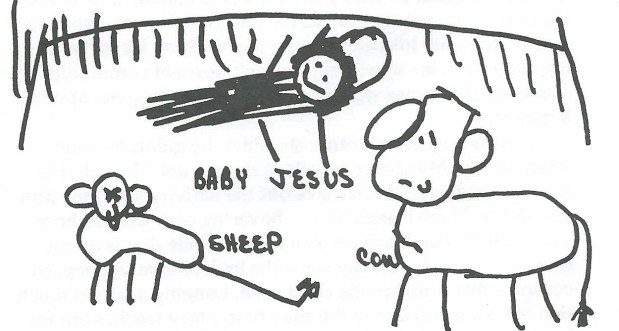
This play originated in 1981 when Gayle, her late husband Gus and daughter Gwynne were living in Frankfurt am Main, Germany. Gus was serving as a Lutheran pastor to a German parish and Gayle was enjoying her role as homemaker and mother. Their daughter Gwynne was a precocious four-year-old who kept her mother hopping. She talked almost non-stop in what her parents called “Gerglish,” a unique combination of German and English. Mama usually spoke English with her and Papa almost always spoke German with her; thus Gwynne understood both languages, spoke pretty good German but found it hard to express herself totally in English. She loved to have books read to her in either language and soaked up knowledge like a sponge. When the spontaneous play that follows began, Gayle realized that Gwynne had grasped the main aspects of the Christmas story but had added some unique twists to relate them to her own life and understanding. That evening, when Gayle related the story in great detail to Gus, he encouraged her to write it all down before the nuances of the story faded from her memory. She did so that very evening. To aid in the reader’s understanding, however, she “translated” everything into English. Other than that, however, the story is as exact to how it actually played out as Gayle’s memory could make it. The drawings we include with this story are Gwynne’s, drawn at her mother’s urging in the days following the play’s inception. We are also including a photo of Gwynne at age 4 dressed as St. Lucia, prepared to make the rounds of our apartment house to bring Saffronsbrod and Pepparkakor (Swedish treats) to our neighbours on the morning of St. Lucia Day, December 13th. That date is the start of the Swedish Christmas season and Gayle’s family heritage on her mother’s side is Swedish. (Yes, those are real lighted candles on the Lucia crown she is wearing! Because of that, Gwynne did this duty rather reluctantly.)

Gwynne as Lucia - age 4

Now, many years later, Gwynne lives in Norway, with her Norwegian husband, their three-year-old son and one-year-old daughter. She is employed as a teacher/librarian in a British International School, where they also celebrate St. Lucia Day. As an adult, Gwynne continues to nurture her unique imagination, teaches Sunday School, loves to play with and read to her children and has a house full of more books, toys and craft projects than one can imagine.


The Christmas Story According to Gwynne

By Gayle and Gwynne Johannesson, Winnipeg, Manitoba

Reprinted from a 1981 Johannesson Christmas letter and later from Esprit, the magazine of Evangelical Lutheran Women, November/December 1993 issue. Copyright © 1981 Gayle Johannesson; 2014 © Gayle Moore-Morrans.


Characters:

Gwynne (G) who also plays the Angel, Joseph, Pastor, and King Herod (in turn)

Mama (M) who also plays Mary, Joseph, Innkeeper (in turn)

Scene:

Gwynne, age 4, a budding actor, plays while Mama sews. Since early in Advent she has become fascinated with the Christmas story, has had it read and told to her, has seen it in pictures and manger scenes, has sung of it and heard it sung—at home, in church, in kindergarten, on television and at the Frankfurt Christmas Market. Now she wants to act it out—in her own unique way.

INTRODUCTION

G: Mama, let’s play “When Jesus was a Little Baby.” I’ll be the angel and you be Mary. (Exits the room in which Mama is sewing; re-enters, flapping arms.)


SCENE 1 – Mary’s garden, Nazareth

G: Fly, fly, fly. (pause) Hi, Mary!

Mary for Christmas Story

M: Hello! Who are you?

G: I’m the angel. I have good news for you. God sent me to tell you you’re going to have a baby in your tummy and he’s going to be the Messiah and save everyone from their sins. I think you better name him Jesus.

M: What wonderful news! You tell God I’m very happy to be chosen to be Jesus’ mother and I’m ready to do whatever God says.

G: Okay. ‘Bye now. Fly, fly, fly. (Exits, flapping arms.) (aside) Now you be Jofes. I’m still the angel.


SCENE 2 – Joseph’s home, Nazareth

Mr

G: (Enters, flapping arms.) Fly, fly, fly. Hey, Jofes, wake up! I’ve got good news for you. God is giving Mary a baby in her tummy and then you have to both go to Bethlehem to be counted. The baby’s name is Jesus and he’s going to be the Messiah and save you from your sins.

M:  That’s great! I’ll get ready to travel right away.

G: Bye. Fly, fly, fly. (Exits) (aside) Now you’re Mary and I’m Jofes.


SCENE 3 – Road to Bethlehem

G: Don’t worry Mary; we’re going to soon be in Bethlehem:

M: I hope so, Joseph. I’m very tired and I think the donkey is, too. Besides that, I think it’s soon time for the baby to be born.

G: Look, Mary; there’s Bethlehem: Let’s find a hotel room: (aside) Now you be the hotelman.

G: Knock, knock. Do you have room for us?

M: No, I’m sorry. We are all full.

G: All the hotels are full? Can’t you please find us some room?

M: Well, I have a stable in back where the animals stay. There’s an empty clean stall if you don’t mind sleeping on hay.

G: Well, is it quiet? We’re going to have a baby, you know; so it’s got to be quiet.

M: Oh, yes. There’s only one old cow and a sheep and two lambs and they don’t make much noise.

G: Good. Come on, Mary. Let’s go. (aside) Now you’re Mary again.


SCENE 4 – Bethlehem stable

G: I’ll fix up a bed for us in the hay. (pause) Oh, oh. We’ve got a problem.

M: What’s wrong?

G: There’s no phone.

Mama: Now Gwynne. Don’t you remember, when Jesus lived on earth it was many years ago and they didn’t have telephones. Anyway, why do you need a telephone?

Gwynne: Well, for heaven’s sake, Mama, we’ve got to call a pastor. I just remembered Jofes and Mary didn’t get married. They’re going to have a baby soon so they better get married!

Mama: Can’t you get a pastor in Bethlehem?

Gwynne: Nope. He’s far away. Well, if there isn’t any phone then we can’t play. (pause) I know—the angel can get a phone. (Exits and enters again, flapping arms.)

M: Oh, Mr. Angel, can you get us a phone so we can call a pastor to marry us before our baby is born?

G: Sure. (Exits and re-enters with phone.) Now I’m Jofes.

G: Ring, ring, ring. Hello, Pastor Johannesson? Can you come and marry us? We’re going to have a baby soon. You can find us easy, just follow the star and when it stops we’re in the red house.

Pastor J for Christmas Story

(Angel flies out, removing telephone. Re-enters as pastor, performs ceremony while M. plays Mary and Joseph in turn. G. exits and re-enters as Joseph. Fixes up a bed for Mary in the hay, settles donkey (hee-haws), talks to cow (moos) and sheep (baas). G. exits and re-enters with doll in cradle.)


SCENE 5 – Next morning, Bethlehem

G: Mary, wake up. Look at the nice manger I made for the baby you had in your tummy. Let’s name him Jesus. You wrap him up and I’ll put him in bed.

M: There, he’s sleeping now. Say, do you hear voices outside? It sounds like shepherds talking and they say an angel choir told them to come to see our baby.

G: Yes, and listen to the song they’re singing.

G&M: (singing) Glo-o-o-o-o, o-o-o-o-o, o-o-o-o-oria! Glory to God in the highest!

manger scene for Christmas story

G: Come on in. (Extends hand to imaginary shepherds.) You can see the baby, but be quiet—cuz he’s sleeping. (Gently strokes the doll’s cheek.)  Isn’t he cute? He’s the Messiah and is going to save you from your sins.

Gwynne: Oh no, no, no! (Runs from room, prances around in hallway.) Get that baby out of here! I don’t want a boy baby; I want a girl baby!

Mama: What’s wrong now? Don’t you want to play anymore?

King Herod for Christmas Story

Gwynne: Oh, Mama, can’t you see? I’m the wicked king. I’m going to throw all the babies in the river. (Exits, re-enters flapping arms.)

G: You’re going to have to get out of here and go to Egypt for a while. It’s a long trip so you better pack lots of things. You can have picnics on the way. I’ll tell you when the wicked king is dead so you can come back. Don’t worry; God will take care of you and I’ll get things ready. (Exits, flapping arms.)


SCENE  6 – Somewhere in Egypt

(G: enters pulling a wagon loaded with dishes, doll clothes, tablecloth, cookies, bananas and a pillow.)

G: Now we’re in the camper. (Spreads tablecloth on floor, sets out dishes and food. Sits down with doll on lap.) You’re getting to be a big boy, Jesus. Here, have a cookie. (Turns to Mary) Isn’t it fun to be camping?

M: Yes, it’s nice here; but I’ll be glad when we can go home to Nazareth.

G: Oh, don’t worry. The old wicked king should be dead soon. Hey, I think I hear the angel. (Exits, re-enters flapping arms.)

G: Fly, fly, fly. That wicked king is dead, so you can come back. Your baby’s safe now. (pause) Say, Jesus sure is a big boy now. That’s a long trip and he’ll be too heavy to carry. I know; I’ll help you. You two take the donkey back and Jesus can fly with me. (Exits, flapping one arm and carrying doll under the other.)

MERRY CHRISTMAS!

Reblogging: Charlie and Jack

We have just viewed this wonderful story of compassion, both the compassion of an old goat for an old horse and also the compassion that little Myla shows for Charlie the horse when he dies. It reminds us of our next book for which Gayle is still working to complete the layout. In Jake, Little Jimmy and Big Louie” you will read about the compassion a boy has for a wingless budgie and later the love that develops between them and an “interloper,” a raven who soon becomes a treasured member of the family.
Computer and printer problems have delayed Gayle’s progress as well as another big editing commitment which is now completed. Watch for our announcement of publication – we hope SOON!!!

busymockingbird's avatarbusy mockingbird

Or: “Why We Have a Dead Horse Taped To Our Window”

Here’s a quick little story:

Recently, we watched a show on PBS called “Animal Odd Couples,” about unusual animal friendships, which Myla loved.  She especially loved the story of Charlie the horse and Jack the goat. CHARLIEJACK

Charlie was a 40-year-old farm horse who was blind in one eye, and very near to being put down when the family noticed that their 16-year old goat, Jack, had begun walking with Charlie around the farm, standing on his good side to lead him, making sure he got where he needed to go.  As the horse got older and blind in both eyes, the goat began leading him in front so he could follow his sound.

The show is very sweet, and you can watch the story of Charlie and Jack here:

Myla was so impressed by this that the…

View original post 230 more words

LOCATION WRITING IN A CHERRY ORCHARD


001-Location Writing Participants

Gayle is still glowing from a sunny, warm and stimulating morning of LOCATION WRITING, a new experience for her as it was for her two companions, Miss P and Patricia. The occasion, which all three hope will be the first of many, is open to other writers in the Vernon, British Columbia area who may wish to join them in the future. Award-winning local author of the “Mighty Orion” novels, Patricia Donahue encountered Gayle and her friend Miss P at a local coffee shop last week. During the conversation that ensued, Patricia and Gayle lamented the demise of the Vernon Writer’s Group they had both attended last year. Thus was born the idea of starting a new group that would experiment with location writing, meeting once a week at various local venues to write and maybe even discuss their pieces. Topics could pertain to the venue being visited, or they could be about whatever the writers might wish to pursue. They decided to make it as relaxing and experiential as possible with no set agenda. What ensued in their first trial was fun and inspiring. The venue was the Kukhia Cherry Orchard in the BX area of Vernon, on the heights overlooking Swan Lake. Patricia’s invitation was worded as follows:

WRITING IN THE ORCHARD !!!!

 Writers of every level are invited to experience writing on location, or Location Writing.

 This is a free opportunity to write as you are inspired by your surroundings:

shapes, colours, smells, breeze, view  …

 A casual experiential 2 hours outdoors in nature. A different location each week.

 Bring writing materials – retro? write with a pencil …write using calligraphy …  coloured pens …

July 30th, 10 – 12 noon Be Chekovs in the Cherry Orchard !!


Here is Gayle’s take on the day.

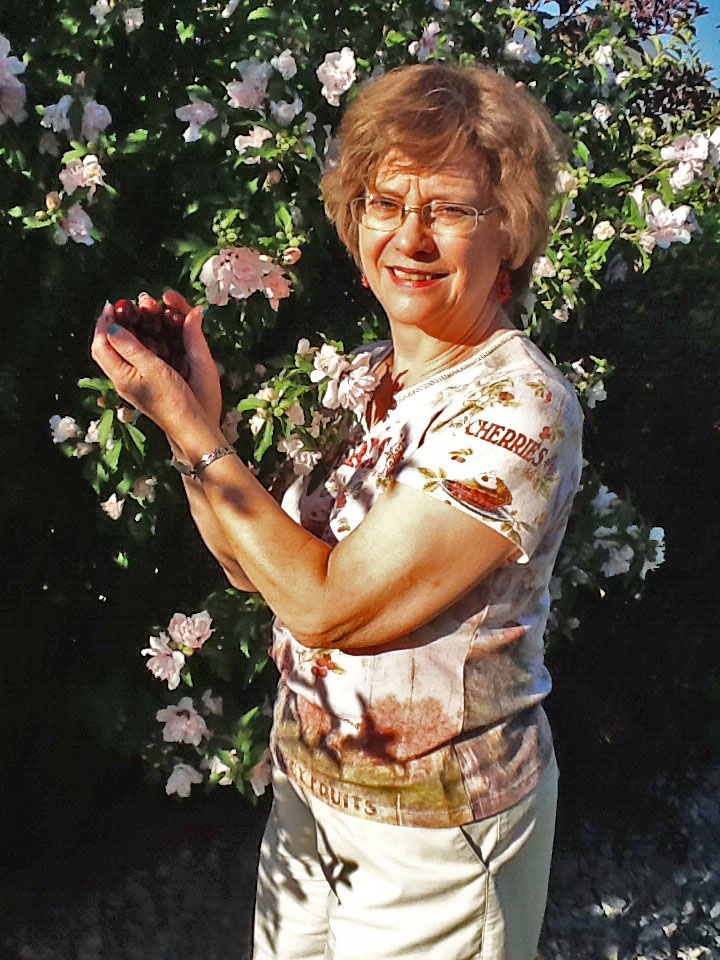
I awoke full of expectation, wishing that my husband Ian would join us for the location writing, but knowing that he was not at his best in the mornings, had pretty well retired from writing and would choose to stay in bed. Since this first session was to be in a cherry orchard, I had to wear my new t-shirt ablaze with cherry-themed “bling.” I also made our morning wake-up smoothies using cherries as an ingredient. Finally heading for the orchard, I picked up my friend at her house and was glad to have her along as she knew the BX area of Vernon a lot better than I did and we found that Patricia’s directions were not exactly accurate.

The orchard was a stimulating venue for writing – rows of trees laden with lush, ripened cherries that grew in thick clusters like grapes – something I wasn’t expecting. We took some pictures while listening to distant voices of U-pick enthusiasts climbing the ladders scattered along other rows and filling their pails. Soon, though, I dismissed them from my mind as we “writers” set up our chairs at various shady spots along one long path between rows of heavily laden cherry trees, just at the edge of the orchard with a fence separating us from a neighbouring apple orchard.

So the writing began! Later we were surprised to find that none of us wrote what we had expected we would write.  Patricia had been prepared to write poetry using coloured calligraphy pens. Instead she filled a couple of torn pages by comparing Chekhov’s iconic play, The Cherry Orchard with what she had gleaned from the orchardist’s life story. He had emigrated to Newfoundland from East Asia at age eleven, spoke with a “Newfie” accent and eventually came to own this wonderful cherry orchard in BC.

When my friend, Miss P had told me about Patricia’s plans, I had responded, “Well, I’m certainly not going to write poetry. I’m not really into that.” To my surprise, I began to write a journaling-type poem about my day. My “bling” t-shirt had inspired me to see the orchard and its surroundings as jewels.

Miss P related that she had initially written some prose about the orchard and then she read us a play-on-words poem using cherries as a metaphor! Very clever!

I certainly enjoyed sharing our quite unique and differing works. For what it’s worth, here’s my poem:

Location Writing – A Gem

by Gayle Moore-Morrans

What a shiny, glorious day!

Soon I will be on my way.

Dressing for an orchard fling,

Donned my shirt with “cherry bling.”

Spun yogurt, banana, peach and cherry,

Smoothies for Ian, more sleepy than merry.

Kissed husband “goodbye”; though writer, too,

He’d rather sleep than write. What’s new?!

Soon my KIA was in motion,

Picked up Friend. What true devotion!

The directions, though, were somewhat flawed,

We found the place, ere nails were gnawed.

Worried now, Patricia had to wait,

Apologetic she made us late.

All forgiven, we parked, unpacked,

Greeted orchardist. No enthusiasm lacked.

Through the rows and rows of trees,

We found some shade and watched the bees

Flitting through the long, jade leaves.

Ah, we loved the God-sent breeze!

Sparkling sky of sapphire blue,

Glistening gems of cherries, too,

Hanging there in ruby clusters

With all the brilliance they could muster.

My blingy shirt, the gem-like fruit,

and nearby topaz apples to boot,

All make me feel that life’s a jewel.

Leaving here will be too cruel!

“Location writing” isn’t really tough,

It’s like a diamond in the rough!

 Photo highlights of the day:


This slideshow requires JavaScript.


Three very different writers hard at work:

This slideshow requires JavaScript.


Home at last. Sharing the morning and some cherries with the family in our shady gazebo and sunny back garden.

This slideshow requires JavaScript.


Writing with my Mom

Very illuminating and inspiring post. I’ll comment on it in my next post.

francisguenette's avatardisappearinginplainsight

IMG_4661

One of my current projects is a book of short stories. I have a dozen of my own offerings, from micro-short flash fiction to slightly longer pieces, plus four stories I have recently co-authored with my mom. If you knew my mom, you’ll raise an eyebrow at how this project is possible. You see, she died in 1997.

My mom wrote a lot. I’m still in the process of recovering so much of her work. But, to my knowledge, only one of her short stories was every published – Ten Days Out appeared in the Story Teller Magazine in the fall of 1996. Most of her work was in a constant stage of rewriting, revising and preparing for resubmission to one magazine or another.

The four stories I have been working on for inclusion with my work appeared in an anthology that she and her writing group, The Coastal Tail…

View original post 410 more words

Fishing Stories and Reminiscences of My Stepfather

Fishing Stories and Reminiscences of My Stepfather

Here are excerpts from my memoir to go with James Collett’s excellent photo of a boat abandoned in Campbeltown Loch. To set the scene, I am 13 and am getting used to having a stepfather. An Irishman from Larne, Bill Moorhead had just married my mother, Chrissie Morrans. You might say that an abandoned boat in Campbeltown Loch helped to knit our relationship.

Fishing boat Argent, aground at The Red Rocks, Campbeltown Loch, Kintyre, Scotland.

Quoted from “From Poverty to Poverty: A Scotsman Encounters Canada” by Ian Moore-Morrans, copyright © 2012. Friesen Press.

  Life was still not rosy for Mother even with her “new found respectability” as Bill turned out to be quite lazy. He would work for a little while, then complain that his heart was bad, quit the job that he had, and then lie around doing nothing for months. Then when he did work, he very often got drunk and gave her a lot of verbal abuse. He never did give my brother or me any trouble, though. I guess he knew better. He was pretty smart when he wanted to be. Quite often, he would reminisce about old times in Larne when he and others would make illicit whisky (“poteen” or homebrew). “Poteen boys” he called them. Then he would show me a photograph of a small motor boat that he said he had built himself during his younger days in Larne. I was so fed up hearing all that he did, that I eventually let it go in one ear and out the other. It seemed to me that all Irishmen bragged a lot about nothing! I don’t mean to suggest that we were enemies, though; mainly just the opposite.
~*~
    Bill taught me quite a few things, among them how to make netting needles that the local fishermen would buy to mend their nets and how to make the best catapult in town, one that was different from any I’ve ever seen, even today. (A catapult in Britain is called a slingshot in North America.) For all Bill’s faults, we got along very well. He certainly wasn’t dumb. He taught me things that I never would have learned if he hadn’t been around. I don’t know what my brother thought of him, for he never ever mentioned Bill to me either positively or negatively. (Actually, my brother never mentioned anything to me, period!) I think, perhaps Bill and Archie thought similarly of each other; and I don’t think it was complimentary either way.
    Regarding the catapult, Bill explained details like making a small hole in the centre of the leather pouch that holds the stone to reduce drag by letting air through while the stone was shooting forward. He taught me to reduce the “Y,” leaving just a stub on the bottom leg and cradling the other two legs with the thumb and forefinger. The securing system of joining the rubber to the leather was very elaborate, quite unusual with all the loops of leather that he used. It was actually quite easy to hit a tin can about ten meters (30 feet) away—impossible with the ones my friends and I had made previously. Best of all, Bill emphasized one very good rule: never shoot at any living thing!
~*~
    One day while I was playing with my friends I heard, “Ian, will you come with me, please? I need your help.” Bill had never said this before, so I didn’t know what to expect. It turned out that he had found a small row boat washed up on the shore just outside town. The stern was all smashed away, and I mean totally gone. I think it would have been classified as “flotsam.” It was perfectly legal for Bill to take it. Wreckage found on the shore was considered “finders keepers.”
    “Help me to carry it to O’Hara’s yard and I’ll fix it up; then we can go fishing.”
    “Sure, Bill,” I replied although my thoughts were, ‘How the heck can ye fix this when the whole back end is missing?’
    But, boy, did he ever fix it! You would never have known that it had been damaged, except for a little different shade where the new wood appeared. The boat was classified as “clinker-built” (overlapping boards). I never did watch him work on it and I’ve often regretted it. I thought he was just doing his usual bragging. I couldn’t believe it was the same little boat when he asked me to help him take it to the water. He had also managed, (how, I don’t know) to have two oars and two row locks (oar locks) and “hand-lines” so that we could use the boat right away, plus a rope to tie it up when we weren’t using it.
    Use it we did! We were never short of fish after that. It was only Bill and I who went fishing; my brother always said “no”, although he would certainly eat his share. We would go out in the evening, usually around seven or eight p.m., spend an hour or two at the most, and return home with cod, mackerel, or flounder. There was plenty of fish. In less than an hour, we usually had enough fish to last us a couple of days, plus some for Bill to sell.
~*~
Just after the onset of the war, the Admiralty had commandeered an enormous “yacht” (not a sailing boat) that belonged to Lord and Lady Docker. It was renamed the “HMS Shamara” and had its own permanent berth at the old quay. This ship would go out every night around eight p.m. and return early the next morning. Nobody knew what she did. Whenever we were going fishing, either Bill or I would check whether she was still tied up, or if she had left the pier. When she was tied up, we fished close to the shore, just west of the small warning beacon, to get us well away from her wash as she passed on her way out. When she was out we fished nearer to the middle of the opening as there were more fish there. (The opening was only about a thousand feet or 330 m. wide.)
One night, however, neither of us had remembered to check. We were right in the middle of the opening to Campbeltown Loch, between the island and the north shore, getting ready to put our fishing lines in the water when Bill asked me if the Shamara was out. I told Bill that I wasn’t sure, but that I thought she was out. Big mistake! It was almost dark and we had our lines in the water when suddenly we heard the “swoosh…swoosh” of Shamara’s bows breaking the water. In the late twilight, just before darkness fell, we could just make out the massive bow of this big ship heading straight for us. I grabbed the oars and rowed like mad, hoping I was rowing in the right direction. Bill started to shout, “Ahoy, Shamara; ahoy, Shamara” at the top of his lungs. I can still see the dark outline of the ship coming straight for us. She was showing no lights whatsoever (and this was peacetime—after the war!). I continued to row like mad, and all the time Bill was shouting his head off. (Bear in mind that this ship was just slightly smaller than a frigate!)
    Bill shouted to me, “Get low in the boat, Ian, as low as you can and hold on to the sides.” He did the same. She missed us by no more than 40 or 50 feet (ca. 16 m.)! We bobbed up and down like a cork, oars in, as we clung for dear life to the edges of the little row boat. (There weren’t any rules about life jackets at that time, and we wouldn’t have been able to afford them anyway!) Bill knew to keep the centre of gravity as low as possible to help prevent capsizing; that was why he told me to get as low in the boat as possible. After that incident we made double sure that we checked if that ship was at her berth before we left to go fishing!
~*~
    We’ve all heard “big fish stories” at one time or another. Well, here’s another to add to the list. It was always Bill’s policy to ask my mother if she wanted to go fishing with us and she always said, “No thanks; you two go and catch fish and that will please me just fine.” At least, she almost always did. One evening when Bill asked her, she just about floored both of us by saying, “Aye, okay, Ah’ll go oot wi’ ye.”
    We were at our usual spot between the island and the mainland (yes, the Shamara was already out!), our lines were in the water and Bill had shown Mother what she was supposed to do.
    “Go down until the sinker touches bottom, Chrissie; then lift it just off, and then touch it down again ever so lightly so that the hooks are a few inches above the sand. That is where the cod are.” (Cod are “bottom-feeders.”).
    Both Bill and I had landed a few fish and Bill was teasing Mother about coming fishing with us, asking when she was going to catch one. Suddenly she cried, “Ah think Ah’ve got one; will ye help me?”
    “When yer pulling like that, Chrissie,” Bill laughed, “and nothing is happening, it means that yer caught on the bottom.” (Remember too, that she was a really little lady!)
    “Well, if Ah’m caught on the bottom, maybe you’ll fix it for me.”
    “Okay, I’ll loosen it for ye and I’ll show ye what t’ do so that you’ll know how to do it in future …. Hey Ian, I think she’s really got somethin’ here, look at the line, it’s going all over the place now …. Hey, wow! It must be a dandy …. C’mon over here and give me a hand.”
    Well, I did go to help, and it took both of us to pull in this great big cod! (Keep in mind, we didn’t have rods; we used hand-lines and had to haul the dark, rough twine in with our bare hands.) We didn’t have a means of measuring the fish; in fact, no one ever thought of doing that in those days. The only indication we had was that the commercial “fish box” we always put our catch in was about 26 inches (65 cm.) long. (Every fish we had caught before always had fit inside the box.) As “Chrissie’s fish” was a full head and tail over the ends, it probably measured about 33 inches (84 cm.) or more long. That was some fish!
    Of course, this episode totally spoiled our “fish stories” from then on. Any time we were going over the evening’s catch, we would hear a little voice in the background saying something like, “Do ye remember the fish that Ah caught, you two?” That was the one and only time that she ever came fishing with us! (Yes, Chrissie, God bless your heart; you’re dead and gone now but I well remember the fish you caught!)
(end of quote)