ALL ABOUT THE “REAL” JIMMY, AN EXCERPT FROM “CAME TO CANADA, EH?”

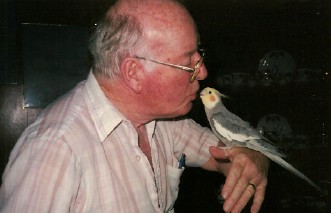
As I (Gayle) am preparing chapters of Ian’s children’s chapter book “Jake, Little Jimmy and Big Louie” to blog, I’m also working on my second (and I hope final) edit of the sequel to Ian’s already published memoir: “From Poverty to Poverty: A Scotsman Encounters Canada.” I’ve already blogged an excerpt from the sequel which we have named” “Came to Canada, Eh? Continuing a Scottish Immigrant’s Story.” Today I’ve just completed editing a section in which Ian describes receiving his real-life bird, a cockatiel he also named “Jimmy.” I thought it might be appropriate to blog this section to give readers an insight into some of the things Ian learned about raising a bird and teaching it to speak and whistle. He later added some of these ideas to the children’s story that is now “Jake, Little Jimmy and Big Louie.” You will notice that certain things Ian experienced with his cockatiel Jimmy later were used in the characterizations of Little Jimmy and also of Big Louie. I’m also including a 1998 photo of Ian and Jimmy, the cockatiel.

Ian and Jimmy

Excerpt from “Came to Canada, Eh? Continuing a Scottish Immigrant’s Story”

by Ian Moore-Morrans

edited by Gayle Moore-Morrans

Copyright © 2013

“Mary and I went down to Winnipeg to spend Christmas with Audrey and Eugene and our three grandchildren, Tammy, Calan and Ainsley in 1997. Then, since Mary and I had been married on the 29th of December, we returned home to Creighton to celebrate our anniversary. We were at Shirley and Brien’s house for a quiet evening on our wedding anniversary when Shirley suddenly appeared carrying a great big bird cage.

” Inside was a beautiful, young cockatiel. He and the lovely cage were being presented to us from our two daughters, their husbands and all five grandchildren, including young Ian and Tiffany. I was invited to take the bird out of its cage and hold him on my hand. He came with no bother and Shirley asked me what I was going to call him (it). Without any hesitation I said ‘Jimmy’ (after the little budgie in my unpublished children’s book, not caring what sex the bird was!). He was such a lovely surprise gift for both of us. And he really was a ‘he’, we found out later.

“Jimmy took quite a lot of looking after, for I had to feed him egg almost continuously, and clean his cage almost continuously, too! He was on the egg diet a long time, longer than he should have been. Brien had obtained Jimmy from a friend at work who bred them. From what Brien learned, Jimmy should have been on seed when he was still enjoying his egg. I had bought some seed for him, but he didn’t seem ready for it. When I was cooking for him, I would generally put two, sometimes three eggs in the pot and boil them hard, storing them in the fridge, for Jimmy seemed to be always hungry. I would cut off a little bit and wrap the remainder for later, making sure that Jimmy also got some of the yolk (that is what he went for first) along with some white.  In the beginning I’d chop the egg up for him, but I soon found that doing so was a complete waste of time, for his little sharp beak would slice through the soft egg just like butter.

“Soon I set about teaching the bird things to say and whistle. Being a musician, I don’t think it is bragging to say that I’m a pretty good whistler as I’m able to do quite a bit of fancy stuff like grace notes, triplets, warbles and different things—a lot of stuff that I did on the trumpet.  Soon our bird was saying ‘Jimmy’s a good boy’ (just like in my little story), ‘Hi Ian, wot’s up?’, ‘Hello, Mary’, ‘I love Shirley’ and so forth. He also started whistling the verse of “Bonnie Jean” from Brigadoon that I was rehearsing for my solo at our upcoming concert in Flin Flon. (I didn’t teach him this, he just picked it up while I was whistling it around the house and going through the words in my head.) In addition, I taught him to whistle the first part of ‘The Mexican Hat Dance’; the bugle call that goes, ‘You gotta get up, you gotta get up, you gotta get up in the morning’; a series of notes from a ‘custom’ car horn, and a silly something we used to sing in Scotland when I was a wee boy that ended with ‘Wee Bobby Geachy’s……white drawers.’ The latter bit used the popular rhythm that everyone knows: ‘Dah Dahdah  DAH  DAH…dah dah!’ However, what I taught Jimmy varied in that I substituted a wolf whistle for the last two notes (the last ‘dah dah’). Jimmy really did it superbly. (Sometimes I would whistle the first bit and he would answer with the wolf whistle and other times it would be reversed, with Jimmy starting it off.)

” Jimmy really performed to perfection the day I was dressed in my kilt just prior to leaving the house for the dress rehearsal of the show I was in. Jimmy’s cage was in the dining room and as I passed the door opening that would allow him to see me, he went, “Wheeet-wheeoo”—a perfect, long, wolf whistle.  I burst out laughing. It was like he did it intentionally, his timing was so right. My answer was, ‘Hey, funny guy. You’ve never seen a Scotsman in a kilt before?'”

Installment 7 of “Jake, Little Jimmy and Big Louie,” a Children’s Chapter Book

Thanks to everyone who has contacted us through WordPress or email saying that they are enjoying our blogging of Ian’s children’s chapter book, “Jake, Little Jimmy and Big Louie.”  We’re still glowing from our great-grandson’s very positive endorsement of the book so far. I, Gayle, will try to be more diligent in getting the rest of the book’s chapters blogged (now that I am off crutches and my new hip is healing nicely) so that we will be able to get into production of the children’s book, hopefully by late spring.

At the same time as this book is being blogged, I’m deep into editing the next volume of Ian’s memoir or autobiographical stories which we are calling “Came to Canada, Eh? (Continuing a Scottish Emigrant’s Story.)” Those of you reading this blog would perhaps be interested in reading an excerpt from that as-yet-unpublished book which tells of Ian’s beginnings as a writer. He began with this very children’s book that we are now blogging.

To set the scene, Ian and his late wife have just moved back to Winnipeg (again). Ian is 63 years old and deciding to finally do what he has always wanted to do but never before found time for. Here’s a excerpt from “Came to Canada, Eh?”

“My whole life I had always wanted to write stories, but the situation was never the way I wanted it to be. Whenever, for example, I wrote a letter to anyone in the Old Country, I would end up sending about 14-16 pages—and I would get one page in reply. Finally, at age 63, I said to myself, ‘Ian, if you don’t start to write now, then you’ll never do it.’ So I sat down and, over a period of three evenings, wrote ‘My Friend Jimmy’. It was a children’s story about a budgie that had no wings—just 16 pages. But I had to write everything longhand. I asked Audrey [our daughter] to keep her eyes open for an old, cheap electric typewriter for me.

“’What do you want an electric typewriter for, Dad? You’ll be wasting your time. Why don’t you get a cheap computer; that’ll do the same thing only better for you?’

“Oh, that was a terrible word to use in front of an old codger like me—a computer? Sudden terror at the thought of even having one in front of me! Well, she eventually managed to convince me that that is what I should get. ‘You can pick one up dirt cheap, Dad. Do you want me to look for one for you?’

“It was a 286, black and white monitor, no hard drive, just two 3.5” floppy disks; but it was a start. I then became a little more ambitious—going to the library and getting out one of those foldout learn-to-type books that stands upright on edge (like a pyramid) and I started to learn to touch type. Me, an old . . . well, something. And I was improving too—starting to type simple sentences without looking at the keyboard. Pretty soon I got myself a 386 computer, then later it was up to a 486, and then a Pentium! Hey, who was that guy who said that the 286 was all he would ever need? I got the Mavis Beacon typing course (on a CD) and was able to calculate that I was up to more than 20 words a minute, even allowing for errors! ‘Not bad for an oldie,’ I thought.

“While I was improving on my typing, I rewrote my children’s story, and kept editing it until it started to look a lot better. I changed some of the contents and then sent it away to a publisher, knowing full well that he would grab it and tell me that it was the very best children’s story he had ever read. … Some hope! Soon I could just about paper the wall with rejections. ‘Never mind,’ I thought, ‘where there’s life, there’s hope.’ I put the story on file and went on to write other stories, thinking that I’d give “My Friend Jimmy” a try again at a later date. (Little was I to know that the later date would be lots later—about 17 years!)”

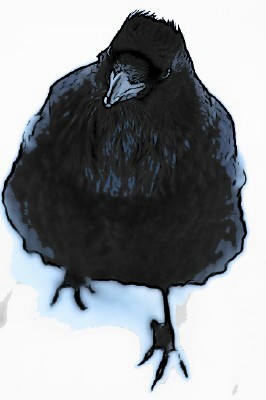
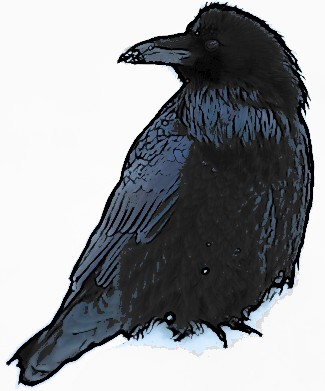
Much has happened since the years those words were written. Since then Ian was widowed, then remarried – this time to me (an editor). So we’ve now published three books and hope to have this children’s book finally published before long. Below is our blog of Chapter 7 plus two drawings we found on the computer of an “adolescent” raven whom Louie might have resembled.

Raven 1 Raven 2

“JAKE, LITTLE JIMMY AND BIG LOUIE”

by Ian Moore-Morrans

edited by Gayle Moore-Morrans

Copyright © 2012

CHAPTER SEVEN

Louie Gives Jake a BIG Problem

The next day was Saturday. Jake was at his local library first thing in the morning, waiting for the doors to open. Once inside, one of the staff helped him look for books about birds.

(The rest of the chapter’s content has been deleted prior to publication.)

* ~ * ~ *

Picture suggestions:  Louie standing on the ground and “talking” while looking up at Jake and Jimmy, who is on Jake’s shoulder.

Louie flapping his wings.

Installment 6 of “Jake, Little Jimmy and Big Louie,” a Children’s Chapter Book

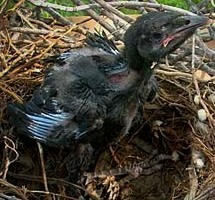
Here, finally, is Chapter 6 of the children’s Chapter Book we are blogging. Our great-grandson, Leland, who just turned 12, is acting as a consultant on the story to let us know if the story reads appropriately for kids ages 7 – 12, and our great-granddaughter, Hannah, age 7, has consented to draw some pictures to go with each chapter. We’re looking forward to hearing from them.This photo of a newborn baby bird will give Hannah an idea of how the baby bird first called “Thing” might have looked.   raven chick ugly

This blogging has taken longer than we had hoped but the blogger (Gayle) is still on crutches recovering from left hip replacement surgery on February 7th. I hope to be off the two crutches in another week and a half and then on to one crutch for a short time and working into walking with a cane. All is going well but doing anything takes a great deal of time and I also spend a lot of time doing my exercises. Deanna, my physiotherapist just paid another house visit today and left me with a new set of a bit more difficult exercises – very helpful but a bit exhausting, too.

We hope you will continue to enjoy the story. Please give us any feedback you think helpful as the book is still in the pre-publication phase.

“JAKE, LITTLE JIMMY AND BIG LOUIE”

by Ian Moore-Morrans

edited by Gayle Moore-Morrans

Copyright © 2012

CHAPTER SIX

“Thing” Becomes “Louie”

raven chick hungryIt was good that the owner of “Bill’s Budgie Barn” knew all about caring for baby birds, not just budgies—but even wild birds.

(The rest of the chapter’s contents has been deleted prior to publication.)

Picture suggestions:

A black chick with its mouth open (see photo sample above).  or

Jake holding and feeding the baby chick some water from an eye dropper, while little Jimmy is perched on Jake’s shoulder.

Celebrating Self-Publishers

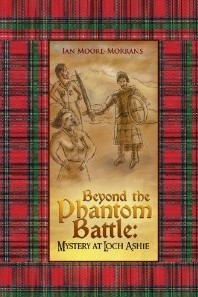
Phantom Battle book cover

With thanks to Xlibris, the self-publishing company with which we published Ian’s novel, Beyond the Phantom Battle: Mystery at Loch Ashie, we are re-posting the latest encouragement about self-publishing from the Xlibris website.

Self-publishing has been both an enjoyable adventure and a lot of work. We enjoy the freedom self-publishing gives us to publish and edit our books with a free hand. It is good to see that a number of very successful authors have also gone through the self-publishing procedure.

The following article is re-posted from Xlibris:

“Getting Your Push from Big Name Indie Writers

“They say it is wise to learn from the mistakes of others. This also holds true for self-publishing. Famous independently published authors—then and now—have been rejected by traditional publishers at one point but eventually made a name for themselves by choosing a publishing route off the beaten track. If, however, you have already stumbled along the way, these nuggets might save you from giving up your self-publishing dreams.

“Alexandre Dumas (1802-1870) Born and raised in poverty with his father dying when he was four, Dumas faced discrimination because of his ethnic African ancestry. However, with his rich imagination, the Count of Monte Cristo author overcame his lowly social stature by penning quite a number of high-adventure tales and historical chronicles published under his name. His works were translated in numerous languages, making him one the world’s widest-read French writers.

“Edgar Allan Poe (1809-1849) The creator of the detective fiction genre had to fight tooth and nail to make a living from his craft. The American literary genius was unfortunate to have written at a time when the US publishing industry suffered from weak copyright law. While his first self-published work The Raven didn’t bring him much financial success, the poem is considered one of the greatest gems in literature history.

“Mark Twain (1835-1910) The American author of the timeless novel The Adventures of Huckleberry Finn built his own publishing company that flourished but suffered bankruptcy following a failed investment in a faulty typesetting machine invention. To rebuild his fortune, he used his natural gift of gab, touring different countries for public speaking engagements. He also wrote more books to pay off his debts.

“George Bernard Shaw (1856-1950) The Irish playwright had initially published his early works to attract producers. Although his first novels were a flop, he was a dedicated playwright who learned from his mistakes. ‘Success does not consist in never making mistakes but in never making the same one a second time,’ he said.

“Rudyard Kipling (1865-1936) The British Nobel Laureate in literature was known to be a fervent artist who wrote almost without pause. He reported for his newswriting job six days a week, with only a day each off Christmas and Easter breaks. His passion for writing was such that he self-published his first collections of poetry. The rest, as they say, is history.

“Stephen Crane (1871-1900) Hailed by literary pundits as ‘one of the most innovative writers of his generation,’ he started writing at the age of four and published his early works at age 16. His first novel Maggie: A Girl of the Streets was, however, rejected by a traditional publisher who thought the story was too unrealistic. Crane loaned money from his brother, published the book, and enjoyed commercial success thereafter.

“Virginia Woolf (1882-1941) She and her husband co-owned a publishing company where her works, along with other notable writers such as T.S. Eliot, were published. Although she believed that “a woman must have money and a room of her own if she is to write fiction,” she married an average-income earning civil servant with whom she nurtured a healthy personal and business relationship.

“Ezra Pound (1885-1972) As a twenty-something sacked college professor with dwindling funds, the American poet self-published his first poetry book, A Lume Spento (With Tapers Spent). He sold 100 copies at six cents apiece. The compilation was praised by The London Evening Standard for being ‘poetic, original, imaginative.’ Pound also befriended celebrated Irish poet W. B. Yeats, whose publisher promoted the book, resulting in its success.

“Anaïs Nin (1903-1977) She is best known as one of the pioneer women writers of the female erotica genre. The French-Cuban diarist, whose journals detailed her own erotic adventures, self-published her first book Under a Glass Bell. The book, hailed as Nin’s finest work, launched her literary success.

“E. L. James The British author of the best-selling novel Fifty Shades of Grey revealed that the novel sums up her ‘midlife crisis.’ Starting out as a fan fiction writer, she got her inspiration from the vampire series The Twilight Saga. The worldwide-commercial success of the erotic trilogy has proven that a novice writer can make it big in the publishing industry.

“Amanda Hocking Cashing in on the popularity of vampire-themed novels, the twenty-something American novelist, formerly a group home worker, has used the booming e-book industry to self-publish her paranormal romance novels. She has sold more than a million copies and was the first self-published author to hit $2 million in sales in 2011. She later signed a $2-million worth contract with a traditional publisher.

“J. A. Konrath The American e-book writer of mystery, thriller, and horror genres is an ardent supporter of self-marketing. He holds a spot in the ‘5 E-book Authors To Watch’ by Mediabistro.com. It’s almost impossible to believe that his previously unpublished stories had reportedly been rejected almost 500 times before he reached his rock star status as a self-published author.

“We hope these stories will motivate you and keep you writing, whether you’re considering starting a writing a career or are already working on your first book.”

Merry Fifth Day of Christmas, plus Installment 3 of “Jake, Little Jimmy & Big Louie,” a Children’s Chapter Book

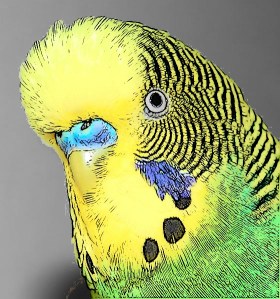
We’re sorry for the delay in blogging this next chapter of Ian’s children’s chapter book entitled “Jake, Little Jimmy and Big Louie,” but, as you know, Christmas intervened between Chapters 2 and 3. Gayle and I wish all of you blog readers a very Merry Fifth Day of Christmas. So far we’ve had a nice quiet celebration with church on Christmas Eve, followed by a delicious and traditional (to Gayle) Swedish Christmas supper to which we had invited friends. We slept late on Christmas Day and ended up opening our presents that afternoon. The next two days have been spent eating, playing with our new dog Misty, lazing and watching a number of movies that we received as Christmas gifts, reading from some of the books we received and, of course, listening to Christmas music. Gayle has finally found time to edit the next chapter of the story we are posting and I’ve approved the edit so here goes with Chapter 3. Please give us any feedback you may wish to pass on. As you know, the book has not yet been published except here in this blog. We are still hoping to have some drawings sent in on JPGs from our great-granddaughter or from any children that might read this story or have this story read to them. We are including suggestions for drawings at the end of each chapter. We’d like to include some of the drawings in the published book and would give credit to the artists. Here is a nice cartoon rendition of a budgie’s head as a model for Little Jimmy.

budgie head cartoon

“JAKE, LITTLE JIMMY AND BIG LOUIE”

by Ian Moore-Morrans

edited by Gayle Moore-Morrans

Copyright © 2012

CHAPTER THREE

Jake and Jimmy Become Friends

As they headed home, Jake and his dad chatted about their visit to Bill’s Budgie Barn and all they had seen there. When the car was in the garage, his dad took the birdcage from the back seat and began heading for the house, carefully carrying it by its handle.

(The rest of the chapter’s content has been deleted prior to the book’s publication.)

* ~ * ~ *

Picture suggestions: Jimmy in his cage

Jimmy sitting on Jake’s folded hands

Jimmy hopping down a ramp

The drawings below were done by Ian some years ago to illustrate how he pictured the ramp set-upRamp to chair 001 in Jake’s room.

Jimmy's ramps 001