LOCATION WRITING IN A COUNTRY RESTAURANT GARDEN

001-LW-Friesen's - Writer's Group

LOCATION WRITING AT FRIESEN’S COUNTRY TYME GARDEN RESTAURANT, COLDSTREAM, BC

 Here we are again in another lovely venue. Just Patricia, Miss P and Gayle sitting and writing in a cozy, shady corner of the back garden.

Sounds? The whirl, whirl, whirl of an irrigator watering a nearby field; a dog barking in the distance; the occasional lowing of cattle in the adjacent field; the clatter of dishes from the Country Tyme kitchen; the steady, low chatter interrupted by louder laughter from restaurant guests sitting around tables scattered throughout the restaurant garden; the dampened whiz of cars driving past on Kalamalka Road.

Smells? Luckily, no cow manure; just the overwhelming aroma of ham, bacon and maple syrup. Though it is already 10:30 a.m., late risers are still having breakfast and brunch seekers are arriving. It is tempting not to think ahead to what promises to be a delicious lunch for us at noon, instead of concentrating on writing.

Feelings? Caressed by soft breezes, surrounded by beautiful flowers and protected by shady trees, I am lulled into a sense of peace, an assurance of God’s presence and inspiration to work on a pressing editing project.

Moving from my lawn chair, I decide to take up a wooden garden swing close by and begin editing a prayer walk for October’s Southern Interior Lutheran Women’s Fall Event that our ELW at Peace Lutheran will be hosting. I may be retired from my former position as Program Director and Editor for Evangelical Lutheran Women, but I’ve remained in the program editing track on a volunteer basis locally. It’s nice to be back in the groove in such an inviting setting.

This slideshow requires JavaScript.


LOCATION WRITING IN A CHERRY ORCHARD


001-Location Writing Participants

Gayle is still glowing from a sunny, warm and stimulating morning of LOCATION WRITING, a new experience for her as it was for her two companions, Miss P and Patricia. The occasion, which all three hope will be the first of many, is open to other writers in the Vernon, British Columbia area who may wish to join them in the future. Award-winning local author of the “Mighty Orion” novels, Patricia Donahue encountered Gayle and her friend Miss P at a local coffee shop last week. During the conversation that ensued, Patricia and Gayle lamented the demise of the Vernon Writer’s Group they had both attended last year. Thus was born the idea of starting a new group that would experiment with location writing, meeting once a week at various local venues to write and maybe even discuss their pieces. Topics could pertain to the venue being visited, or they could be about whatever the writers might wish to pursue. They decided to make it as relaxing and experiential as possible with no set agenda. What ensued in their first trial was fun and inspiring. The venue was the Kukhia Cherry Orchard in the BX area of Vernon, on the heights overlooking Swan Lake. Patricia’s invitation was worded as follows:

WRITING IN THE ORCHARD !!!!

 Writers of every level are invited to experience writing on location, or Location Writing.

 This is a free opportunity to write as you are inspired by your surroundings:

shapes, colours, smells, breeze, view  …

 A casual experiential 2 hours outdoors in nature. A different location each week.

 Bring writing materials – retro? write with a pencil …write using calligraphy …  coloured pens …

July 30th, 10 – 12 noon Be Chekovs in the Cherry Orchard !!


Here is Gayle’s take on the day.

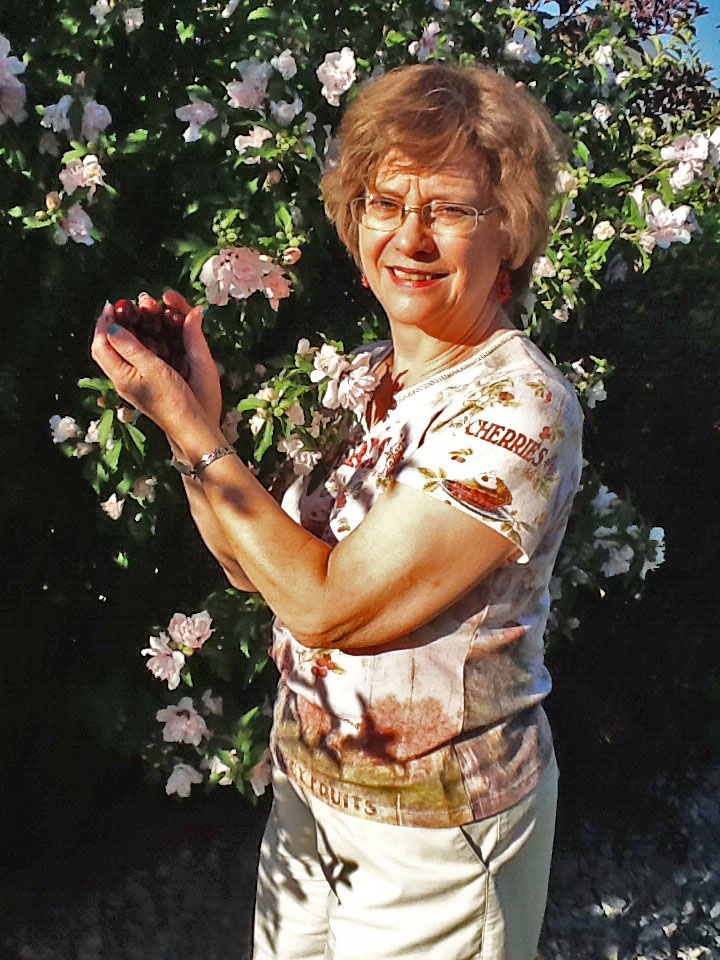
I awoke full of expectation, wishing that my husband Ian would join us for the location writing, but knowing that he was not at his best in the mornings, had pretty well retired from writing and would choose to stay in bed. Since this first session was to be in a cherry orchard, I had to wear my new t-shirt ablaze with cherry-themed “bling.” I also made our morning wake-up smoothies using cherries as an ingredient. Finally heading for the orchard, I picked up my friend at her house and was glad to have her along as she knew the BX area of Vernon a lot better than I did and we found that Patricia’s directions were not exactly accurate.

The orchard was a stimulating venue for writing – rows of trees laden with lush, ripened cherries that grew in thick clusters like grapes – something I wasn’t expecting. We took some pictures while listening to distant voices of U-pick enthusiasts climbing the ladders scattered along other rows and filling their pails. Soon, though, I dismissed them from my mind as we “writers” set up our chairs at various shady spots along one long path between rows of heavily laden cherry trees, just at the edge of the orchard with a fence separating us from a neighbouring apple orchard.

So the writing began! Later we were surprised to find that none of us wrote what we had expected we would write.  Patricia had been prepared to write poetry using coloured calligraphy pens. Instead she filled a couple of torn pages by comparing Chekhov’s iconic play, The Cherry Orchard with what she had gleaned from the orchardist’s life story. He had emigrated to Newfoundland from East Asia at age eleven, spoke with a “Newfie” accent and eventually came to own this wonderful cherry orchard in BC.

When my friend, Miss P had told me about Patricia’s plans, I had responded, “Well, I’m certainly not going to write poetry. I’m not really into that.” To my surprise, I began to write a journaling-type poem about my day. My “bling” t-shirt had inspired me to see the orchard and its surroundings as jewels.

Miss P related that she had initially written some prose about the orchard and then she read us a play-on-words poem using cherries as a metaphor! Very clever!

I certainly enjoyed sharing our quite unique and differing works. For what it’s worth, here’s my poem:

Location Writing – A Gem

by Gayle Moore-Morrans

What a shiny, glorious day!

Soon I will be on my way.

Dressing for an orchard fling,

Donned my shirt with “cherry bling.”

Spun yogurt, banana, peach and cherry,

Smoothies for Ian, more sleepy than merry.

Kissed husband “goodbye”; though writer, too,

He’d rather sleep than write. What’s new?!

Soon my KIA was in motion,

Picked up Friend. What true devotion!

The directions, though, were somewhat flawed,

We found the place, ere nails were gnawed.

Worried now, Patricia had to wait,

Apologetic she made us late.

All forgiven, we parked, unpacked,

Greeted orchardist. No enthusiasm lacked.

Through the rows and rows of trees,

We found some shade and watched the bees

Flitting through the long, jade leaves.

Ah, we loved the God-sent breeze!

Sparkling sky of sapphire blue,

Glistening gems of cherries, too,

Hanging there in ruby clusters

With all the brilliance they could muster.

My blingy shirt, the gem-like fruit,

and nearby topaz apples to boot,

All make me feel that life’s a jewel.

Leaving here will be too cruel!

“Location writing” isn’t really tough,

It’s like a diamond in the rough!

 Photo highlights of the day:


This slideshow requires JavaScript.


Three very different writers hard at work:

This slideshow requires JavaScript.


Home at last. Sharing the morning and some cherries with the family in our shady gazebo and sunny back garden.

This slideshow requires JavaScript.


An Editor’s Musing: Why do some writers “let it all hang out” instead of editing their posts or comments? How can comments be helpful?

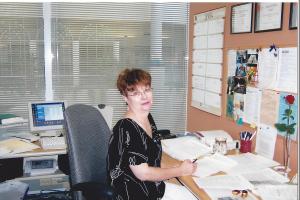
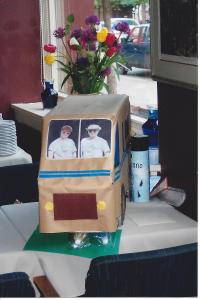
Gayle as Esprit Editor    Gayle'e retirement party presentAt left  you’ll see a photo of “editor me” at my desk on one of the last days before retirement (in 2004) as Editor of Esprit magazine and Program Director for Evangelical Lutheran Women at our office on the second floor of Portage Place in Winnipeg. In addition I’ve included a photo of the gift I received at my retirement party in July 2004. As Ian and I were preparing to take off  for a retirement adventure driving down to Mexico in our newly acquired 35-foot motorhome, my boss chose to wrap an assortment of “helps” for that trip inside or underneath a large box decorated to look like our motorhome – complete with photos of Ian as driver and me as passenger.

After several years in Mexico, with trips up to Manitoba to maintain our Canadian residency, we returned to Canada for good. I hope to start blogging about our Mexico sojourn in the near future. Time will tell if I ever get to it. While there in Mexico I began editing Ian’s writings and am continuing that in our present home in British Columbia, as well as now contributing to his writings. Here my desk is in our little den and I look out the window at the low mountains surrounding our part of the Okanagan Valley. The desk is different from the one at ELW, but just as messy. That’s the way I work. I do not like a messy final product, however, and decided that it was time for me to have an editor’s rant about what I am seeing on some web blogs and in many comments that come into our site.

I don’t think I’m unique in claiming frustration when reading some comments on web blogs or even some particular web blogs which are so full of errors in grammar, spelling, punctuation or just plain English that I feel compelled to edit them as I’m reading. Sometimes even understanding them is impossible, so I quit reading and trash the comment or close the web blog.

As I routinely check out other web blogs, I am more-often-than-not impressed by so many varied topics and excellent writing, but am also occasionally appalled by the lack of English writing skills by some bloggers. In those cases, I cross those web blogs off the list of ones I want to follow, no matter how interesting the topic might be. I find it painful to read something when I feel a need to correct practically every sentence. (As an aside: I lived in Germany for 18 years and ended up speaking passable German but would never in my life think of hosting a blog in German! I wouldn’t feel confident enough to do a decent job of it. My late husband who worked in a profession there, could easily have hosted a blog in German. Obviously his language skills were much superior to mine.)

My motto is: “check, double-check and recheck anything you post”, for it is easy to miss a word here or there if one doesn’t do so. I always try to self-edit any of my blogs and usually have Ian read through them before posting. That isn’t to say that I might not post a small grammatical or spelling error from time to time. It happens to the best of us. Almost inevitably after checking and re-checking the magazine I edited and having our executive director and a professional copy editor go over everything before publishing, I would find some little thing wrong when reading the issue after publication.

In the past I’ve found myself editing a lot of comments that come in on this web blog so that they can be understood. I conclude that quite a few of those who comment on posts do not have English as their first language and are obviously using an English-to-another-language dictionary when they make their comments. Perhaps they are taking an ESL course and have been given an assignment to comment on specific web posts. (Comments often come from the same site with different email addresses.) If that is the case, how I wish the instructor would at least give them some help in making the comments understandable. It is nice to get compliments or constructive criticism, but not if the comment cannot be readily understood and if the blogger receiving the comment has to edit it extensively in order to print it. WordPress usually identifies these type of comments as “spam”; in the past I’ve looked at every comment and sometimes chose to “un-spam”a few because I’d like to honour the intent. I have edited them for comprehension, though. I’m wondering if other bloggers have chosen to do this or if these type of comments simply get trashed. Here’s an example of one comment we recently received, showing the places where I have cut out more than half of the words and added clarifying words in order to get what I think the commenter intended.

“Attractive section of content. I just stumbled upon your web site and in accession capital to assert that I acquire in fact enjoyed account your blog posts. Any way I’ll be subscribing to your [web blog.] augment and even I achievement you access consistently fast.”

Another recent commenter asserted that, though our blog’s content was good, many of the posts were “rife with spelling issues.” Well, that got my dander up! I did, however, calm down and try to address what I thought might be the problem. Here’s my answer:

“We’re surprised to hear that you find several of our posts ‘rife with spelling issues’. We are wondering if you might be pointing out our use of the British way of spelling English words, as opposed to the American way. (An example would be the use of “ou” in place of “o” as in “neighbour.” We are Canadians and so use the British way of spelling. I (Gayle) am the blogger and, though American-born, changed my way of spelling sometime after I emigrated to Canada and became editor of a Canadian magazine. I’ve kept up that way of spelling in retirement and, as Ian is British-born and I edit his writing, that method has worked out well for us. Then, too, Ian speaks Scottish-English so when he writes about Scotland in either his novels or memoirs, he uses what I call “Scottishisms.” Some of those words are only found in Scottish-English or may mean something entirely different in Scotland than they do in other countries where English is spoken. We’ve pointed that out in some of our posts about his memoir, “From Poverty to Poverty: A Scotsman Encounters Canada.” I had quite an education in “Scottishisms” when editing that book! In addition, I had to turn off the spell-check as my word-processing program gave up on providing corrections! Of course, even editors sometimes need to be edited; however, I try to double-check whatever I post. We’d be interested in hearing from you further so that you could point out some examples of those spelling issues. Looking forward to hearing from you.” To date, we have received no further communication on this subject.

That brings up the challenge when commenting on web posts of exactly what to say. Sure it is nice to have affirmation that someone “enjoyed” a post or found it “awesome” or “educational” or “informative.” But does that really help the blogger to know how they are connecting with the reader? In haste I, too, sometimes choose to just give kudos by checking the “like” button on a post; but if I take the time and REALLY like or dislike something I try to comment on it. How did I feel when I read the post? Intrigued? Scared? Amused? Why and how? Perhaps the blogger was promoting a book, a picture, a poem or a piece of music that he/she had written, drawn, photographed or performed. Did the blog catch your interest so that you plan to order the book or picture, quote the poem or obtain the recording? Did the post remind you of a happening in your own life or a person you met or an emotion you felt? Then describe that connection. You might wish to reblog the post, giving credit to the writer and quote your reaction to it on your own blog or on Facebook, Twitter or the like.

Conversely, if a post draws a negative response from me and I think it can be constructive, I’d like to think that I would be willing to document why I had that response. Although I didn’t post the following comment on a novel writer’s blog but instead posted it on Amazon after reading the novel, here is an example of how I could make both a positive and, I hope, constructive negative response to the novel on a writer’s blog:

“You have written a well-rounded story about a group of characters, each flawed in a unique way, all seeking redemption. Your background in counseling is evident throughout; perhaps that is what makes your story so believable. Your prose is clear, yet poetic. Your descriptions of both characters and scene are captivating. I would have given this book five stars had it not been for the unnecessary profanity which I felt cheapened the narrative, especially those instances when the name of Jesus was invoked through cursing.”

I send a challenge to bloggers and commenters alike: If you can’t edit your own postings, please, please find someone who can do the edit for you.

Please and thanks in a spirit of kindness and mutual understanding. Keep the relevant and understandable comments coming!

Gayle Moore-Morrans
P.S. In the meantime we have recently received a comment (perhaps sent in error?) which went on for several hundred words.  The comments were obviously a multiple choice list of helps for would-be commenters who needed guidance on how to word comments they wanted to make on various posts. In the past the comments we received from that particular commenter had included, solely or partly, promotions for his web blog that included little or nothing about the post he was supposedly commenting on. Many of the multiple-choice comments he included sounded similar to many of the comments we have received from a number of people over time. Thus, in the future I intend to honour Word Press’ use of Akismet to check incoming comments and rate them as “spam”, then delete the spam comments without reading them. Most of us writers and editors who blog find it difficult to have enough time to do our writing or editing what with all the other duties and distractions of life. We don’t need 276 comments in our “Spam Comments” section. That is the number I encountered last week after not checking the comments for about a week’s time. For the first time, I chose to permanently delete all those spam comments without even looking at them.  I truly appreciate the efforts a number of commenters make in sending in compliments or kudos on our posts, or even criticisms when they are constructive. However, I’m trying to promote our books or share views on writing, photographing, reminiscing or life in general and am hoping to glean relevant information from other bloggers instead of spending valuable time reading, rewriting, replying to or trashing umpteen comments a day. I am sharing these words in hopes that others will understand my frustrations and those of other bloggers who are surely having similar problems with unwarranted comments. Perhaps some of them will attempt to correct their comments or have them edited by someone else or those who just want to advertise their own blogs will cease and desist. At least I won’t have to relate to them if I trust Akismet’s weeding out those comments.

A Norwegian Sheep Enjoying Summer in the Forest – Our Answer to Cee’s Photo Challenge, Nature Animals

A Norwegian Sheep Enjoying Summer in the Forest – Our Answer to Cee’s Photo Challenge, Nature Animals

Thanks to Cee’s Fun Photo Challenge -Nature Animals, Gayle is posting her favourite photo taken two summers ago when she was visiting her daughter who lives with her husband and children in Norway in the midst of a mountainous forest surrounded by sheep farms.

image

Gwynne had been telling of the local practice to put sheep out into the forest each summer to give the lambs a start in life, grazing on the lush foliage, enjoying the fresh air and following their mothers as they wandered and lived among the trees. Some of the sheep would be killed by wolves during their wandering time; however, most of them would survive and indeed flourish. All the neighbours would then participate in a roundup in the autumn to gather up the sheep and bring them back to their pens for the winter. The adult sheep could be found by listening for the tinkling sound of the bells around their necks as they moved around. The half grown lambs would stay close to their mothers.

One lovely afternoon Gayle and her daughter Gwynne drove further up into the forest hoping to “hunt” sheep with a camera. Gayle was disappointed that they didn’t see any sheep as they drove along the narrow forest roads, but Gwynne urged her to be patient. Soon she pulled over to the side of the road and told her mother to listen. Gayle and her camera were out in a flash, plunging into the moss-covered ground and following the sound of bells. She soon captured the curious ewe pictured above, peeking out from the green woods, just like a model posing for her first photo op. As soon as the photo was snapped, the ewe disappeared. Gayle figured that would be her one and only glimpse until she heard a steady tinkling of bells and a lot of scrambling sounds. The ewe returned and again posed in a clearing, this time with two sweet lambs in tow. What a fantastic opportunity to fulfill a photo challenge!

image

Another Campbeltown Story Inspired by James Collett’s Photography

campbeltown-from-beinn-ghuilean-pano-bw-wm-web

Thanks again to Photographer James Collett for this terrific picture of Ian’s hometown as seen from Ben Guillion, the mountain pictured in our previous post. We have made the following comments on James Collett’s Photography page where we found this photo:

“Another beautiful view of my hometown, Campbeltown, from Beinn Ghuilean (Ben Guillion mountain). I have a story in my memoir “From Poverty to Poverty: A Scotsman Encounters Canada” which takes place after World War II when I, as a boy, “salvaged” a machine gun from the wreck of an aircraft on Ben Guillion and lugged it to a hiding place in the middle of some whin bushes, much like those shown on this picture. I never was able to find it again (probably just as well.) Here’s the story which happened around 1946:

I think I was about twelve when the following happened. Just to the south of the town, and bordering on it, is Ben Ghuilean (the Gaelic spelling; normally now it is referred to as Ben Gullion. The word “Ben” in Scot’s English means “mountain.”) This is a reasonably-sized mountain. I have already referred to a small airfield five miles from town. This airfield was still used after the war to some extent for training Royal Air Force pilots. One foggy day a two-seater aircraft plunged into the side of that mountain, killing both airmen.

It was quite a climb to the crash site and, needless to say, there were lots of (morbid-minded) townsfolk who just had to make the climb, though they would never have considered doing so at any other time. Apart from the strenuous effort, it was well known that there were adders on the mountain. (Adders are a type of viper, a little over two feet long. The bite of this snake, while it wouldn’t kill you, would make you very ill for some time.) This thought didn’t bother us brave (or stupid) lads, as we spent quite a lot of time on various faces of the mountain. (I had killed an adder some time before and preserved it in alcohol in a glass jar to keep in the house. No one objected at first, but later I had to keep it where we kept our coal.)

No one was allowed anywhere near the crash site until the bodies of the two airmen were removed. People were collecting bits of this and bits of that—stuff that probably went into the rubbish bin (garbage) a few weeks down the road after they had lost interest in the incident. Not so with “yours truly.” I noticed that there were two machine guns, one on each wing, and I set about removing one. What did I want a machine gun for? Maybe I was going to take it to class for “show and tell.” Na, we didn’t have that silly exercise in those days. I really had no idea why I was taking it. I guess it is what the modern kids would call “cool.”

Anyway, I struggled with it for ages and finally got it free. Even today, I still marvel at the fact that I got a machine gun from an aircraft without having a spanner (wrench) or even a pry-bar. I carried the heavy thing down the mountainside on my shoulder to the foothills, where I hid it by throwing it into the middle of some “whin bushes” (furze or gorse). These bushes were evergreen, covered all over with long, sharp dark green needles, standing three or four feet high and at least that across, with nice yellow flowers. (They grow wild in Scotland, but I don’t believe they grow in North America, unless maybe on the east coast.)

I hid the gun because it was still daylight and I didn’t want anyone to see me walking into town with a machine gun over my shoulder. Besides, I had to walk past the police station! I would probably have been arrested (or worse still, maybe even talked about). So, what did I do when it was time to retrieve it? Well, I got hold of some old potato sacks (gunnysacks), my friend Ian McKenzie and his four-wheeled cart, and the two of us headed back up to where I had hidden the gun.

What do you know? It wasn’t there! Did I have the correct bush? “Look over there …. No … try this one … .” There were lots of clumps of bushes. We just about went crazy! I was quite sure that I had taken note of where I had hidden it so that I would find it again. It should still have been there. Well, the two of us searched for ages, all around where I thought it should be, but with no luck. Since the bush was very prickly, I had to get flat on my belly, as low as possible to try to avoid the needles and crawl into the bushes at every place I thought the gun might be. It was awful! We got all scratched and thoroughly disgusted before we decided that it wasn’t there. Remember that during this “carry-on” we little boys were wearing short trousers that came only to our knees.

What I finally figured was that someone had seen me hide the gun and, after I had gone, removed it and took it to the proper authorities. Either that, or I had got really screwed up and there is still a machine gun hidden among some bushes for future archaeologists to find a long time down the road. Anyway, it was a very stupid thing to do and I don’t know what my mother would have said if I had walked into the house carrying a great big machine gun. One thing’s for sure—I would have got a thick ear!

Quoted from “From Poverty to Poverty: A Scotsman Encounters Canada” by Ian Moore-Morrans, copyright © 2012. Friesen Press.