LOCATION WRITING IN A COUNTRY RESTAURANT GARDEN

001-LW-Friesen's - Writer's Group

LOCATION WRITING AT FRIESEN’S COUNTRY TYME GARDEN RESTAURANT, COLDSTREAM, BC

 Here we are again in another lovely venue. Just Patricia, Miss P and Gayle sitting and writing in a cozy, shady corner of the back garden.

Sounds? The whirl, whirl, whirl of an irrigator watering a nearby field; a dog barking in the distance; the occasional lowing of cattle in the adjacent field; the clatter of dishes from the Country Tyme kitchen; the steady, low chatter interrupted by louder laughter from restaurant guests sitting around tables scattered throughout the restaurant garden; the dampened whiz of cars driving past on Kalamalka Road.

Smells? Luckily, no cow manure; just the overwhelming aroma of ham, bacon and maple syrup. Though it is already 10:30 a.m., late risers are still having breakfast and brunch seekers are arriving. It is tempting not to think ahead to what promises to be a delicious lunch for us at noon, instead of concentrating on writing.

Feelings? Caressed by soft breezes, surrounded by beautiful flowers and protected by shady trees, I am lulled into a sense of peace, an assurance of God’s presence and inspiration to work on a pressing editing project.

Moving from my lawn chair, I decide to take up a wooden garden swing close by and begin editing a prayer walk for October’s Southern Interior Lutheran Women’s Fall Event that our ELW at Peace Lutheran will be hosting. I may be retired from my former position as Program Director and Editor for Evangelical Lutheran Women, but I’ve remained in the program editing track on a volunteer basis locally. It’s nice to be back in the groove in such an inviting setting.

This slideshow requires JavaScript.


An Editor’s Musing: Why do some writers “let it all hang out” instead of editing their posts or comments? How can comments be helpful?

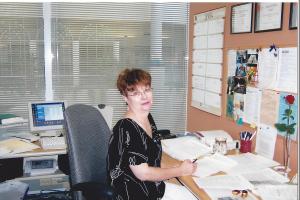
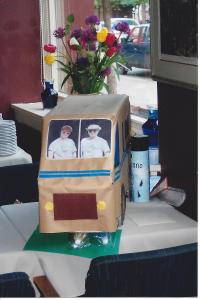
Gayle as Esprit Editor    Gayle'e retirement party presentAt left  you’ll see a photo of “editor me” at my desk on one of the last days before retirement (in 2004) as Editor of Esprit magazine and Program Director for Evangelical Lutheran Women at our office on the second floor of Portage Place in Winnipeg. In addition I’ve included a photo of the gift I received at my retirement party in July 2004. As Ian and I were preparing to take off  for a retirement adventure driving down to Mexico in our newly acquired 35-foot motorhome, my boss chose to wrap an assortment of “helps” for that trip inside or underneath a large box decorated to look like our motorhome – complete with photos of Ian as driver and me as passenger.

After several years in Mexico, with trips up to Manitoba to maintain our Canadian residency, we returned to Canada for good. I hope to start blogging about our Mexico sojourn in the near future. Time will tell if I ever get to it. While there in Mexico I began editing Ian’s writings and am continuing that in our present home in British Columbia, as well as now contributing to his writings. Here my desk is in our little den and I look out the window at the low mountains surrounding our part of the Okanagan Valley. The desk is different from the one at ELW, but just as messy. That’s the way I work. I do not like a messy final product, however, and decided that it was time for me to have an editor’s rant about what I am seeing on some web blogs and in many comments that come into our site.

I don’t think I’m unique in claiming frustration when reading some comments on web blogs or even some particular web blogs which are so full of errors in grammar, spelling, punctuation or just plain English that I feel compelled to edit them as I’m reading. Sometimes even understanding them is impossible, so I quit reading and trash the comment or close the web blog.

As I routinely check out other web blogs, I am more-often-than-not impressed by so many varied topics and excellent writing, but am also occasionally appalled by the lack of English writing skills by some bloggers. In those cases, I cross those web blogs off the list of ones I want to follow, no matter how interesting the topic might be. I find it painful to read something when I feel a need to correct practically every sentence. (As an aside: I lived in Germany for 18 years and ended up speaking passable German but would never in my life think of hosting a blog in German! I wouldn’t feel confident enough to do a decent job of it. My late husband who worked in a profession there, could easily have hosted a blog in German. Obviously his language skills were much superior to mine.)

My motto is: “check, double-check and recheck anything you post”, for it is easy to miss a word here or there if one doesn’t do so. I always try to self-edit any of my blogs and usually have Ian read through them before posting. That isn’t to say that I might not post a small grammatical or spelling error from time to time. It happens to the best of us. Almost inevitably after checking and re-checking the magazine I edited and having our executive director and a professional copy editor go over everything before publishing, I would find some little thing wrong when reading the issue after publication.

In the past I’ve found myself editing a lot of comments that come in on this web blog so that they can be understood. I conclude that quite a few of those who comment on posts do not have English as their first language and are obviously using an English-to-another-language dictionary when they make their comments. Perhaps they are taking an ESL course and have been given an assignment to comment on specific web posts. (Comments often come from the same site with different email addresses.) If that is the case, how I wish the instructor would at least give them some help in making the comments understandable. It is nice to get compliments or constructive criticism, but not if the comment cannot be readily understood and if the blogger receiving the comment has to edit it extensively in order to print it. WordPress usually identifies these type of comments as “spam”; in the past I’ve looked at every comment and sometimes chose to “un-spam”a few because I’d like to honour the intent. I have edited them for comprehension, though. I’m wondering if other bloggers have chosen to do this or if these type of comments simply get trashed. Here’s an example of one comment we recently received, showing the places where I have cut out more than half of the words and added clarifying words in order to get what I think the commenter intended.

“Attractive section of content. I just stumbled upon your web site and in accession capital to assert that I acquire in fact enjoyed account your blog posts. Any way I’ll be subscribing to your [web blog.] augment and even I achievement you access consistently fast.”

Another recent commenter asserted that, though our blog’s content was good, many of the posts were “rife with spelling issues.” Well, that got my dander up! I did, however, calm down and try to address what I thought might be the problem. Here’s my answer:

“We’re surprised to hear that you find several of our posts ‘rife with spelling issues’. We are wondering if you might be pointing out our use of the British way of spelling English words, as opposed to the American way. (An example would be the use of “ou” in place of “o” as in “neighbour.” We are Canadians and so use the British way of spelling. I (Gayle) am the blogger and, though American-born, changed my way of spelling sometime after I emigrated to Canada and became editor of a Canadian magazine. I’ve kept up that way of spelling in retirement and, as Ian is British-born and I edit his writing, that method has worked out well for us. Then, too, Ian speaks Scottish-English so when he writes about Scotland in either his novels or memoirs, he uses what I call “Scottishisms.” Some of those words are only found in Scottish-English or may mean something entirely different in Scotland than they do in other countries where English is spoken. We’ve pointed that out in some of our posts about his memoir, “From Poverty to Poverty: A Scotsman Encounters Canada.” I had quite an education in “Scottishisms” when editing that book! In addition, I had to turn off the spell-check as my word-processing program gave up on providing corrections! Of course, even editors sometimes need to be edited; however, I try to double-check whatever I post. We’d be interested in hearing from you further so that you could point out some examples of those spelling issues. Looking forward to hearing from you.” To date, we have received no further communication on this subject.

That brings up the challenge when commenting on web posts of exactly what to say. Sure it is nice to have affirmation that someone “enjoyed” a post or found it “awesome” or “educational” or “informative.” But does that really help the blogger to know how they are connecting with the reader? In haste I, too, sometimes choose to just give kudos by checking the “like” button on a post; but if I take the time and REALLY like or dislike something I try to comment on it. How did I feel when I read the post? Intrigued? Scared? Amused? Why and how? Perhaps the blogger was promoting a book, a picture, a poem or a piece of music that he/she had written, drawn, photographed or performed. Did the blog catch your interest so that you plan to order the book or picture, quote the poem or obtain the recording? Did the post remind you of a happening in your own life or a person you met or an emotion you felt? Then describe that connection. You might wish to reblog the post, giving credit to the writer and quote your reaction to it on your own blog or on Facebook, Twitter or the like.

Conversely, if a post draws a negative response from me and I think it can be constructive, I’d like to think that I would be willing to document why I had that response. Although I didn’t post the following comment on a novel writer’s blog but instead posted it on Amazon after reading the novel, here is an example of how I could make both a positive and, I hope, constructive negative response to the novel on a writer’s blog:

“You have written a well-rounded story about a group of characters, each flawed in a unique way, all seeking redemption. Your background in counseling is evident throughout; perhaps that is what makes your story so believable. Your prose is clear, yet poetic. Your descriptions of both characters and scene are captivating. I would have given this book five stars had it not been for the unnecessary profanity which I felt cheapened the narrative, especially those instances when the name of Jesus was invoked through cursing.”

I send a challenge to bloggers and commenters alike: If you can’t edit your own postings, please, please find someone who can do the edit for you.

Please and thanks in a spirit of kindness and mutual understanding. Keep the relevant and understandable comments coming!

Gayle Moore-Morrans
P.S. In the meantime we have recently received a comment (perhaps sent in error?) which went on for several hundred words.  The comments were obviously a multiple choice list of helps for would-be commenters who needed guidance on how to word comments they wanted to make on various posts. In the past the comments we received from that particular commenter had included, solely or partly, promotions for his web blog that included little or nothing about the post he was supposedly commenting on. Many of the multiple-choice comments he included sounded similar to many of the comments we have received from a number of people over time. Thus, in the future I intend to honour Word Press’ use of Akismet to check incoming comments and rate them as “spam”, then delete the spam comments without reading them. Most of us writers and editors who blog find it difficult to have enough time to do our writing or editing what with all the other duties and distractions of life. We don’t need 276 comments in our “Spam Comments” section. That is the number I encountered last week after not checking the comments for about a week’s time. For the first time, I chose to permanently delete all those spam comments without even looking at them.  I truly appreciate the efforts a number of commenters make in sending in compliments or kudos on our posts, or even criticisms when they are constructive. However, I’m trying to promote our books or share views on writing, photographing, reminiscing or life in general and am hoping to glean relevant information from other bloggers instead of spending valuable time reading, rewriting, replying to or trashing umpteen comments a day. I am sharing these words in hopes that others will understand my frustrations and those of other bloggers who are surely having similar problems with unwarranted comments. Perhaps some of them will attempt to correct their comments or have them edited by someone else or those who just want to advertise their own blogs will cease and desist. At least I won’t have to relate to them if I trust Akismet’s weeding out those comments.

Am I a Co-Author or Just the Editor?

This is Gayle Moore-Morrans blogging. We previewed most of the chapters of Ian’s children’s chapter book, “Jake, Little Jimmy and Big Louie” on this site last year and asked for some feedback from others as well as asking two of our great-grandchildren for input prior to publication – — Now-13-year-old Leland for consultation on the appropriateness of the book’s contents for his age group and now-8-year-old Hannah for some drawings to illustrate the book. In our post of March 21, 2013 I blogged Leland’s review entitled: “Wow!” A Recommendation for Ian’s blogged book, “Jake, Little Jimmy and Big Louie.” I’m now ready to re-scan Hannah’s illustrations for the book as I’ve edited them on Microsoft Paint. Our new printer – an HP OfficeJet Pro 8600 is finally installed and ready for me to do the layout. Here is a preview of the book’s cover illustration showing the boy Jake, and, on his shoulders, his BFFs, Little Jimmy the budgie and Big Louie, the raven.

000-Cover Photo

I’ve usually been identified as Ian’s editor, blogger, publishing and marketing person. How should we recognize my role in this children’s book that has evolved over the years it has been in the making? Am I just the editor or am I also the co-author? In our previous post I re-blogged a very helpful post by Francis Guenette on how she is writing with her mother even though her mother is no longer living. That prompted me to reply to her my thanks for answering a question that my husband Ian and I have been mulling over the past months.

Here are my comments on Francis Guennette’s blog post “Writing with My Mom.”

               Wow, did your blog post on writing with your mother ever resonate with me, Fran! In fact, I feel it has answered a few questions I’ve had in the past year. As you know, our blog is mostly about my husband Ian’s writings. When I started out editing his stories about nine years ago I had just retired from my editing job, we had only been married a year and soon headed for Mexico in our motor home to explore retirement there. I relished getting to know him better through his writings, especially becoming familiar with his impoverished upbringing in Scotland during the depression and war years, his military service with the RAF in Egypt and his early marriage and fatherhood and then immigration to Canada. Editing that book was a true editing job in that I took his words and only changed them for grammatical reasons when necessary but then rearranged large chunks in a much more logical sequence as he had pretty much written it in a “stream of consciousness” fashion. When I found there were gaps or inconsistencies I returned the manuscript to him for additions and clarification. Though Ian was in his early 70s then, he was in robust health and had energy to burn. When he wasn’t writing he was entertaining by performing Scottish songs or teaching me his repertoire so that we could sing and perform together.

                That way of working cooperatively continued after our move back to Canada two and a half years later. But it lasted only for a little over a year when a sudden illness brought him to death’s door and a long hospitalization, much of it while he was in an induced coma. Recovery from the near-fatal illness was a slow process. He was kept alive and healed by over five years’ treatment with prednisone; however, it is basically a poison which wrecked havoc on the rest of his body. A heart attack in 2010 necessitated five stents in his arteries and another regimen of medication, exercise and diet changes. Now at 81, he is pretty much a recluse, rarely sings, no longer writes and rarely even reads. He sleeps a lot and is lucid mostly late afternoons and evenings but doesn’t have the energy to do much with his pile of writings which still need to be published, nor has he been able to do anything about promoting those which have already been published.

               That’s where I come in. I’ve put aside the pile of writing I’ve done over the years, mostly on spiritual insights and family history and feel it is my “labor of love” to try to get the rest of Ian’s writings edited and published. However, as you’ve found with your mother’s writings I have been grappling with the fact that I no longer can ask Ian to do re-writes when I feel they are warranted. Like you said with your mother’s work, “I began to make changes and what I was doing was much more than editing.” Ian and I have discussed how to address the authorship of the next book which I hope will be coming out soon. Granted, he is the main author. He originally wrote the children’s story, nursed it through a number of revisions over the years and had sent it to several publishers even before I met him. It was hung up on the need for editing though. I now have done the editing but have also made a number of changes in the story and added a spiritual component to it which I felt was lacking and needed. It no longer is just the story that Ian wrote. I’ve also recruited our 8-year-old great-granddaughter to do the illustrations for the book and have extensively adjusted those illustrations using Microsoft Paint to make them more consistent and the characters more uniform. So how do we identify the authorship of the book? Ian and I have discussed this and have tossed around listing a co-authorship or a “with” authorship such as “by Ian Moore-Morrans with Gayle Moore-Morrans.” We’ve thought that perhaps the former gives too much credit to me and perhaps the latter makes it look as if Ian had a ghost writer (which certainly isn’t the case).

               I found your remarks helpful when you stated, “I will put the book out in both our names and claim co-authorship for my mom’s stories – though her name will appear first. No matter the work I’ve done, the one who came up with the ideas and the characters deserves first billing.” So I’m feeling more at peace with the “by author with another author” claim.

               What a great legacy your mother has left you and how wonderful that you can keep her memory so alive by working with her writings. I have the added advantage of still having Ian here with me so I can toss ideas and solutions around with him even though he can no longer physically do the re-writes and adjustments. I can even do future book readings and promotions for him without having to take along videos of him reading from the particular book. (Something I did twice in 2012 when I was able to travel to the States to do book readings/sales for Ian when he was unable to travel there because he couldn’t get travel insurance to go out of Canada.)  In addition, Ian has added an addendum to his will granting me full ownership of his writings, both published and unpublished and free rein in pursuing publication of any as-yet unpublished writings of his.

               I wish you well with your co-authorship adventure with your mother and plan to re-blog this latest post of yours on our blog at ianmooremorrans.com. Thanks for your insights.

Gayle Moore-Morrans

Writing with my Mom

Very illuminating and inspiring post. I’ll comment on it in my next post.

francisguenette's avatardisappearinginplainsight

IMG_4661

One of my current projects is a book of short stories. I have a dozen of my own offerings, from micro-short flash fiction to slightly longer pieces, plus four stories I have recently co-authored with my mom. If you knew my mom, you’ll raise an eyebrow at how this project is possible. You see, she died in 1997.

My mom wrote a lot. I’m still in the process of recovering so much of her work. But, to my knowledge, only one of her short stories was every published – Ten Days Out appeared in the Story Teller Magazine in the fall of 1996. Most of her work was in a constant stage of rewriting, revising and preparing for resubmission to one magazine or another.

The four stories I have been working on for inclusion with my work appeared in an anthology that she and her writing group, The Coastal Tail…

View original post 410 more words

Installment 7 of “Jake, Little Jimmy and Big Louie,” a Children’s Chapter Book

Thanks to everyone who has contacted us through WordPress or email saying that they are enjoying our blogging of Ian’s children’s chapter book, “Jake, Little Jimmy and Big Louie.”  We’re still glowing from our great-grandson’s very positive endorsement of the book so far. I, Gayle, will try to be more diligent in getting the rest of the book’s chapters blogged (now that I am off crutches and my new hip is healing nicely) so that we will be able to get into production of the children’s book, hopefully by late spring.

At the same time as this book is being blogged, I’m deep into editing the next volume of Ian’s memoir or autobiographical stories which we are calling “Came to Canada, Eh? (Continuing a Scottish Emigrant’s Story.)” Those of you reading this blog would perhaps be interested in reading an excerpt from that as-yet-unpublished book which tells of Ian’s beginnings as a writer. He began with this very children’s book that we are now blogging.

To set the scene, Ian and his late wife have just moved back to Winnipeg (again). Ian is 63 years old and deciding to finally do what he has always wanted to do but never before found time for. Here’s a excerpt from “Came to Canada, Eh?”

“My whole life I had always wanted to write stories, but the situation was never the way I wanted it to be. Whenever, for example, I wrote a letter to anyone in the Old Country, I would end up sending about 14-16 pages—and I would get one page in reply. Finally, at age 63, I said to myself, ‘Ian, if you don’t start to write now, then you’ll never do it.’ So I sat down and, over a period of three evenings, wrote ‘My Friend Jimmy’. It was a children’s story about a budgie that had no wings—just 16 pages. But I had to write everything longhand. I asked Audrey [our daughter] to keep her eyes open for an old, cheap electric typewriter for me.

“’What do you want an electric typewriter for, Dad? You’ll be wasting your time. Why don’t you get a cheap computer; that’ll do the same thing only better for you?’

“Oh, that was a terrible word to use in front of an old codger like me—a computer? Sudden terror at the thought of even having one in front of me! Well, she eventually managed to convince me that that is what I should get. ‘You can pick one up dirt cheap, Dad. Do you want me to look for one for you?’

“It was a 286, black and white monitor, no hard drive, just two 3.5” floppy disks; but it was a start. I then became a little more ambitious—going to the library and getting out one of those foldout learn-to-type books that stands upright on edge (like a pyramid) and I started to learn to touch type. Me, an old . . . well, something. And I was improving too—starting to type simple sentences without looking at the keyboard. Pretty soon I got myself a 386 computer, then later it was up to a 486, and then a Pentium! Hey, who was that guy who said that the 286 was all he would ever need? I got the Mavis Beacon typing course (on a CD) and was able to calculate that I was up to more than 20 words a minute, even allowing for errors! ‘Not bad for an oldie,’ I thought.

“While I was improving on my typing, I rewrote my children’s story, and kept editing it until it started to look a lot better. I changed some of the contents and then sent it away to a publisher, knowing full well that he would grab it and tell me that it was the very best children’s story he had ever read. … Some hope! Soon I could just about paper the wall with rejections. ‘Never mind,’ I thought, ‘where there’s life, there’s hope.’ I put the story on file and went on to write other stories, thinking that I’d give “My Friend Jimmy” a try again at a later date. (Little was I to know that the later date would be lots later—about 17 years!)”

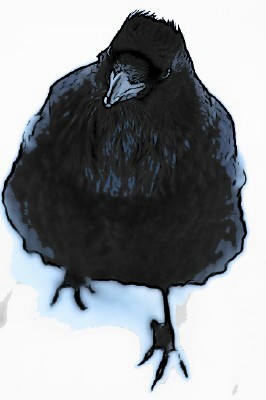
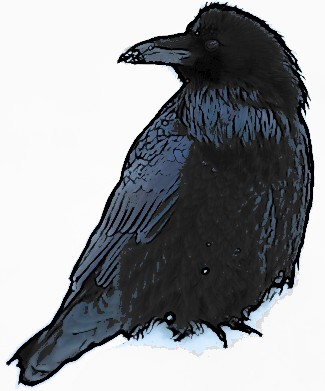
Much has happened since the years those words were written. Since then Ian was widowed, then remarried – this time to me (an editor). So we’ve now published three books and hope to have this children’s book finally published before long. Below is our blog of Chapter 7 plus two drawings we found on the computer of an “adolescent” raven whom Louie might have resembled.

Raven 1 Raven 2

“JAKE, LITTLE JIMMY AND BIG LOUIE”

by Ian Moore-Morrans

edited by Gayle Moore-Morrans

Copyright © 2012

CHAPTER SEVEN

Louie Gives Jake a BIG Problem

The next day was Saturday. Jake was at his local library first thing in the morning, waiting for the doors to open. Once inside, one of the staff helped him look for books about birds.

(The rest of the chapter’s content has been deleted prior to publication.)

* ~ * ~ *

Picture suggestions:  Louie standing on the ground and “talking” while looking up at Jake and Jimmy, who is on Jake’s shoulder.

Louie flapping his wings.