Touring the Royal Canadian Mint

royal-canadian-mint-winnipeg

According to its website at mint.ca, the Royal Canadian Mint decribes its Winnipeg location as “… our high-tech, high-volume manufacturing facility. Every single Canadian circulation coin is produced here – literally billions each year. Established in 1976, the Winnipeg plant occupies a 14,864 m2 state-of-the-art facility.” Ian has a special connection to Winnipeg’s Mint since he worked in that architectularly-beautiful and important building for three years shortly after it opened.

Gayle’s editing of our next book, Ian’s second memoir entitled Came To Canada, Eh? Continuing A Scottish Immigrant’s Storyis finally back in full swing after about a three-month hiatus to pack up and move into a larger apartment in our seniors’ lifelease building in Winnipeg. Finding appropriate photos to include with a story about one of the unique jobs Ian held has proved an impossibility until today. Camera in hand,  we made a trip to Winnipeg’s Royal Canadian Mint where Ian had worked from 1977 until 1979.

Though having lived in Winnipeg twice for a total of about 22 years and often having seen the beautiful Royal Canadian Mint building from the highway, Gayle had never toured the facility. Ian hadn’t been back to the building for 37 years. What a fun tour we had yesterday!

Included below is a portion of our book’s fifth chapter which Ian calls, “Heading A Wee Bit Back East-Winnipeg, Here We Come.”

“As I wasn’t too satisfied in the job I first had in Winnipeg, I applied for and got a job in the new “money factory” that had opened in Winnipeg in 1976. I should maybe explain that the “money factory” was the Royal Canadian Mint (certainly the most impressive-looking building I’ve ever worked in). The Mint building is a large, shining triangle rising up out of the surrounding prairie with a small picturesque lake at its side populated by a flock of Canada geese and an occasional pelican or two. Whenever anyone asked me what I worked at, I would say that I made money. Actually, I worked in the die production department,  using a lathe and a milling machine to make some of the dies that were eventually used to stamp images on the coins.

(If you happen to have any 1977-1979 Canadian coins in your pocket, there’s a possibility that they were stamped with dies that I made. Incidentally, the Royal Canadian Mint also produces coins for about 75 other countries as well.)

“The public was regularly invited to take tours of the mint so they could see the process by which Canadian coins were produced. You might say that I became a bit of a ‘tourist attraction’ during those tours. No one ever commended me for making the tours a bit more colourful, but I believe I did. You see, I love to whistle and have found that whistling makes the work go faster and also makes it more interesting. So there’s me, merrily whistling along (probably a Scottish folk tune) when I overheard a commotion on the catwalk above our work station. A small crowd of tourists had stopped and were pointing down at me while commenting on the ‘happy work atmosphere.’ Well, I couldn’t ignore them, so I gave them a wee wave and a bow. From then on whenever a tour came by, I would wave at the group and give them a nice whistled tune. They could have called me the Mint’s version of one of the seven dwarfs of Snow White fame (probably “Happy”) performing “Whistle While You Work.”

“[While this book was going through its final edit in 2016, my wife/editor thought we needed to add a few photos of the mint as I didn’t have any in my photo collection. We decided to take a tour of the mint, to educate her on the minting process and help me reminisce a bit, all the while taking a few photos. This time I was an 84-year-old tour participant, listening to a guide, peering from the catwalk and straining to see the process from my wheelchair. I didn’t hear any whistling or see any workers waving; but considering that the catwalk over the working floors has been  glassed in, I’m not sure we could have heard someone whistling anyway. The tour is still interesting, though; at least for anyone curious about the minting process. We were fascinated to learn of the two-metal process that was developed for the “toonie” ($2 dollar coin) that is made of a steel ring around a brass disc. Both the “loonie” ($1 coin picturing the North American bird, the loon) and the “toonie” were introduced long after I had left the mint job.]”

Copyright © 2016, Ian Moore-Morrans

Below you can check out some of the photos Gayle took yesterday of the “Parade of Nation’s Flags”along the entrance to the Mint representing some of the 75 nations for whom the Mint produces coins; a front view of the Mint location; a view of the machine shop where Ian used to produce dies for coins; and two photos of Ian sitting on his wheelchair in the lobby where he enjoyed posing with a unique “Mountie” and an antique minting machine, as well a mint.ca website photo of some beautiful Canadian coins made right at the Royal Canadian Mint in Winnipeg.

This slideshow requires JavaScript.

AN APRIL SWIM IN PARADISE

Gayle is experiencing a nostalgic evening and needing a break from visiting Ian in hospital (he is recovering well from two mini-strokes or transient aschemic attacks three days ago), preparing for a Saturday moving sale in our garage and back yard and trying to pack a few boxes a day in preparation for our move in May. (Any semblance of having a routine day has vanished for the time being, yet she feels compelled to do a long-overdue post on this blog.) We have sold our house in Vernon, British Columbia, actually move out in three weeks (on May 11th), will have our household stuff put into storage and move in with friends for about 10 days before heading east to Manitoba where we hope to settle once a life-lease apartment (for which we have been on a waiting list) comes available – hopefully by June or July. In the meantime, we plan to drive to northern Manitoba to deliver our dog, Misty, to her new parents, daughter Shirley and son-in-law Brien, visit for awhile and then head south to Winnipeg where we plan to settle. In a way it will be like coming home as that is the city in which we met and married almost 13 years ago.

Nostalgia has been brought on by our choosing to sell some of our Mexican treasures that we accumulated when we maintained a home in Mexico (November 2004-May 2007, with yearly trips back to Manitoba to retain our Canadian residency). It is now early spring here in British Columbia with tulips, magnolias, daffodils, lilacs and fruit trees in full bloom, and still the end of winter in Manitoba. In contrast our first April in Mexico was glorious with a warm, full-blown spring, as we moved from our motorhome into a rental house in Chapala Haciendas, a suburb of Chapala in the mountains of central Mexico on the shores of Lake Chapala, Mexico’s largest lake. Here we became acquainted with new types of flowering plants and trees, a much earlier and warmer spring than either of us had ever experienced and an exotic atmosphere that led to a charmed fascination with all the new experiences we were enjoying. Though Gayle got fully acquainted with Location Writing last summer, now that we think about it, the following piece was an even earlier occasion for Location Writing. Our rental house was a one-and-a-half story brick house, inside and out. We mostly lived on the front veranda and garden surrounding the swimming pool which took up most of the front lawn. You will notice that Gayle refers to Ian as “Scotty,” the name he chose to be known by during our Mexican sojourn. We will start with a slide show to illustrate her story.

This slideshow requires JavaScript.

AN APRIL SWIM IN PARADISE

by Gayle Moore-Morrans

With the sun’s rays a bit deflected as the clock nears four, it is finally time for my daily rendezvous with my beloved new pool. I don my orange flowered swimsuit to contrast with the turquoise pool walls and lavish on some sunscreen. My swim shoes await me at the brick steps that surround our upstairs bathtub; but first I need to shake them out in case any wee scorpion has decided to take refugee in one of them. (Thankfully, one hasn’t.) Grabbing my sunglasses and a towel from the clothesline downstairs, I descend from the terrace to the front lawn and down the steps into the pool. Scotty, my husband, has already moved the solar blanket off the water, skimmed the water’s surface with the pool net and turned on the pump so the water is shimmering fresh and turquoise in the sunlight.

My routine begins – ten laps along the length of the pool. Not too impressive when you think the pool is only 16 feet long, but that’s all my metal-laden bones can handle. With a humerus supported inside by a titanium rod, an artificial knee and an ankle held together by plates and screws, I’m proud to be able to do that much kicking and stroking. Then its time to whip out my trusty foam noodles – one fuchsia and one chartreuse. Without them, my pool time would be shorter and much less fun. Spanish practice comes next – cientos agua (100 water) sit-ups with the noodles’ assistance. When I started five months ago I kept track of my sit-ups while counting from uno to diez (1-10) in Spanish, over and over until the counting became rote. Then I graduated to the teens – onze, doze, treze, quatorze, quince, dieseseis, etc. Now its second nature to get from uno to cien (100) and beyond.

Sit-ups done, it’s time to relax and enjoy the surroundings. Fronting the built-into-the-hill pool is a brick wall which I peer over to enjoy the panorama in front of the house. A bright red-headed-and-breasted bird sits on his usual perch on our car window where he visits with and pecks at his reflection. Then he flies to the front gate leading to our driveway, on to the bodega (gardener’s shed) and finally into one of the towering jacaranda trees lining the street. I admire those graceful trees, profuse now in all their springtime glory, blanketed with large grapelike clusters of tiny, light purple trumpet-shaped flowers, their fernlike leaves just beginning to appear.

Beyond the street our hill continues descending into a valley dotted with houses peeping out from swatches of purple from more jacarandas and the dark green of pine and fichus trees. Then the heavily wooded mountains loom at the horizon, still brown from their winter rest but beginning to show patches of green with the promise of an emerald blanket once the rainy season begins in June. Towering over the highest peak is a cluster of telecommunications towers and a clear blue sky broken only by a fading jet stream.

Now my attention turns to my immediate surroundings. Several “critters” attempt to share the pool with me. A few days ago when I first started down the pool steps, I jumped at the sight of a two-inch long scorpion floating by. He (or she) wasn’t alive, though, so I relaxed and watched it sink to the bottom of the pool. Today I decide to check the drain pail at the far end of the pool and, sure enough, “Scorpi” has been drawn into it by the action of the pump. (I ask Scotty to take it out and let it dry so we can add it to the collection of dead scorpions I’m planning to take as souvenirs to my son in Canada.) Another of my more unpleasant swimming companions is the “helicopter-wasps” who buzz around my head from time to time. I’m not sure of their scientific name, but Scotty has given them the helicopter handle because they seem to have revolving antenna on top and long legs that hang down when they are flying, resembling landing gear. (Luckily, they don’t seem to be interested in stinging me, except for the one that got caught in my towel when I was drying myself the other day. The cool water sure felt good on that sting.)

I prefer more pleasant pool companions, although they don’t seem to fare too well in the water. Lovely dragonflies flitter along above me, the occasional one getting too close to the water. As its wings get waterlogged, it struggles to free itself, just getting wetter and in danger of drowning. I come to the rescue, picking it up along with a handful of water and gently toss it to the brick edge of the pool. Its struggles lessen as it feels the solid wall beneath it, but its wings are still too waterlogged to fly. I watch to see how it is drying out and, when the drying seems to take excessively long, swim over to it and gently blow on the wings. Before long, the lovely insect seems to shake itself, flex its wings and take off for another flight. It’s not the only reckless flyer, however; before long I’ve got three other dragonflies recovering on the sides of the pool wall.

Peppy, our wee poodle, strolls down from the terrace to sniff around the pool and watch my antics. I try to coax him in for a swim, but he’s not interested. He’s joined me swimming in a lake in Canada, but I think the steps into the pool are a bit daunting for him. Or maybe he’s decided he’s just too old to swim or, like Scotty, thinks that the water is too cold.

My last daily routine includes floating around on the noodles, exercising my arms and “bicycling” with my legs while checking on the growth and beauty of the plants and trees in the yard surrounding the pool. Two fan palms on the south side provide a lovely bit of shade and an ever-interesting view of their delightful crisscross patterned trunk made from the scars of palm fronds long ago wilted and cut away. I continue to be appalled at the sloppy job the landlady’s son did while painting the pool – the turquoise paint somehow made its way over to the palm trunk, strangely colouring some of those crisscrosses. Surrounding the palms are eight-to-ten-foot tall poinsettia trees, rather scrawny now that their winter blooms have faded and most of the leaves have dropped. They’ll need severe pruning before long, having earned a bit of rest before those barren stalks again produce profuse red, pale pink or white flowers ready for another Christmas. I remember that they are native to Mexico and have a most apt name in Spanish – flor de nochebuena (Christmas Eve flower). I also love to think of the large scarlet poinsettia blooms that covered about a mile of cobble-stoned streets last December when we watched a village parade in honour of the Virgin of Guadalupe, Mexico’s patron saint.

After the poinsettias, a number of very strange looking “skeletons” line the walk going around the south side of our house. These trees are called “frangipani” in English, but in Spanish are known as flor de mayo or mayflower trees. At present they look a bit like giant saguaro cacti with their barren arms sticking out and up, except that they don’t have spikes and their fat leafless stalks are a dull gray colour. I’ve noticed that the ends of each stalk have begun to produce a deep dull reddish and spiky growth, several of which have turned into a circlet of long green leaves with small buds in the center. Apparently, by May these buds will open into delicate, fragrant clusters of small four-petaled pink or white flowers that are often formed into leis. It’s hard to imagine that such an ugly tree will turn into a celebrated beauty in just a few short weeks.

Swimming into the southeast corner, I gaze at the fascinating banana trees. Though rather young and thus not very high yet, one of the trunks has produced a huge, full-grown dull red flower whose large top and bottom petals are slowly curling open, little by little each day. Several days ago the inside of this flower revealed small teeth-like protrusions which have been very gradually turning into larger rows of “teeth” and now today the top row has begun to look like teeny green bananas. I know they will eventually become larger hard green bananas and finally ripe light green and then softer yellow fruits. Surprisingly, the huge bunch of bananas that is finally formed doesn’t hang down as I supposed; instead, it proudly “hangs” upward, just waiting for the picking. Every few days, I ask Scotty to get the camera and record the progress of the flower as it gradually turns into fruit.

Across the cobblestone driveway on the west side of the pool, I enjoy the shade of a towering fichus tree with its huge, gnarled trunk and large, exposed upper roots surrounding several hills of ant debris and a crowded pot of peace lilies which I’m planning to divide into two pots, claiming one for my own. On either side of the fichus, vibrantly-colored bougainvillea vines climb the fence and twine their way into the trees, cascading with lush flashes of purple, violet, crimson, orange, gold, fuchsia, pink, rose and white. Several beds of brilliant, scarlet lilies complete the scene.

After an hour in the water, I’m suddenly feeling a bit cold but do another couple of laps before calling it quits. My swim completed, I climb the steps and take a seat to dry off and warm up in the fading hour of sunlight. My eyes linger on the pots of fragrant blooming rose bushes and flamboyant orange, blue and yellow tufted bird-of-paradise plants that I’ve planted along the brick path around the pool and then onto the lush potted ferns and geraniums along the terrace. This surrounding beauty captivates me anew each day. If April is this gorgeous, I anxiously await the wonders that May and June will bring to my daily dip in this Mexican paradise.

STORY INSPIRED BY A PET BIRD

The following article appeared in the Vernon Morning Star newspaper, Vernon, British Columbia, posted February 8, 2015 in the Lifestyle section. Gayle has made a few deletions and additions for accuracy. The original article is at

Story inspired by a … pet [bird]

by Cara Brady

Gayle & Ian - JLJBL interview-Morning Star

Gayle and Ian Moore-Morrans sign copies of their new children’s book, Jake, [Little] Jimmy & Big Louie. they will have a book signing Feb. 28 at 2 p.m. at teach and Learn. (photo credit: Cara Brady/Morning Star)

When a writer meets and marries an editor, the result is books. Ian and Gayle Moore-Morrans have just published their first book written together, a children’s book called Jake, Little Jimmy & Big Louie.

Their previous books, written by Ian and edited by Gayle, are From Poverty to Poverty: A Scotsman Encounters Canada, a memoir, and Beyond the Phantom Battle: Mystery at Loch Ashie[, a novel].

The couple included members of their extended family, great-grandchildren Leland German, then 11, as reader, and Hannah German, then [seven], as illustrator.

Jake, Jimmy & Big Louie is a book to appeal to anyone of any age who has ever loved and raised a pet. Ian draws on his own experiences raising a cockatiel to tell the story of a boy who takes on a budgie with a disability and an at-first unwanted raven, and follows their adventures and growing friendship.

Ian, 82, still has vivid memories of the first time he ever saw a book. He grew up in poverty on the West Coast of Scotland.

“I must have been about four. My brother brought home a book from school and it had pictures in it. It was such a temptation. I went to school until I was 14 and got good marks in writing. My teacher told me I should be a journalist but that seemed too far beyond me,” he recalled. “I joined the air force and it was the first time I had sheets on my bed and three meals a day.”

He later became a blacksmith, then an industrial machinist and has written a book, Metal Machining Made Easy.

Gayle also showed an early aptitude for writing and wrote for church papers and magazines while she was a parish worker, [secretary, social services director and program and magazine editor]. She married a pastor and lived in Germany for [eighteen] years, keeping up her writing and editing and detailed scrapbooks. She was widowed [after she moved to Canada] and met Ian, who had lost his wife, in 2003 in Winnipeg. They made their way west and decided they liked Vernon after performing here as Mr. Scotland and his Bonnie Lassie, a singing duet, at a Kelvern Celtic Society Ceilidh.

Ian said [he] started to write the book [many] years ago [at age 63]. “I had a dream about this little budgie and thought if I’m ever going to start writing this story, I better start writing it now.”

Gayle added, “We dedicate this book to our grandchildren and great-grandchildren.”

Ian and Gayle are now working on a new book, Came to Canada, Eh? Continuing a Scottish Immigrants Story. Jake, Little Jimmy & Big Louie is available through http://www.createspace.com/5114278 or Amazon. Their blog is at http://www.ianmooremorrans.com and their publishing company is Moomor Publishing.

Ian and Gayle will have a book signing Feb. 28 at 2 p.m. at Teach and Learn in Vernon.

In addition, Gayle and Ian will host two book launches for Jake, Little Jimmy & Big Louie at their home, Sunday, February 22. Information from the poster follows:

Announcing
Book Launches for 
“Jake, Little Jimmy & Big Louie,”
the adventures of a boy and his two pet birds
set in Vernon, British Columbia
(a children’s chapter book for ages 7-12 and for older people, too)
Sunday, February 22, at 2 p.m. and 7 p.m. (take your pick)
Book readings and signings, a “bird hunt,” and refreshments
At the home of authors Ian & Gayle Moore-Morrans
House #69, 6688 Tronson Road, Vernon
(just west of the airport)
250-275-1446 (you may call ahead to reserve a place)
also
A Book Reading & Signing
Saturday, February 28 at 2 p.m.
Vernon Teach and Learn Ltd.
3015-30th Avenue, Vernon


BODY AND SPIRIT: LIFE’S LESSONS REINFORCED

BODY AND SPIRIT: LIFE’S LESSONS REINFORCED

Through the years, Gayle has shared the following with friends who are recovering from accidents or lengthy hospitalizations. Sunday she learned another friend was coping with a fractured ankle after falling on skis as she was getting off a chair lift and was jostled or startled by an over-anxious skate boarder. Here’s to a good healing, Pat! Gayle can’t blame a skate boarder for a previous accident she experienced. She was the over-anxious one wanting to spy a bird building a nest on her roof. And she never did see the darn bird! Perhaps this is what it looked like.

Bird building a nest on roof-bartramsgarden.org

Life’s Lessons Reinforced by Gayle Johannesson (later Moore-Morrans)
adapted from an editorial originally published in Esprit magazine, 1999, presented at a Lake Chapala Society Writer’s Group in Ajijic, Mexico, 2005

One fine Manitoba day in early May 1999, I eagerly awaited getting home after a long day at my editing job. After seven months of winter, Winnipeg was a glorious place to be and I planned to spend a long evening on my deck enjoying the warm air, extended sunshine and birdsong. As soon as I walked in, my daughter excitedly shouted, “Mum, you should check it out. I think a bird is building a nest on our roof.”

Of course, I can never leave well enough alone, so had to immediately trot out to the deck to investigate. I jumped up onto one of the benches surrounding our hexagonal deck table and then onto the table, but wasn’t close enough to view the roof. Jumping down, I hauled the table and bench closer and again hopped up onto the bench and then to the table. This time, however, I landed on a corner where there wasn’t a table leg. Down I crashed—all of three feet, mind you—slamming my right leg on the bench and landing wedged against the railing of the deck on my back with my right arm pinned under me. My frantic screams quickly brought my daughter and next-door neighbours to the scene. Soon the fire department and ambulance service arrived. I have little recollection of their rescue other than a vague feeling of horror as they threw all the furniture off our high deck and struggled to get me into a neck brace and stretcher, down the ten steep steps to the back yard and into the ambulance.

All this resulted in seven and a half hours of emergency surgery to repair what turned out to be seven breaks in the right ankle, knee and upper arm. I woke up in considerable pain with 17 pieces of metal in me—a rod and screws through the humerus, a four-inch plate in the fibula, bolts to try to hold the crushed tibial plateau at the bottom of my knee together, numerous screws to keep all these things in place, and, of course, a huge leg cast and arm immobilizer. Because of the multiple breaks it was a long time before I could get out of a wheelchair and onto crutches. My doctor declared me “architecturally challenged” because my bi-level house necessitated going down eight steps to the lower level or up eight steps to the upper level. Thus, I was destined to spend three and a half months in hospital, only being discharged in mid-August when I could finally maneuver steps on my crutches.

Most of my fourteen weeks was spent in a rehabilitation hospital, braving four hours of physiotherapy daily and gradually adding occupational and hydrotherapy sessions. I learned quickly, however, that my injuries were minor compared to most of my fellow patients, the majority of whom had suffered severe strokes, spinal cord injuries, complications from multiple sclerosis or loss of limbs due to accidents or diabetes.

What kept me relatively sane throughout all this was my editorial job. Luckily, my quarterly magazine was due to go to press a week after my accident and most of my work had been done. Our publisher quickly secured the services of one of our writers to complete my editorial and put the thing to bed. One week later I started serious work on the next issue, clumsily using my left hand and the telephone. Soon I became a one-hand whiz on my laptop computer, with the modem enabling me to communicate with writers, the office, our art designer and printer, aided by daily visits from our secretary who delivered papers back and forth. The hospital staff got quite used to me burning the midnight oil at the computer, probably considering me a bit nuts though they were very supportive as long as I didn’t keep my three roommates awake.

I’d like to share with you my editorial for the Fall 1999 issue of Esprit, the magazine of Evangelical Lutheran Women. The magazine is thematic and, as coincidence would have it, the theme for the issue which was finishing up just as I left hospital was “Body and Spirit.” I entitled it, “Life’s Lessons Reinforced.”

“Beginning to write this column brings me full circle since the last issue of Esprit. Then, my horrendous fall and seven breaks in right leg and arm bones resulted in the need for someone else to write this column. Now, after 14 weeks in hospital (most of it in rehabilitation), I have two more days before going home and this editorial is due. What a place this has been to glean ideas for the topic, “Body and Spirit!” I would not have chosen the classroom, but every minute in this environment has reinforced some important lessons in life.

“Lesson #1: I am a combination of body and spirit—an integrated whole that cannot be divided into neat categories of spiritual, emotional or physical. Wound the body and the spirit is wounded. Wound the spirit and the body is often equally affected.

“Lesson #2: It’s OK to cry. Roommates or caregivers need to allow one the chance to release emotions without feeling that the crying has to be explained or “fixed.” And, I needed to give myself permission to cry without feeling guilty or “stupid.”

“Lesson #3: Private moments are precious. I only realized how much so when I didn’t have any. Grasp them, however and whenever they come.

“Lesson #4: The social part of my humanity is equally important. The need for others is as basic as food, water or shelter. The warmth and touch a person receives or doesn’t receive from family or friends can have a profound impact on healing. What a contrast I saw in the progress of two roommates who had had similar strokes. One had no family present. Her four children, in another province, neither visited nor wrote. One son called a few times, promised the doctor he’d visit and take her home with him and then never showed up. Only one friend ever visited and then rarely. Her body healed enough to leave hospital but her spirits were low. The other woman, an Inuit from the far north, arrived with eight family members in tow. They attended therapy sessions with her, assisted in her care and kept her in their midst except for sleeping. Despite considerable disability and almost complete lack of English skills, she progressed with a cheerful demeanor, appearing confident and content.

“Lesson #5: Communication is a wonderful release. If someone will listen, it’s good to be allowed to unload a frustration, share a pain or rejoice in an improvement. When I’m the one feeling up to it, it’s also important to allow the other person to unload on me.

“Lesson #6: God loves a cheerful caregiver—and so do patients. Caregivers love a cheerful patient as well—but patients often find it hard to be cheerful all by themselves. Cheer travels, though, so let’s start with the caregiver.

“Lesson #7: Many of us who have prided ourselves as caregivers have a hard time accepting having to be cared for. It’s a humbling experience to have to ask for everything one needs. Proverbs tells us “humility goes before honour.” However, it sometimes takes a little assertiveness to make your needs known—one shouldn’t be too humble to ask.

“Lesson #8: The little things in life can give the greatest pleasure. When progress towards healing is slow, it’s important to note each little step forward. How uplifting it can be to have a therapist point out the centimeter improvement in bending or straightening a broken knee or the slight movement of a stroke-paralyzed hand. A woman I’ll call “Jane,” silenced by brain injury, one day surprised us by suddenly singing out, “When you’re smiling, the whole world smiles at you!” How we celebrated those words, even though it might be a long time before she could repeat them.

“Lesson #9: The spirit of God dwells within me. The chances for meditation and interaction with the source of my being are endless. The Lord’s presence is there whether I’m lying on a stretcher in a speeding ambulance; being anointed with oil in a healing ritual before surgery; chanting silently God’s assurance from the book of Isaiah, “You are precious in my sight, and honoured and I love you” (Isaiah 43:4a) while painfully trying to turn the arm ergometer; anxiously taking the first steps on crutches; talking about losses and gains with my roommates; suffering neglect from too-busy medical staff; receiving a hot pack or massage from caring medical staff; praying behind curtains closed around my bed nook; or lying sleepless gazing at God’s beautiful night of moon and clouds outside my window. God is always there to sustain and comfort me. It’s good to be healing in body and spirit. Praise the Lord!

Gwynne & Gayle on crutches-Aug 1999_edited-1August 1999, Finally home after 3 1/2 months in rehab. Gwynne, just back from a summer in Norway and Gayle on her crutches. At left is part of our high deck and the steps I had to be carried down on a stretcher in May.

And they didn’t live Happily ever after … An Alzheimer Story

Yesterday our community in Vernon, British Columbia, observed a Walk for Alzheimer Research and for those who are living with Alzheimer Disease and their families. The Ukeleles for Fun band for which I usually play percussion performed for the walkers as they rounded the arena track. I wasn’t able to participate this year as I had an important commitment at my church, but I was there in spirit. I also contribute regularly to the Alzheimer Society’s research campaign and have been doing so for many years. I urge everyone to consider regular donations of whatever they can afford to Alzheimer research. The main reason I am so committed to this worthy cause is that my late husband, Gus Johannesson, had early onset AD, was diagnosed at age 58 and died four years later. At the time of his diagnosis our children were 12 and 17 years’ old. Now my present husband, has been diagnosed with mild cognitive impairment and is getting some help from an Alzheimer drug that wasn’t available when Gus needed it back in 1992. It is not a cure, but can hold off many of the complications from AD for a length of time. I’m hoping and praying that a cure may be found in the near future. In remembrance of Gus, I am sharing a copy of the letter that Alzheimer Manitoba asked me to write for their 1994 campaign.

Gayle Moore-Morrans


Alzheimer   Manitoba     

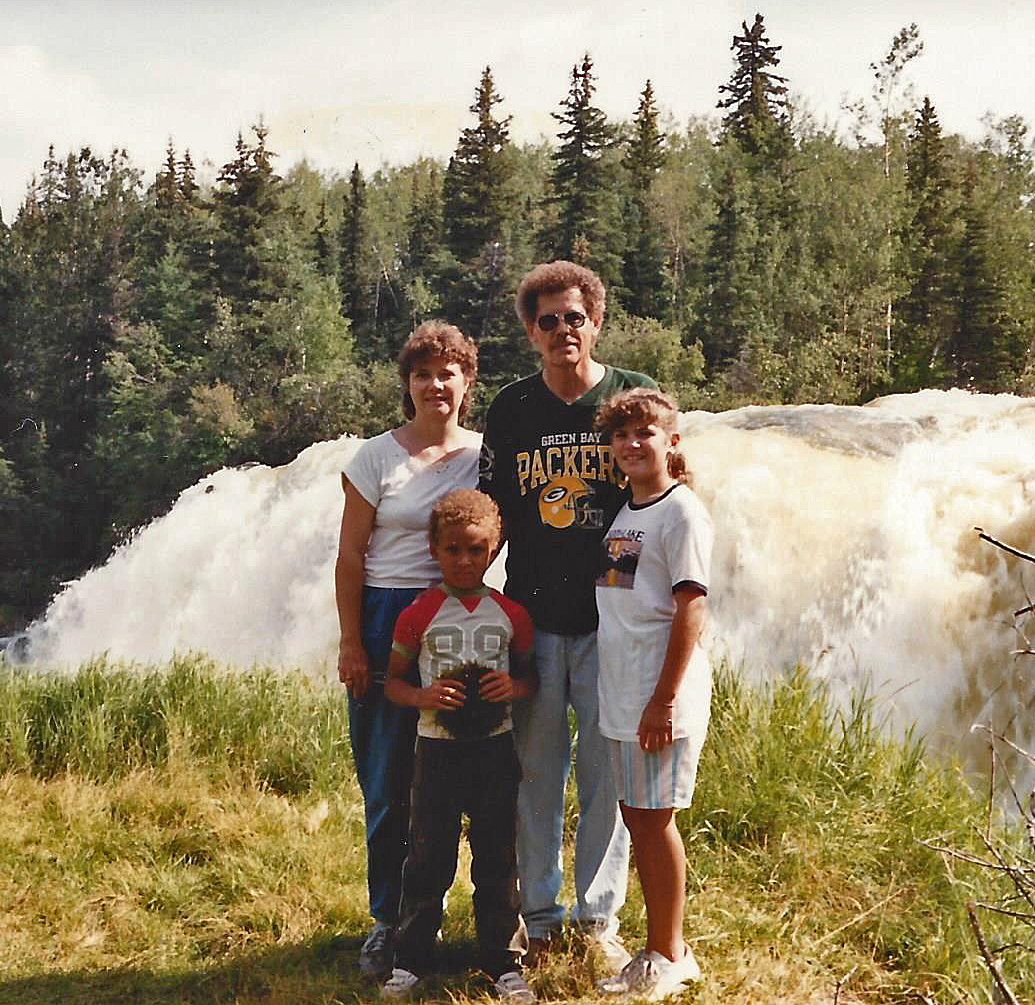
Johannessons at Pishew Falls MB 1988

And they didn’t live Happily ever after . . .

November 7, 1994

Dear Friends,

This September my husband Gus turned sixty. We wanted to celebrate as many families do, but the plans for our party were a bit different. His 60th “Toast and Roast” became the retirement party he never had and an affirmation of what he has meant to his family and friends while he is still able to appreciate it.

On the day of festivities we presented him with a book of remembrances gathered from friends and relatives around the world. This book is a tribute to Gus’s life as well as a tool for memory as he copes with his illness.

Two years ago Gus was diagnosed with Alzheimer Disease. I can’t say that our lives immediately changed. The disease doesn’t change your life overnight, but has over a number of years changed every aspect of our lives. To date, the cause of AD is unknown, there is neither cure nor definite treatment; it is progressive and will eventually be terminal.

It is incredible the emotional upheaval we all have been through these past years. All four of us have had counselling and hope that it remains available whenever we need it. The family has found comfort, relief, professional information and fellowship in support groups for adult caregivers, a children’s support group, the early stage support group, numerous educational sessions, and from Alzheimer staff and volunteers.

The Alzheimer Society of Manitoba has been able to provide these services because of people like you. I am happy to have this opportunity to personally thank you and let you hear firsthand how meaningful your help is for my family and many others.

It took a long time to really recognize that something serious was happening as Gus has always been a bit of the “absent-mined professor” type and we just figured he was getting more-so with age. This is not the situation. A man admired for his keen mind, having studied at the doctoral level in systematic theology has now forgotten how to tie a tie or manage the simple task of handling a sandwich. In happier days Gus was a Lutheran pastor giving support and guidance to others. Today he is on the receiving end.

Alzheimer Disease attacks the whole family. We are all hurting, angry, frustrated, scared; dealing with a tremendous loss.

Your roles change. I have had to become in as many ways as possible mother and father to my children and husband, directing all my energies outside of the workplace to the family. The children and I have become caregivers, not easy for an adult, let alone a twelve-year-old and seventeen-year-old. A caregiver’s day is often referred to as the “36-hour day.” That is how we live, each and every day.

As is typical with early AD, symptoms come and go resulting in good and bad days. So far Gus’s skills that are totally gone are writing, public speaking, driving, anything mathematical, and many deductive reasoning processes.

We thank God for the good days, for the patience that we are learning, for on-going medical research, for the help offered by the Alzheimer Society and most of all, for the prayers, love, help and support of family and friends.

Our family includes you when we say “Friends.” You probably don’t know us personally, but as a supporter of the Alzheimer Society you help make each and every day a little bit brighter, a little bit easier.

Once again, thank you for making our lives happier. Please continue your needed support. It is your caring and generosity that makes the difference!

With our sincere appreciation,

Gayle Johannesson

P.S. The number of families coping with the devastating reality of Alzheimer Disease is expected to at least double in the next decade.